Byte-Sized Overview
Before the Duttons owned the largest ranch in Montana, they owned a wagon, several determined horses and an increasingly optimistic belief that Oregon might be reached without everybody dying in a river.
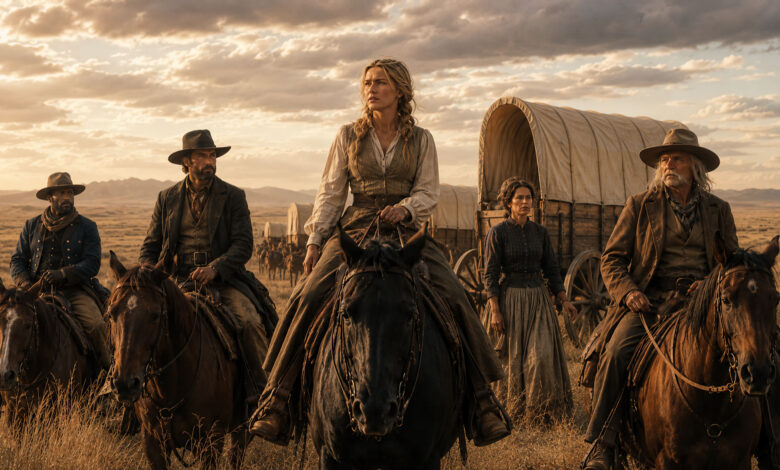
1883 follows James and Margaret Dutton as they travel west from Texas with their children Elsa and John. They join a wagon train of European immigrants led by Civil War veteran Shea Brennan and former Buffalo Soldier Thomas. The intended destination is Oregon. The actual journey runs through lawless towns, deep water, drought, bandits, disease, grief and the discovery that most treasured furniture becomes less treasured when an ox must pull it across mud.
Taylor Sheridan created the ten-episode limited series as the origin story of the Yellowstone Dutton Ranch, but the heart of the programme belongs to Elsa. Isabel May narrates and plays the teenage daughter whose excitement turns the migration from a grim catalogue of deaths into a coming-of-age story. Elsa becomes a rider, falls in love, experiences devastating loss and learns to see the frontier as freedom even while it steadily takes everything from her.
Sam Elliott brings weary authority as Shea, while Tim McGraw and Faith Hill make James and Margaret a convincing frontier couple rather than famous singers visiting a costume department. LaMonica Garrett’s Thomas provides patience, intelligence and one of the story’s few relationships built upon hope instead of inherited obligation.
It is beautiful, brutal and emotionally direct. The Oregon Trail game was more forgiving, and at least that allowed you to restart before the river crossing.
1883 Transmission Details
- Show: 1883, also marketed as 1883: A Yellowstone Origin Story.
- Years Active: 2021-2022.
- Seasons: 1 limited series.
- Episodes: 10.
- Original Broadcaster: Paramount+, beginning on 19 December 2021 and concluding on 27 February 2022.
- Where to Watch:
- US: Paramount+.
- UK: Paramount+.
- Creator: Taylor Sheridan.
- Writer: Taylor Sheridan wrote all ten episodes.
- Key Executive Producers: Taylor Sheridan, John Linson, Art Linson, David C. Glasser, Ron Burkle and Bob Yari.
- Main Cast: Sam Elliott, Tim McGraw, Faith Hill, Isabel May and LaMonica Garrett.
- Wagon-Train Ensemble: Marc Rissmann, Audie Rick, Eric Nelsen, James Landry Hébert, Noah Le Gros, Gratiela Brancusi, Anna Fiamora and Amanda Jaros.
- Major Guest Cast: Billy Bob Thornton, Tom Hanks, Rita Wilson, Graham Greene, Martin Sensmeier, Dawn Olivieri and Taylor Sheridan.
- Composers: Brian Tyler and Breton Vivian.
- Production Companies: MTV Entertainment Studios, 101 Studios, Bosque Ranch Productions and Linson Entertainment.
- Related Productions: Yellowstone follows the ranch founded at the end of this journey. 1923 continues the Dutton family story forty years later, with Elsa again serving as narrator. Lawmen: Bass Reeves was initially announced using 1883 branding during development but became a separate story outside Dutton continuity.
- Sub-Genre Tags: Historical Western, frontier drama, family saga, survival drama, wagon trains, coming-of-age drama, American West, period drama, road story and television prequels.
1883 Signal Strength (aka: Is It Worth Your Binge?)
Absolutely. 1883 is the strongest self-contained entry in the original Dutton story, partly because ten episodes force it to reach a destination before the franchise can establish another branch of the family tree.
No knowledge of Yellowstone is required. Viewers who know the modern series will recognise the Dutton name and understand that the journey must end in Montana, but the characters do not spend their lives preparing references for descendants. James and Margaret want land and safety. Elsa wants experience. Shea wants to see the Pacific before joining the family he has lost. Their aims would work without a single flash-forward to Kevin Costner.
Isabel May is the programme’s revelation. Elsa’s narration can be extremely lyrical, occasionally sounding as though she has discovered both the American frontier and an unusually generous supply of metaphors before breakfast. Yet May gives the words conviction. Elsa experiences the landscape sensually and spiritually, making wonder feel as important as danger. Her voice prevents the story becoming ten hours of capable men explaining why another wagon has overturned.
Sam Elliott is every bit as effective as expected. Shea Brennan begins after the deaths of his wife and daughter from smallpox, placing a man already contemplating suicide in charge of people with minimal chance of survival. His sternness is not cruelty for its own sake. He knows that sentiment cannot negotiate with a river, hunger or winter. The tragedy is that understanding danger does not grant him enough power to prevent it.
Tim McGraw and Faith Hill are impressively grounded. James is protective without becoming invulnerable, and Margaret understands both the necessity of the journey and the price her daughter is paying for freedom. Their marriage feels lived-in. They argue over risk, parenting and Elsa, but each trusts the other’s competence when circumstances become lethal.
LaMonica Garrett gives Thomas calm authority beside Elliott’s grief. As a Black Civil War veteran and Pinkerton agent travelling through 1883 America, Thomas reads danger with a precision others can avoid developing. His relationship with Noemi, a Romani widow, is tender because both understand that safety is practical before it is romantic. A mirror, food and a reliable companion carry more meaning than a speech delivered beside perfect lighting.
The physical production is formidable. Weather looks painful, river crossings feel genuinely dangerous and wagons occupy landscapes too large to care whether anybody reaches the next episode. The series avoids the clean nostalgia of older wagon-train adventures. Clothes become filthy, animals die, feet are injured and the group discards possessions because a piano is less useful when pulling it may kill the family that owns it.
Historical authenticity is an aim rather than a guarantee. The series combines incidents, peoples and geography for drama. Its immigrants are sometimes portrayed as implausibly helpless so that the guides can explain survival, and their internal lives receive far less attention than those of the Duttons. Native characters are often dignified and important, particularly Sam and Spotted Eagle, but they appear within a story still organised around a settler family’s arrival.
It is also relentlessly sad. Death is not reserved for a finale or ratings-week surprise. Children, spouses, lovers and strangers die because the frontier is violent, medical care is limited and one poor choice can destroy several wagons. Viewers seeking the swagger and corporate warfare of Yellowstone may be surprised to find a migration drama more interested in grief than triumph.
The ten-episode format makes the commitment manageable, though the episodes are substantial and the emotional weight discourages a cheerful all-night marathon. It is highly bingeable, but perhaps do not schedule the finale immediately before an event at which appearing quietly devastated would require explanation.
Vibe Check
- Tone: Lyrical, unsparing and deeply melancholy, with moments of exhilaration before the next avoidable fatality.
- Visuals: Endless plains, muddy crossings, storm skies, wagon camps, mountain valleys and firelight reflected in extremely tired faces.
- Bingeability: High, although emotional recovery may require more time than the journey allows its characters.
- Western Level: Maximum. Cowboys, wagon trains, bandits, buffalo, Comanche riders and frontier towns are all present without becoming theme-park decoration.
- Historical Detail: Immersive and tactile, with some compression and invention serving the drama.
- Action Level: Sudden and severe. Gunfights, stampedes, river disasters, tornadoes and attacks rarely allow a heroic entrance.
- Romance Level: Intense, beautiful and operating under frontier life expectancy.
- Humour Level: Modest but welcome, usually supplied by Elsa’s candour, Thomas’s patience or Shea discovering another item the migrants consider essential.
- Survival Odds: Closely connected to swimming ability, footwear and willingness to listen before the river.
- Luggage Allowance: Decreases after every obstacle until civilisation is represented by one cooking pot and a memory of the piano.
Spoiler Mode: Plot Brief for Pub Chat
Major spoilers for the complete limited series begin here. The trail ahead contains death, grief and no convenient restart point.
The story opens near its end. Elsa Dutton lies injured during an attack on a wagon camp, facing Lakota warriors with a pistol and an arrow through her body. She kills a man before being surrounded. The series then returns to the beginning, allowing viewers to understand exactly how the hopeful young woman reached that moment.
Shea Brennan is a former Union Army captain living in Tennessee after the Civil War. Smallpox kills his wife Helen and their daughter. Shea burns the house with their bodies inside to prevent the disease spreading, then prepares to shoot himself. Thomas, his friend and fellow Pinkerton agent, arrives in time to stop him. He offers Shea one remaining purpose: a paid job escorting immigrants from Texas towards Oregon.
Thomas served as a Buffalo Soldier and understands both military discipline and the racial danger surrounding a Black man with authority in the post-war West. He and Shea operate as partners rather than leader and subordinate. Thomas often moderates Shea’s despair, while Shea trusts Thomas’s judgement without the condescension common to the period.
James Dutton travels towards Fort Worth by wagon, protecting his money and supplies from thieves along the way. He fought for the Confederacy and carries the memory of surrender after the Battle of Antietam, when Union General George Meade showed him mercy. The war has ended, but James has not found a future in Tennessee. He intends to take his family west and obtain land beyond the poverty and memories left behind.
Margaret Dutton travels by train with their seventeen-year-old daughter Elsa, five-year-old son John, James’s widowed sister Claire and Claire’s daughter Mary Abel. Fort Worth is lawless, crowded and dangerous. A drunken man enters Elsa’s hotel room and attempts to rape her before James shoots him. The family learns immediately that civilisation at the edge of the trail provides very little civil protection.
Shea and Thomas have been hired by a group of European immigrants, many of them German-speaking, who intend to reach Oregon. Josef acts as translator between the guides and families. The travellers have money, wagons and possessions but little knowledge of horses, firearms, swimming or the distances involved. Shea discovers that leading them will require teaching basic survival while resisting their belief that every instruction is an unnecessary attack upon furniture.
James initially intends to travel independently. Shea recognises his skill with weapons and livestock, while James understands that a larger party offers protection. They form an uneasy alliance. Shea leads, but James refuses to surrender decisions concerning his family. The conflict between command and independence continues throughout the journey.
Shea hires young cowboys Ennis and Wade to help gather and drive longhorn cattle. Elsa joins the work and feels alive outside the restrictions placed upon women in towns. She exchanges dresses for trousers, learns to handle the herd and quickly attracts Ennis. Their flirtation becomes a relationship built from open admiration rather than the formal courtship Margaret expects.
Before the wagon train has properly escaped Texas, strangers approach the camp. Claire provokes them by throwing stones, and the confrontation becomes a gunfight. Mary Abel and several migrants are killed. Shea, Thomas, James and Josef join Fort Worth marshal Jim Courtright to hunt the attackers, confronting and killing them in a saloon.
Claire cannot survive another loss. She has already buried a husband and six children; Mary Abel was her last. After James buries the girl, Claire shoots herself beside the grave. The journey has barely begun and one complete branch of the travelling Dutton family has already ended.
The Brazos River becomes the first natural disaster the migrants cannot intimidate or shoot. Shea orders them to reduce the weight of their wagons, abandoning furniture, stoves, pianos and possessions brought across the Atlantic. The refusal to let go is understandable, since those objects connect them to former lives, but the river has no interest in emotional value.
James crosses his family separately during the night so he can help the others the next day. Many migrants cannot swim. Wagons overturn, animals panic and people drown as the current takes them. Shea and Thomas rescue whoever they can, but the crossing destroys lives and supplies. The group emerges smaller, poorer and less able to survive the next obstacle.
Elsa and Ennis become lovers. James is furious when he discovers the relationship, knocking Ennis from his horse and demanding to know his intentions. Ennis stands by Elsa and says he will marry her. James accepts that his daughter is making an adult choice even if the timing, location and available parental privacy could be improved.
Bandits follow the weakened train and attempt to steal the cattle. Shea, Thomas, James and the cowboys prepare an ambush, but the fight turns chaotic. Ennis is shot and killed. Elsa reaches him before he dies and tells him she loves him. He answers that he loved her, leaving the change of tense to do an unreasonable amount of emotional damage.
Elsa’s grief becomes rage. She kills the surviving bandit responsible, continuing to fire after the immediate threat has ended. James recognises that Ennis’s death has changed her. Margaret fears the frontier is stripping away the daughter she knew, while Elsa believes pain has made her understand life more fully.
At Doan’s Crossing, the travellers resupply before leaving Texas. Elsa remains consumed by grief until a conversation with a stranger encourages her to choose life rather than surrender to mourning. Thomas buys Noemi a silver-backed mirror. Noemi is a Romani widow with two young sons whose husband died during the journey. She has little protection and fewer options, but she refuses to become passive cargo.
Thomas and Noemi gradually form a relationship. He offers practical help without claiming ownership of her, and she challenges his assumption that a Black man and Romani woman cannot build a safe future together. Their bond becomes the series’ quiet alternative to Dutton inheritance: family can be created through choice rather than defended through blood.
The wagon train enters open country where water and shelter become harder to find. Theft within the group forces Shea to impose harsh discipline. Travellers steal food from one another, endangering everyone. Shea expels those responsible despite knowing that separation may be a death sentence. Leadership repeatedly requires him to choose between immediate mercy and the survival of the larger group.
A violent tornado catches the travellers on the plains. Wagons are destroyed, possessions scatter and Elsa is thrown into the chaos. A Comanche warrior named Sam protects her as the storm passes. Sam is named for the man who killed his wife, a name he adopted as a reminder of his revenge. He sees Elsa’s strength without treating her frontier identity as a temporary costume.
Elsa joins Sam and other Comanche riders in hunting buffalo. She kills one, eats part of its heart in accordance with the moment and receives the name Lightning with the Yellow Hair. Their attraction becomes love with a speed appropriate to people who know tomorrow is not contractual.
Sam and Elsa marry through a private exchange of vows rather than a ceremony recognised by either government or church. Margaret is horrified by the speed and cultural distance of the relationship, but James sees that his daughter has chosen freely. Sam will not abandon his land to travel to Oregon. Elsa agrees to continue with her family, help them reach safety and then return to him.
Their separation is joyful in promise and painful to watch because the opening has already shown that Elsa will not complete the return journey. Sam races beside the departing wagons before turning back. Elsa carries his language, clothing and sense of belonging with her.
The travellers reach territory where horse thieves have massacred Lakota women and children. Shea, Thomas and James understand the danger immediately. Returning warriors will find their families dead and may assume the wagon train is responsible. The guides decide to track the killers while the migrants wait at the site and explain what happened.
Fear defeats the plan. The immigrants discover clothing and possessions beside the dead and take them, making themselves appear even more like the murderers. They leave the agreed location, believing movement offers safety. When Lakota warriors find them, the evidence points towards guilt.
The attack seen in the opening unfolds. Elsa attempts to explain but cannot stop the violence. An arrow passes through her abdomen. She speaks words learned from Sam and identifies herself through her Comanche connection. The Lakota leader listens, recognises that the wagon train did not commit the massacre and allows the survivors to leave.
The arrow has been contaminated and struck Elsa near the liver. James knows infection will kill her even after the shaft is removed. He and Margaret initially conceal the certainty, but Elsa understands her own body and overhears enough to confirm it. The young woman who imagined returning to Sam must now decide where she will die.
The same sequence destroys more of the wagon train. Josef is bitten by a rattlesnake. His wife Risa is thrown from her horse and suffers fatal injuries. The settlers lose confidence in Shea, blaming his leadership for suffering no route could have eliminated. They choose to continue towards Oregon without the guides.
Shea warns that they will not survive. Most do not. The remaining group fragments while Elsa weakens. James decides that wherever she dies must become the family’s home because Margaret and young John cannot continue travelling after burying her. The destination is no longer Oregon. It is the place Elsa chooses.
At Fort Caspar, a surgeon confirms the wound is fatal. The Duttons seek information about nearby country. They encounter Spotted Eagle, a Crow elder who understands James’s need for a place with a valley, water and mountains where his daughter can be buried.
Spotted Eagle directs him towards Paradise Valley. He asks that his people always be allowed to hunt there. He also warns that in seven generations his people will rise and take the land back. James, focused only upon Elsa, agrees that they may have it. The exchange becomes the moral and narrative foundation of the entire Yellowstone story.
James rides with Elsa into the valley while she still has enough strength to choose. They sit beneath a tree overlooking the landscape. Elsa tells him she understands and is no longer afraid. She dies in her father’s arms after saying that the place is beautiful. James buries her there and establishes the home that will become Yellowstone Ranch.
The survivors reach their separate endings. Thomas, Noemi and her sons make a life together in Oregon. Josef survives but loses his snake-bitten leg. After Risa’s death, he reaches land of his own, removes his wedding ring and begins the future they were meant to share.
Shea reaches the Pacific Ocean, completing the promise to show his wife the sea through his own eyes. A hummingbird appears beside him, suggesting the presence of Helen or the dead he carries. With his final purpose fulfilled, Shea shoots himself on the beach.
Elsa’s last vision presents a different destination. She rides across open country with Sam, reunited in an afterlife untouched by the journey’s ending. Her body creates the place where the Duttons settle, but her spirit belongs to the freedom she found beyond their future fences.
Later franchise stories complete the immediate aftermath. James and Margaret have another son, Spencer, born after the journey. James dies in 1893 after being shot while confronting horse thieves. Margaret dies during the following winter. James’s brother Jacob and his wife Cara arrive to raise John and Spencer and preserve the ranch, leading into 1923.
Generations later, Kayce Dutton sells Yellowstone back to the Broken Rock Reservation for the historical price of $1.25 an acre. Spotted Eagle’s prophecy is fulfilled, and Elsa’s narration closes the modern series. The land selected for her grave survives precisely because Dutton ownership does not.
1883 Character Shout-Outs
- Elsa Dutton: Narrator, rider and emotional centre whose search for freedom creates the place her descendants will spend generations defending.
- James Dutton: Confederate veteran, father and capable frontiersman, seeking land for his family before grief chooses the destination for him.
- Margaret Dutton: James’s wife and Elsa’s mother, practical enough for the trail and perceptive enough to understand what survival is costing her children.
- Shea Brennan: Former Union captain and wagon master, leading strangers towards Oregon after smallpox removes every personal reason to remain alive.
- Thomas: Former Buffalo Soldier and Pinkerton agent whose patience, skill and relationship with Noemi offer the story’s clearest path towards hope.
- Ennis: Young cowboy who falls completely in love with Elsa and receives painfully little time to build the future he promises.
- Wade: Experienced cowboy helping manage the herd, blessed with the valuable frontier ability to perform his work without generating an additional tragedy.
- Noemi: Romani widow and mother determined to survive without allowing desperation to decide her worth.
- Josef: Immigrant translator caught between Shea’s instructions and travellers frightened enough to distrust every difficult truth.
- Risa: Josef’s wife, enduring the trail beside him until injury destroys the future they crossed an ocean to seek.
- Sam: Comanche warrior, Elsa’s husband and the person who recognises that her transformed identity belongs to the land rather than polite society.
- John Dutton: James and Margaret’s young son, quiet witness to the journey and ancestor of the modern Dutton line.
- Spotted Eagle: Crow elder who directs James to Paradise Valley and predicts the eventual return of the land.
1883 Memorable Moments
- Shea burning his home after smallpox kills his wife and daughter.
- Thomas arriving before Shea can take his own life and offering him one final journey.
- James surviving an attempted robbery beside his wagon before reaching Fort Worth.
- James killing the man who enters Elsa’s hotel room.
- Tom Hanks appearing briefly as General George Meade after the Battle of Antietam.
- Claire provoking the roadside confrontation that ends with Mary Abel’s death.
- Marshal Jim Courtright helping track the killers into a Fort Worth saloon.
- Claire taking her own life beside her daughter’s grave.
- Shea ordering the immigrants to abandon furniture before the Brazos crossing.
- Wagons overturning and travellers drowning in the river despite the guides’ efforts.
- Elsa exchanging her dress for trousers and discovering that cowboy work suits her.
- James knocking Ennis from his horse before accepting the young man’s intention to marry Elsa.
- Ennis dying in Elsa’s arms after the bandit attack.
- Elsa killing the surviving bandit in grief and rage.
- Thomas giving Noemi the silver-backed mirror.
- The tornado tearing across the plains and Sam shielding Elsa.
- Elsa killing a buffalo and receiving the name Lightning with the Yellow Hair.
- Elsa and Sam exchanging vows before their separation.
- The wagon train discovering the murdered Lakota families.
- Elsa using Sam’s language to stop the attack after being shot with the arrow.
- Josef’s rattlesnake bite and the desperate treatment of his leg.
- James and Margaret accepting that the place Elsa dies must become their home.
- Spotted Eagle describing Paradise Valley and making the seven-generation prophecy.
- Elsa choosing the tree where she dies in James’s arms.
- Josef reaching Oregon alone and claiming the land he intended to share with Risa.
- Thomas and Noemi establishing their home with her sons.
- Shea seeing the Pacific, greeting the hummingbird and ending his life after completing his promise.
- Elsa riding with Sam in the final vision of her own heaven.
Performance Highlights
- Isabel May: Carries the series through openness rather than conventional toughness. May makes Elsa’s wonder believable, then allows grief and experience to change her posture, voice and gaze without erasing the young woman from the opening.
- Sam Elliott: Uses the authority accumulated across a lifetime of Western roles while making Shea specifically vulnerable. The familiar voice delivers commands, but the eyes continually reveal a man who has already left most of himself behind.
- Tim McGraw: Gives James quiet competence without imitating Kevin Costner’s John Dutton. His strongest work comes when a protective father must recognise that Elsa’s life belongs to her, even when every choice terrifies him.
- Faith Hill: Makes Margaret formidable, loving and frightened in equal measure. Her arguments with James and Elsa feel rooted in practical danger rather than restrictive morality alone.
- LaMonica Garrett: Provides steadiness within a story designed to exhaust certainty. Thomas’s humour, authority and tenderness with Noemi make him far more than Shea’s supporting partner.
- Eric Nelsen: Gives Ennis charm without polish. His love for Elsa is convincing because it appears to surprise him as completely as it delights her.
- Gratiela Brancusi: Plays Noemi with intelligence and contained urgency, ensuring her relationship with Thomas emerges from mutual recognition rather than rescue fantasy.
- Marc Rissmann: Makes Josef sympathetic even when fear places him against the guides. His physical work in the finale gives survival a cost visible in every movement.
- Martin Sensmeier: Gives Sam calm presence and romantic warmth. The character’s limited screen time feels larger because Sensmeier presents a complete relationship with land, community and loss.
- Audie Rick: Keeps young John observant and natural within an adult story, avoiding the theatrical cleverness often assigned to television children.
- Billy Bob Thornton: Turns a brief appearance as Jim Courtright into a complete demonstration of frontier authority. He enters, resolves the matter and leaves before anybody can request a spin-off at the bar.
- Graham Greene: Brings wisdom and humour to Spotted Eagle without reducing the character to a prophetic device. His final exchange with James contains generosity, warning and ownership of a future the Duttons cannot yet imagine.
Skull Face’s Take
1883 is what happens when a television franchise pauses its mythology long enough to ask what the founding legend actually cost. The answer is almost everybody.
The modern Duttons speak about the ranch as though an ancestor selected it through strategic vision and heroic perseverance. The limited series reveals something sadder. James stops in Montana because Elsa cannot travel farther. Yellowstone is not founded at the end of a triumphant plan. It is built around a grave.
That distinction changes the entire franchise. John Dutton treats every acre as a promise to his father, but the original agreement was made with Spotted Eagle during the worst day of James’s life. The land can be used, Native people may hunt upon it and in seven generations it will return. Later Duttons remember the duty to hold the ranch and forget the conditions attached to receiving it.
Elsa is the correct narrator because she never becomes a ranch owner. She experiences the frontier before fences, deeds and inheritance convert it into property. Her freedom is romantic and sometimes naïve, but it allows the landscape to possess meaning beyond economic survival. She loves Ennis, Sam, horses, storms and open country with the intensity of somebody discovering that a life can be larger than the rules surrounding it.
The narration will divide viewers. It can be beautiful, and it can describe a sunrise as though sunrise has appointed legal representation. Yet the heightened language matches a story remembered through death. Elsa is not recording wagon inventory. She is turning the last months of her life into the origin myth her family never understands properly.
Shea gives the series its counterweight. He knows that the frontier is not impressed by poetry. Water kills, food runs out, infection wins and people refuse advice because possessions feel like proof of who they were. Elliott never lets Shea become merely harsh. Every death confirms his belief that leadership is inadequate and his fear that he is guiding people towards suffering rather than opportunity.
Thomas and Noemi provide essential hope. Their ending does not depend upon dynasty or ownership at continental scale. They reach Oregon, form a family and build a home. Josef also survives, but alone and physically altered, making the fulfilment of the migration dream inseparable from what it has taken.
The immigrants receive the least generous writing. Their lack of preparedness is historically plausible in broad terms, but the programme sometimes treats a varied group of adults as a single mechanism for ignoring Shea. More individual perspective would have made their losses carry the same force as those suffered by the Duttons. Josef and Risa cannot represent every person who entered the river.
Native characters are treated with more respect than in many traditional Westerns. Sam possesses his own loyalties and does not abandon his community to complete Elsa’s romance. Spotted Eagle controls the final negotiation and accurately names the future. The Lakota attack is placed within the context of murdered women and children. Even so, the series remains a settler narrative in which Native lives often reshape the Dutton journey rather than occupy equal narrative space.
The finale is superb because it completes every promise without pretending survival is victory. Elsa reaches paradise and dies there. Shea reaches the ocean and chooses death. Josef reaches Oregon without Risa. Thomas and Noemi reach a home together. James reaches land he never intended to seek and spends the rest of his short life defending the grave at its centre.
Skull Face recommends all ten episodes. Leave the piano, learn to swim and listen when Sam Elliott says the river is dangerous.
Why 1883 Has Drama/Action Icon Potential
1883 has the visual clarity of a classic Western but uses it to challenge classic triumph. A line of wagons crossing an immense plain usually suggests progress. Here it also shows vulnerability. Every family carries its entire past inside a wooden box that weather, water or one frightened animal can overturn.
Elsa supplies the defining image. Her clothing changes from a conventional dress to practical trousers, then incorporates Comanche elements after her marriage to Sam. The transformation records experience upon her body. By the final episodes, she no longer visually belongs to the society that began the journey or fully to the community she intended to rejoin. She is a person created by movement.
Shea’s silhouette carries a different Western history. Sam Elliott already embodies decades of screen frontier mythology, and the programme uses that familiarity before dismantling it. Shea is skilled, brave and authoritative. None of those qualities can save his family, Ennis, Elsa, Risa or most of the migrants. Competence changes the odds; it does not negotiate an exemption from grief.
The action remains memorable because danger is environmental as often as human. The Brazos crossing is more frightening than many gunfights. A tornado erases the illusion that wagons provide shelter. A rattlesnake bite becomes a medical emergency with almost no effective treatment. The arrow that kills Elsa does not do so immediately, turning one moment of violence into an entire episode of approaching loss.
The series also creates franchise iconography retrospectively. Paradise Valley, the Dutton graves and the future ranch house acquire meaning through Elsa. The modern Yellowstone brand represents ownership and loyalty, but the original site was selected by a dying woman who wanted somewhere beautiful to rest.
Its ending links directly to the modern series without requiring a conventional crossover. Spotted Eagle’s seven-generation prophecy becomes one of the franchise’s organising ideas. When Kayce returns the ranch to Broken Rock, 1883 supplies the emotional and historical logic. The first chronological chapter speaks during the last moments of the flagship story.
The ten-episode completeness strengthens its long-term potential. There is no unresolved second-season machinery and no villain preserved for renewal. The journey has a beginning, destination and cost. Viewers can enter the Dutton universe through 1883, stop after the finale and still have experienced a complete Western tragedy.
That is rarer than land in Paradise Valley without a development dispute.
Deep Dive Highlights
- Taylor Sheridan created 1883 as the first chronological story in the Dutton family saga.
- The limited series premiered on Paramount+ on 19 December 2021.
- Its tenth and final episode launched on 27 February 2022.
- Sheridan wrote all ten episodes.
- Taylor Sheridan, Ben Richardson and Christina Alexandra Voros directed episodes.
- Sheridan wrote the pilot rapidly after recognising Isabel May as the right perspective for the story.
- May had originally auditioned for a different Sheridan production before 1883 was developed around her qualities.
- Isabel May narrates the series as Elsa Dutton.
- May later narrates 1923 and returns as the closing voice of the Yellowstone series finale.
- Sam Elliott plays Shea Brennan, a former Union officer and Pinkerton agent.
- LaMonica Garrett plays Thomas, a former Buffalo Soldier working beside Shea.
- Tim McGraw and Faith Hill, married country-music stars, play James and Margaret Dutton.
- McGraw and Hill had previously appeared as the same characters in flashbacks during Yellowstone.
- Audie Rick plays their young son John Dutton.
- The later-born Spencer Dutton does not appear in 1883 but becomes central to 1923.
- 1923 confirms that Spencer and Alexandra’s son John Dutton II becomes the father of the modern John Dutton III.
- The series was produced on a reported budget approaching $170 million.
- Filming used locations across Texas and Montana, with severe weather contributing to the physical demands upon cast and crew.
- Production emphasised worn clothing, practical environments and limited modern grooming to strengthen period texture.
- Ben Richardson served as cinematographer as well as directing several episodes.
- Brian Tyler and Breton Vivian composed the score.
- The music received Emmy recognition.
- The series won an Emmy for its cinematography.
- The opening Fort Worth setting represents the historically notorious district known as Hell’s Half Acre.
- Billy Bob Thornton guest stars as real historical marshal Jim Courtright.
- Tom Hanks appears as General George Meade in the Antietam flashback.
- Rita Wilson, Hanks’s wife, appears later as frontier storekeeper Carolyn.
- Taylor Sheridan appears as legendary cattleman Charles Goodnight.
- The wagon train’s broad route reflects nineteenth-century westward migration but compresses geography and events for television.
- The dangerous river crossing demonstrates why drowning was a significant risk during overland migration.
- Cholera, smallpox, injury, exposure, animal accidents and contaminated wounds caused more frontier deaths than cinematic gunfights.
- Elsa’s fatal arrow wound is presented as untreatable because of infection and internal damage rather than the arrow alone.
- Martin Sensmeier, who plays Sam, had previously appeared in Yellowstone as a different character named Martin.
- Graham Greene plays Spotted Eagle in the finale.
- Spotted Eagle’s prophecy connects the founding of Yellowstone Ranch to its return in the modern series.
- James agrees that Native people may continue hunting upon the land.
- The Dutton family settles at Paradise Valley because Elsa chooses it as her burial place.
- Later franchise chronology states that James dies in 1893 and Margaret in 1894.
- James’s brother Jacob and Jacob’s wife Cara then take responsibility for John and Spencer.
- Those events establish the family situation at the beginning of 1923.
- The afterlife image of Elsa and Sam provides emotional reunion without changing the fact that they never meet again during life.
- 1883 was always designed as a limited story, despite early announcements that caused confusion about additional episodes.
- A Bass Reeves project was initially promoted as an extension carrying 1883 branding.
- It was later released as Lawmen: Bass Reeves, a separate anthology story rather than part of Dutton continuity.
- All ten episodes of 1883 stream on Paramount+ in the United States and United Kingdom.
Legacy & Impact
1883 proved that the world of Yellowstone could survive without Kevin Costner, the modern ranch or any character capable of calling the governor. It replaced contemporary power with physical vulnerability and made the franchise’s central property feel newly tragic.
The series arrived when Yellowstone was becoming a major audience success. A conventional prequel might have explained family names, brands and property boundaries. Sheridan instead built a migration story around a character absent from the modern family’s spoken history. Elsa becomes the true founder because her death fixes the Duttons to Montana.
That choice alters the meaning of legacy. The ranch does not begin as a calculated empire. James is not seeking Paradise Valley specifically, and the family does not conquer it after a victorious campaign. A Crow elder offers guidance to a father carrying his dying daughter. The land is received through grief and under a promise that later generations forget.
Isabel May’s performance became one of the franchise’s defining elements. Elsa’s narration supplies the voice for 1923 despite her death decades earlier, making her the saga’s observer beyond ordinary chronology. Her return during the final minutes of Yellowstone confirms that the modern story ends where the origin began: with land that outlasts the people claiming it.
The show also expanded audience expectations for streaming Westerns. Its budget, location work and cinematography gave a ten-episode limited series the physical scale of a long feature film. Wagon travel feels slow, repetitive and dangerous rather than reduced to a montage between towns. The production allowed weather and distance to become dramatic forces.
Its portrayal of migration is deliberately anti-nostalgic. The travellers are not uniformly heroic settlers moving towards inevitable national progress. They are frightened people discarding the remains of former lives, entering territories already occupied and dying from ignorance, accident and violence. The programme still centres the Duttons, but it complicates the triumph traditionally assigned to westward expansion.
There are valid limitations. The immigrants frequently function as examples of incompetence rather than fully developed individuals. Native characters possess dignity but limited screen time, and their experiences are often introduced when they alter Elsa’s growth. The series acknowledges that the land is not empty while continuing to frame its emotional ownership around the family arriving to occupy it.
Thomas and Noemi leave an important alternative legacy. Their future is not connected to Yellowstone, enormous acreage or descendants required to preserve a dynasty. They survive, love and establish a home in Oregon. Their ending suggests that a successful migration can produce belonging without demanding an empire.
The direct continuation in 1923 deepens the tragedy. James and Margaret do not enjoy a long peaceful life upon the ranch. Their deaths leave Jacob and Cara to raise the boys and defend the property through another era of violence. The modern Dutton belief that land creates permanence is repeatedly disproved by the lives of the people holding it.
As a complete work, 1883 remains accessible even as the franchise expands. It needs no sequel to resolve Elsa, Shea, Thomas or Josef. The connections reward viewers who continue, but the final ride with Sam closes the emotional story on its own terms.
The Dutton ranch begins with a burial and ends with a return. 1883 made both events feel inevitable, separated by seven generations who mistook temporary possession for destiny.
Want to Go Deeper?
- Watch all ten episodes of 1883 on Paramount+ (The complete journey, from Fort Worth optimism to a valley selected through grief.)
- See where 1883 fits in the Dutton viewing order (Chronologically first, emotionally capable of making every later ranch dispute feel less important.)
- Explore the official Dutton family timeline (Elsa’s grave, the seven-generation prophecy and the family line extending through 1923.)
- Continue the origin story with 1923 (Jacob, Cara, Spencer and the next struggle to preserve the ranch.)
- Find every Dutton series and its streaming home (Useful when a franchise travels across more platforms than the migrants crossed rivers.)
- Browse Taylor Sheridan’s Paramount+ series (Western origins, modern oilfields, organised crime and a continuing shortage of uncomplicated employment.)
Recommended TV Products

Watch Law & Order: Special Victims Unit on Prime Video
From the creator of "Law & Order", comes a powerful series chronicling the life and crimes of the Special Victims Unit of the NYPD.
Watch Now
Watch Lioness Season 3 on Prime Video
Inspired by a U.S. Military program, three agents embark on a dangerous undercover mission following the 9/11 terrorist attack.
Watch Now
The Terminal List Season 2: Coming Soon
Season Two finds James Reece searching for a new purpose after finishing his list. But when the CIA corners him, Reece must clear his name by stopping a resurgent terrorist group that has turned an ally to their cause. In this globe-trotting espionage thriller, Reece will uncover a conspiracy that reaches from Moscow to Langley, even to his own family's history.
Watch the TrailerAs an Amazon Associate I earn from qualifying purchases.