Byte-Sized Overview
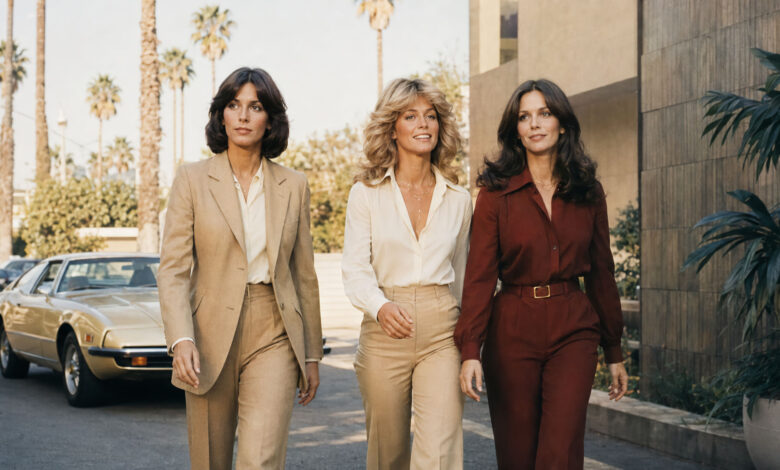
Once upon a time, three women went to the police academy. Each proved more capable than the routine assignments awaiting her, so all three left the force and joined the Charles Townsend Agency. Their new employer was a millionaire they never saw, their office briefing arrived by speakerphone and their cases required an unusually well-stocked wardrobe department.
Charlie’s Angels follows former police officers Sabrina Duncan, Jill Munroe and Kelly Garrett as they investigate murders, robberies, disappearances and elaborate criminal enterprises across 1970s Los Angeles. Charlie Townsend supplies the cases and remains carefully out of sight. John Bosley handles the visible administration, joins the undercover work and responds to danger with the expression of a man who thought private detection would involve considerably more filing.
The original trio lasts for one season, but the agency keeps recruiting. Jill’s younger sister Kris Munroe joins in season two. Tiffany Welles replaces Sabrina for season four, while streetwise New Yorker Julie Rogers completes the final line-up. Jaclyn Smith’s Kelly is the only Angel present throughout all five seasons, with Cheryl Ladd becoming almost as central during her four-year run.
The programme was sold through glamour and became a cultural phenomenon partly because of it. Yet the format also placed three women at the centre of a weekly action drama, allowed them to outthink and overpower male criminals, and presented their friendship as the show’s most dependable relationship. The contradiction has followed it ever since: liberating fantasy and calculated objectification sharing a sports car.
At its best, Charlie’s Angels is bright, charming and much smarter than its reputation suggests. The plots are rarely severe enough to spoil the sunshine, the disguises arrive faster than the clues and Charlie’s telephone appears to have better security than several government buildings. It is detective television as escapist adventure, powered by chemistry, confidence and enough feathered hair to alter local weather patterns.
Charlie’s Angels Transmission Details
- Show: Charlie’s Angels, the original television series rather than the 2000 and 2003 films, the short-lived 2011 television reboot or the 2019 film.
- Years Active: 1976-1981. The television-film pilot aired on 21 March 1976; the regular series ran from 22 September 1976 to 24 June 1981.
- Seasons: 5.
- Episodes: 115, including feature-length and two-part stories. Individual listings and home-video releases sometimes count split instalments differently.
- Typical Running Time: Approximately 48-50 minutes, with several feature-length premieres and specials.
- Original US Broadcaster: ABC.
- Original UK Broadcaster: ITV, where regional scheduling varied. The series reached British television in January 1977 and became a major imported success.
- Where to Watch:
- UK: Available to buy digitally through Apple TV Store and Amazon Video at the time of writing. No complete subscription-streaming home is currently listed, so availability should be checked before issuing Charlie with an expense claim.
- US: The series appears through a changing collection of ad-supported services, digital channels and purchase platforms, including Sony-authorised outlets. Availability varies by service and season.
- Creators: Ivan Goff and Ben Roberts.
- Executive Producers: Aaron Spelling and Leonard Goldberg.
- Key Producers: Edward J. Lakso, Rick Husky and Bert Pearl, with production responsibilities changing during the run.
- Main Cast: Kate Jackson, Farrah Fawcett, Jaclyn Smith, Cheryl Ladd, Shelley Hack, Tanya Roberts and David Doyle, with John Forsythe as the voice of Charlie Townsend.
- The Five Line-Ups: Sabrina, Jill and Kelly; Sabrina, Kris and Kelly; Kelly, Kris and Tiffany; Kelly, Kris and Julie. Jill also returns for six guest appearances across seasons three and four.
- Theme Music: Jack Elliott and Allyn Ferguson.
- Production Companies: Spelling-Goldberg Productions in association with Columbia Pictures Television.
- Filming Location: Primarily Los Angeles and surrounding Southern California locations, with feature-length stories also taking the Angels to Las Vegas, Hawaii and aboard The Love Boat.
- Related Productions: The feature films Charlie’s Angels (2000), Charlie’s Angels: Full Throttle (2003) and Charlie’s Angels (2019); the 2011 ABC television remake; and the uncommissioned season-four backdoor pilot Toni’s Boys.
- Sub-Genre Tags: Private-detective drama, action adventure, crime drama, undercover investigation, mystery, comedy drama, 1970s television, female-led action, Los Angeles noir in unusually good sunlight and glamorous escapism.
Charlie’s Angels Signal Strength (aka: Is It Worth Your Binge?)
Yes, particularly if you can enjoy a procedural without demanding that every police station, criminal conspiracy and health spa conform to documentary standards.
The first season is the obvious entry point. Kate Jackson, Farrah Fawcett and Jaclyn Smith arrive with their chemistry already functioning, while David Doyle quickly establishes Bosley as a colleague rather than a supervisor. Sabrina is the strategist, Jill brings fearless physical energy and Kelly combines empathy with a willingness to enter danger. These are broad distinctions, but the performers make the women feel like friends whose strengths overlap. They joke, disagree, improvise and protect one another without requiring a weekly argument to demonstrate that three women can occupy the same room.
The format is reassuringly simple. Charlie presents a case through the speakerphone. Bosley distributes information. The Angels select cover identities and enter whichever profession has become unexpectedly lethal that week. They become models, nurses, dancers, prison inmates, racing drivers, army recruits, roller-derby competitors, circus performers and almost anything else for which the wardrobe can be assembled before lunch. The investigation usually separates them, allowing one Angel to charm a suspect, another to search the office and the third to discover that the apparently respectable proprietor has locked the door.
Its reputation as “jiggle television” cannot simply be waved away. The camera regularly emphasises bodies, costumes and swimwear, while plots arrange conspicuous reasons for undercover work at spas, beauty contests and resorts. ABC and the producers understood exactly what was being marketed. The opening titles reduce the premise to attractive silhouettes, a mysterious male voice and the suggestion that police work was keeping three women insufficiently glamorous.
Yet that description is incomplete. The Angels are not Charlie’s romantic possessions, and the programme rarely makes them compete for male approval. They conduct the investigations, recognise danger, drive the cars, fight the criminals and rescue one another. Charlie may assign the work, but he does not appear to complete it. Bosley assists without becoming the indispensable man who solves everything after the women have made the room decorative. For younger viewers in the 1970s, simply seeing three women occupy the action positions carried an imaginative force that dismissive criticism often failed to measure.
Kate Jackson gives the earliest seasons their detective credibility. Sabrina observes before acting and commonly coordinates the operation, making her the nearest thing the team has to a field leader. Farrah Fawcett’s Jill is warmer and funnier than the poster phenomenon sometimes allowed people to remember. She can use glamour as a cover, but she is also athletic, resourceful and entirely comfortable taking the physical route through a problem. Jaclyn Smith brings Kelly an emotional openness that makes witnesses trust her and dangerous situations feel personal.
Farrah Fawcett’s departure after the first season could have broken the series. Instead, Cheryl Ladd makes one of television’s more successful cast replacements. Kris is introduced as Jill’s younger sister, which acknowledges the missing character without requiring Ladd to imitate her. Kris is initially less experienced, more impulsive and openly funny. The difference gives the second and third seasons a fresh rhythm, and Ladd’s relaxed chemistry with Jackson and Smith soon makes the new trio feel legitimate rather than temporary.
The Sabrina-Kris-Kelly years may be the best sustained version of the programme. The undercover stories become larger, the comedy broadens and the feature-length premieres provide travel and spectacle. The show is already repeating certain professions, because apparently every model agency in California has an unacceptable homicide policy, but the central friendship remains strong enough to carry familiar plots.
Season four is a more noticeable transition. Kate Jackson leaves, removing both the original field leader and the performer most able to give thin procedural dialogue an extra layer of thought. Shelley Hack’s Tiffany Welles is introduced as an educated Boston police graduate with a sophisticated background. Hack gives her intelligence and restraint, but the scripts never define Tiffany as decisively as they had defined Sabrina or Kris. She is frequently treated as “the new Angel” rather than a character whose particular skills reshape the team.
That season is not the collapse sometimes described. Jaclyn Smith and Cheryl Ladd provide continuity, Jill’s guest returns reconnect the series with its first-season identity, and several episodes exploit the growing mythology around Charlie and the agency. The Love Boat crossover is gloriously shameless television scheduling, while Toni’s Boys attempts to reverse the formula with Barbara Stanwyck directing three male detectives. The proposed spin-off was not commissioned, perhaps because the men lacked the essential investigative skill of being Charlie’s Angels.
Tanya Roberts brings greater physical energy to season five as Julie Rogers, a former model and streetwise fighter who has not attended the police academy. Her recruitment shows Charlie bending the agency’s original requirements after seeing her courage in action. Julie’s informality works well against Kelly’s experience and Kris’s confidence, but the series is now fighting declining ratings, changing time slots and an industry moving beyond its late-1970s moment. Only 17 episodes are produced, and the final run can feel like a programme trying several routes while ABC keeps moving the road.
The episodic structure makes selective viewing easy. You can begin with the pilot and first season, sample the strongest Kris episodes, then visit the Tiffany and Julie years to see how the formula adapts. A complete binge reveals repetition, recycled guest actors and a striking number of villains who explain their plans within hearing distance of a private detective. It also reveals durable warmth. Even when the mystery is transparent, watching the Angels construct identities, support one another and puncture male overconfidence remains pleasurable.
The action is television-scale rather than brutal. There are fights, chases, shootings and kidnappings, but the atmosphere stays bright and the consequences rarely persist beyond the closing scene. The show is comfort viewing with danger arranged around it. Its greatest special effect is not a car crash or explosion. It is the absolute confidence with which three detectives can enter an unfamiliar workplace on Monday and become its most convincing employees by Tuesday.
Vibe Check
- Tone: Glossy, playful and lightly suspenseful, with serious crimes conducted in remarkably attractive weather.
- Visuals: Southern California sunshine, sports cars, oceanfront homes, offices in tasteful earth tones and enough soft focus to qualify as meteorology.
- Bingeability: High in short runs. A full five-season watch may create occupational suspicion of fashion houses, health farms and luxury resorts.
- Mystery Level: Accessible. The culprit is often identifiable before Charlie finishes paying the telephone bill.
- Action Level: Regular car chases, fist fights, shoot-outs and undercover jeopardy, generally kept within network-friendly limits.
- Undercover Level: Exceptional. If Los Angeles requires a replacement model, nurse, dancer, prison inmate or racing driver, the Townsend Agency has three available by the end of the briefing.
- Romance Level: Weekly flirtation with very limited administrative consequences.
- Fashion Level: Historic. Practical surveillance attire occasionally loses an argument with the decade.
- Team Chemistry: The real engine of the series and the reason several cast changes work better than they should.
- Charlie Visibility: Technically present, strategically obscured and probably claiming the entire arrangement against tax.
Spoiler Mode: Plot Brief for Pub Chat
Major spoilers for all five seasons begin here, including every change of Angel and the final episode. Charlie will not confirm whether he has read this warning.
The origin of the Townsend Agency is delivered through the celebrated opening narration rather than dramatised as a conventional first episode. Sabrina Duncan, Jill Munroe and Kelly Garrett graduate from the Los Angeles Police Academy but receive assignments far beneath their abilities. Sabrina is sent to office work, Jill becomes a crossing guard and Kelly is assigned to parking enforcement. They leave the department and are recruited by private detective Charles Townsend, who calls them his Angels.
By the pilot film, the trio already functions as an experienced unit. Charlie communicates from an undisclosed location and keeps his face hidden, while John Bosley and Scott Woodville provide support. The case concerns a wealthy wine-growing family and an elaborate inheritance plot. Kelly poses as the missing heiress who may be entitled to control the estate, drawing the conspirators into revealing themselves. The Angels survive the resulting traps through their own planning, making the pilot’s central point clear: male backup may arrive, but it should not expect the rescue to wait.
Woodville disappears when the weekly series begins, leaving Bosley as Charlie’s visible representative. David Doyle gradually turns him into something more valuable than a comic administrator. Bosley accepts undercover identities, provides practical help and cares deeply about the women, although he retains the endearing air of someone who would prefer the criminal to respect normal office hours.
The first regular episode, Hellride, sends the Angels into motor racing after a female driver dies in a suspicious crash. Sabrina poses as a racing driver while Jill, Kelly and Bosley adopt supporting covers, establishing the weekly method of placing one or more Angels inside the victim’s world. The Mexican Connection expands the action through an international drug-smuggling operation, while Night of the Strangler exploits Kelly’s resemblance to a murdered model. Jaclyn Smith plays both Kelly and the victim, giving the investigation an uncanny personal edge.
Angels in Chains becomes one of the signature early episodes. The trio deliberately enters a rural women’s prison while investigating a missing inmate and discovers a corrupt system built around intimidation and exploitation. The episode unquestionably uses the prison setting for sensational television, but it also presents the Angels as vulnerable, angry and mutually protective. Their eventual counterattack is satisfying because the institution has spent so long assuming nobody will believe the women trapped inside it.
The first season repeatedly threatens the agency itself. In Target: Angels, killers pursue Sabrina, Jill and Kelly as a route towards Charlie. Other stories send them into a private club, a military base, a hospital, a roller derby and an exclusive resort. To Kill an Angel has Kelly wounded while trying to protect a vulnerable boy who has witnessed a crime, allowing the usual caper rhythm to pause for genuine concern. The cases reset, but the friendship accumulates.
Off screen, the show’s enormous success turns Farrah Fawcett into an international phenomenon. She leaves after the first season, prompting a contract dispute with ABC and the producers. The eventual settlement requires six guest appearances, divided between seasons three and four. The series does not kill Jill or manufacture a betrayal. She leaves the agency for a racing career in Europe, preserving both the character and her relationships.
Season two opens with Angels in Paradise. Charlie is apparently kidnapped in Hawaii, forcing Sabrina and Kelly to seek Jill’s help. Jill cannot remain with the agency, but she recommends her younger sister Kris, a recent police-academy graduate. Cheryl Ladd enters a role that initially seems impossible: replace the most famous television star of the moment without pretending audiences have forgotten her. Making Kris Jill’s sister solves part of the problem. Her warmth, humour and occasional inexperience solve the rest.
Kris becomes an Angel and the new trio moves through increasingly colourful assignments. Circus of Terror places them inside a sabotaged circus, where their covers involve clowning, knife throwing and motorcycle stunts. Angels on Ice uses a touring ice show as the setting for murder and espionage. Mother Angel gives Kelly temporary responsibility for a child who witnessed a killing, combining danger with the emotional instincts Smith brings to the character.
The second season confirms that the show can survive its first major departure. Sabrina remains the organising intelligence, Kelly the empathetic centre and Kris the lively newcomer who quickly develops into an equal. Charlie continues to conceal himself with almost supernatural efficiency. The Angels glimpse silhouettes, hear his voice and occasionally occupy the same general location, but a complete meeting remains more difficult to arrange than most international conspiracies.
Season three begins with Angels in Vegas, a feature-length case involving murder around a casino. The larger setting suits the programme’s growing taste for spectacle and gives the Angels an ideal environment for glamorous covers, hidden motives and men who mistake confidence for evidence of innocence. Kris is now fully established, and the team feels less like a replacement arrangement than a second classic line-up.
Jill returns during the season, beginning with Angel Come Home. Her appearances acknowledge the extraordinary publicity surrounding Fawcett’s exit while allowing Jill to behave as a continuing friend rather than a lost member erased by new credits. She becomes involved in cases linked to racing, old contacts and attempts on her life. The reunions with Sabrina, Kelly and Kris are affectionate, and the potentially awkward meeting between Jill and the sister who took her place is treated as family rather than competition.
The third season also shows the format stretching. Criminals impersonate the Angels in Counterfeit Angels, exploiting the team’s public identity. In other episodes the women enter schools, dance marathons, sports environments and wealthy social circles. Formula is now part of the pleasure. Viewers know a briefing will lead to aliases, that Bosley will acquire a cover with insufficient warning and that at least one villain will underestimate the person asking harmless questions.
Kate Jackson leaves after season three. Sabrina’s absence is explained as marriage and a new life, but she receives no substantial on-screen farewell. The loss is significant because Sabrina has frequently been the team’s tactical voice. Jackson’s controlled performance lends plausibility to even the airiest plot, and the series must now replace not only an Angel but its most obvious field leader.
Season four begins with the feature-length Love Boat Angels. Kelly and Kris take a case aboard the Pacific Princess, combining two Aaron Spelling productions with the efficiency of a network executive discovering that one promotional campaign can carry two shows. Jill is also involved, while Bosley encounters the ship’s familiar crew. The story is crossover spectacle first and restrained detective fiction at some distance behind.
Tiffany Welles joins shortly afterwards. She is a Boston police-academy graduate, the daughter of one of Charlie’s old friends and more socially polished than her predecessors. The intention is to introduce an intelligent East Coast perspective, but Tiffany receives fewer defining episodes than the other Angels. Shelley Hack plays her with calm competence, while Kelly and Kris naturally carry more of the emotional history.
Farrah Fawcett completes her contracted guest appearances during this period. Jill’s return in Fallen Angel places her under suspicion when circumstances connect her to a jewel thief. Caged Angel again uses a prison setting, this time sending Kris inside while her colleagues investigate. The season also delivers Toni’s Boys, in which the Angels are threatened and Charlie asks his friend Antonia Blake to deploy three male detectives for their protection. Barbara Stanwyck’s Toni directs the men in an intentional reversal of the original premise. ABC declines to commission the proposed spin-off, leaving Toni with one case and several unused personnel forms.
Tiffany departs after a single season and is replaced by Julie Rogers. Unlike every previous Angel, Julie is not a police-academy graduate. She is a former model from New York with street experience, physical courage and a direct manner. In the season-five opening story, she helps Kelly and Kris investigate a murder and proves herself during the operation. Charlie offers her a place at the agency, deciding that practical ability can substitute for the qualification described every week in the opening narration.
The final season relocates the premiere action to Hawaii and sends the new line-up through cases involving fashion, smuggling, organised crime, hypnosis and feuding moonshiners. Julie brings energy, but the production has less time to develop her. The delayed season begins after an actors’ strike, ABC changes its time slot repeatedly and the ratings fall. The programme that once seemed to define a television moment now finds the moment moving elsewhere.
The last episode, Let Our Angel Live, centres on Kelly. During a stakeout, she confronts a man who has stolen from his employer and is shot at close range. Bosley subdues the gunman, but the mystery is effectively over. The remainder becomes an emotional vigil as Bosley, Kris and Julie wait at the hospital and remember earlier cases through clips.
Kelly survives surgery. In her recollection, Charlie finally visits her, although his face remains concealed from the audience. It is an appropriate final trick: Kelly may experience the meeting viewers have been denied, but the programme protects the mystery to the end. There is no formal closing of the Townsend Agency and no suggestion that the surviving Angels abandon their work. The episode was produced as a season finale rather than a carefully planned series farewell, yet it functions as one. The only Angel present for the entire run is surrounded by the people who have become her family, and the unseen man on the telephone finally comes close enough to be felt.
Charlie’s Angels Character Shout-Outs
- Sabrina Duncan: The original strategist and unofficial field leader. Sabrina can enter a room, identify the weak point and invent three cover identities before Bosley has removed his coat.
- Jill Munroe: Athletic, fearless and effortlessly charismatic. Jill’s glamour attracts attention, while her confidence ensures the attention belongs exactly where she wants it.
- Kelly Garrett: The emotional centre and sole five-season Angel. Kelly’s compassion makes witnesses trust her, but criminals who mistake kindness for softness receive a practical correction.
- Kris Munroe: Jill’s younger sister and the replacement who becomes indispensable. Her humour and occasional impulsiveness freshen the team without reducing her competence.
- Tiffany Welles: Educated, composed and socially connected. Tiffany deserved more stories that used her Boston background and analytical intelligence rather than merely introducing her as the latest person to answer Charlie’s telephone.
- Julie Rogers: The only Angel without police-academy training. Julie earns her place through courage, street knowledge and a persuasive ability to make formal recruitment criteria seem unnecessarily fussy.
- John Bosley: Office manager, field operative, undercover enthusiast and the agency’s dependable uncle. Bosley is comic without being useless and protective without imagining the Angels need permission.
- Charlie Townsend: Millionaire detective-agency owner, speakerphone virtuoso and undisputed champion of avoiding the camera. His faith in the Angels is genuine, even if his approach to staff meetings would alarm human resources.
- Scott Woodville: The pilot’s additional Townsend Agency supervisor, removed before the weekly series after proving that one visible male administrator was sufficient.
- Antonia “Toni” Blake: Charlie’s wealthy friend and proprietor of an all-male detective team. One backdoor pilot, three handsome investigators and no series order, which is still more screen time than Charlie’s face receives.
Charlie’s Angels Memorable Moments
- The opening narration explaining that three talented police graduates were assigned to office work, parking meters and school crossings before Charlie offered something better.
- Kelly posing as a missing heiress in the pilot and proving that the Angels can finish the rescue before male assistance fully understands the problem.
- Sabrina posing as a racing driver in Hellride, establishing the show’s combination of undercover investigation and action spectacle.
- Kelly impersonating a murdered lookalike in Night of the Strangler.
- Sabrina, Jill and Kelly entering a corrupt prison in Angels in Chains and turning institutional arrogance against the people running it.
- Kelly being shot in To Kill an Angel while protecting the young witness at the centre of the case.
- Kris arriving in Hawaii during Angels in Paradise and surviving one of television’s least enviable first days at work.
- The circus covers in Circus of Terror, because ordinary background checks apparently seemed insufficiently dangerous.
- The feature-length glamour and casino intrigue of Angels in Vegas.
- Jill returning in Angel Come Home and meeting Kris without the programme manufacturing resentment between the sisters.
- Criminal impostors borrowing the team’s identities in Counterfeit Angels and discovering that matching clothes are not the complete qualification.
- The Pacific Princess hosting Love Boat Angels, an occasion on which Bosley and Captain Stubing occupy the same television universe without reality suffering permanent damage.
- Jill being implicated in the crimes of a jewel thief during Fallen Angel.
- Barbara Stanwyck dispatching her own handsome investigators in Toni’s Boys, the spin-off attempt that answers a question very few viewers had submitted in writing.
- Julie helping Kelly and Kris before being invited to become the first Angel recruited without police-academy credentials.
- Kelly’s shooting and hospital vigil in Let Our Angel Live, followed by the closest the series comes to showing Charlie beside one of his Angels.
Performance Highlights
- Kate Jackson: Gives Sabrina intelligence without coldness and authority without grandstanding. Her quiet focus makes the investigations credible and her dry humour prevents competence from becoming solemn.
- Farrah Fawcett: Brings Jill physical confidence, comic ease and an openness sometimes obscured by the scale of her celebrity. The performance is more playful and capable than the poster-era shorthand suggests.
- Jaclyn Smith: Provides the series with emotional continuity across every cast change. Smith makes Kelly’s empathy an investigative skill and carries the finale with five seasons of accumulated affection.
- Cheryl Ladd: Accomplishes the nearly impossible task of following Fawcett without copying her. Kris grows from cheerful younger sister into a confident veteran who belongs in every version of the show’s history.
- Shelley Hack: Gives Tiffany intelligence and composed professionalism even when the scripts struggle to provide a distinctive interior life. Her understatement offers an interesting contrast with the programme’s brighter instincts.
- Tanya Roberts: Supplies Julie with physical energy and informal toughness. Roberts makes her outsider status immediately legible and suggests a different kind of Angel the series had too little time to explore.
- David Doyle: Turns Bosley into the team’s affectionate constant. His comic timing is precise, but the performance never treats Bosley’s concern for the women as a joke.
- John Forsythe: Creates a complete authority figure using only voice, timing and amused restraint. Charlie sounds charming enough to inspire loyalty and elusive enough to make a direct extension number seem classified information.
Skull Face’s Take
Charlie’s Angels is one of those programmes everyone believes they know before watching an episode. Three glamorous women, one speakerphone, several hairstyles and a producer named Aaron Spelling appear to provide the entire case file. The reality is more interesting. The show is exactly as glossy and commercially calculated as its reputation suggests, but it is also warmer, funnier and more quietly progressive than the insult “jiggle television” permits.
The central pleasure is not Charlie’s mystery or the weekly crime. It is the competence shared by the women. Sabrina, Jill, Kelly and their successors do not spend each episode proving they deserve to be investigators. The premise assumes it. Criminals underestimate them because of appearance, gender or cover identity, and the Angels use that error as operational equipment. The plots may provide conspicuous swimsuits, but they also provide women driving the pursuit cars and deciding how the trap closes.
The first three seasons are the strongest. Kate Jackson gives the mysteries structure, Jaclyn Smith gives them feeling and Farrah Fawcett supplies the original trio with extraordinary screen energy. Cheryl Ladd’s arrival then demonstrates that chemistry can be rebuilt without being faked. Kris is not Jill with a different hair appointment. She is funnier, less polished and gradually more assured. By season three, the replacement has ceased to feel like a replacement.
Later seasons lose some balance. Tiffany is underwritten, Julie arrives when the series has only 17 episodes remaining and the reliance on familiar undercover environments becomes obvious. A viewer could reasonably conclude that modelling in 1970s California carried a mortality rate normally associated with deep-sea fishing. The mysteries seldom defeat close attention, and guest villains frequently possess the useful weakness of discussing crimes beside ventilation grilles.
None of that destroys the charm. The locations are bright, the cars are handsome, the theme announces adventure before a word has been spoken and David Doyle ensures the agency always feels like a workplace whose employees genuinely like one another. John Forsythe’s vocal performance gives Charlie a presence more effective than any regular appearance could have achieved. Showing him would have turned a delightful running mystery into another man behind a desk.
The show’s contradictions should remain visible. It sold female empowerment using imagery designed for a male audience. It gave actresses the centre of an action series while surrounding them with exhausting publicity, merchandise and limited creative control. It broadened what women could do on television while repeatedly finding professional reasons to put them in revealing costumes. Both sides are part of the legacy.
Viewed now, the most durable element is friendship. The Angels support rather than compete. Departures do not become betrayals, sisters do not become rivals and the visible man in the team respects their judgement. That emotional generosity keeps the series comfortable even when its decade has become very visible around it. The crimes may be disposable, but the Angels remain excellent company. Put the speakerphone somewhere secure and begin with season one.
Why Charlie’s Angels Has Drama/Action Icon Potential
Few television series can be reduced to a silhouette as efficiently as Charlie’s Angels. Three women stand back to back, each holding a pistol, while a disembodied male voice waits on a speakerphone. The image communicates team, mystery, glamour and danger before the theme music completes its first phrase. It has been parodied, copied, modernised and merchandised for half a century because the design is almost impossible to misunderstand.
The action iconography is equally durable. The Angels run through Los Angeles in flared trousers, drive sports cars, draw weapons, enter male-dominated spaces and convert glamour into camouflage. Their poses were created partly for promotion, but the episodes supply the competence behind them. They are not simply photographed as action heroes. They perform surveillance, construct operations and physically confront criminals every week.
Charlie’s absence gives the concept its final ingredient. The familiar authority figure is reduced to a voice, leaving the women as the visible centre of the franchise. Bosley may coordinate and assist, but every poster, title sequence and cultural memory belongs to the Angels. Later films could alter tone, technology and personnel while retaining the basic shape. Three women, one unseen network and a mission remain enough to open the agency again.
Deep Dive Highlights
- Ivan Goff and Ben Roberts created the series after producer Leonard Goldberg developed the idea of a female-led detective adventure with the spirit of The Avengers and Honey West.
- The concept passed through the titles The Alley Cats and Harry’s Angels before becoming Charlie’s Angels. Kate Jackson has long been associated with suggesting “Angels” after seeing angel artwork in Aaron Spelling’s office, and in 2026 spoke publicly about her contribution to the title and opening phrase.
- The pilot television film aired on ABC on 21 March 1976. Its success was so strong that the network repeated it to confirm the audience had not been a statistical hallucination.
- The weekly series premiered on 22 September 1976 with Hellride and finished its first season fifth in the US Nielsen ratings.
- The second season remained an enormous hit, tying for fourth place despite the departure of Farrah Fawcett and the arrival of Cheryl Ladd.
- Sabrina, Jill and Kelly are all introduced as police-academy graduates who left after receiving trivial assignments. The series begins after they are already established at the Townsend Agency.
- Jaclyn Smith is the only Angel to appear as a regular in all five seasons. David Doyle also remains throughout the run, while John Forsythe supplies Charlie’s voice from beginning to end.
- John Forsythe was recruited at very short notice after the pilot’s original voice performer proved unsuitable. He recorded separately and rarely encountered the actresses whose unseen employer he played.
- Farrah Fawcett left after season one amid a contract dispute. The settlement brought Jill Munroe back for six guest appearances across seasons three and four.
- Cheryl Ladd initially resisted replacing one of television’s most famous performers. Making Kris the younger Munroe sister allowed the series to acknowledge Jill while giving Ladd a different character to build.
- Kate Jackson received two Primetime Emmy nominations for playing Sabrina Duncan. David Doyle and the programme’s sound-editing team were also nominated, giving the original series four Emmy nominations in total across the Academy’s records.
- The first-season trio became a merchandising phenomenon involving dolls, games, trading cards, lunchboxes, annuals and extensive licensed imagery.
- Farrah Fawcett’s famous red-swimsuit poster was not a scene or costume from the series, but its extraordinary popularity became inseparable from the celebrity surrounding the first season. The swimsuit later entered the Smithsonian collection.
- Shelley Hack’s Tiffany Welles appears only in season four. The character is a Boston police graduate whose father is an old friend of Charlie.
- Tanya Roberts’s Julie Rogers is the sole original-series Angel without police-academy training. She is recruited after helping Kelly and Kris during the final-season premiere.
- Toni’s Boys was designed as a backdoor pilot starring Barbara Stanwyck and three male private investigators. ABC did not order it as a series.
- The fifth season was delayed by the 1980 actors’ strike and moved between several time slots. It finished far below the ratings positions achieved during the show’s early years.
- Let Our Angel Live was broadcast on 24 June 1981. It was a season finale rather than a specially commissioned series conclusion, but Kelly’s survival and Charlie’s concealed hospital visit provide emotional closure.
- The franchise continued through two films led by Cameron Diaz, Drew Barrymore and Lucy Liu, a 2011 ABC remake, and a 2019 film featuring Kristen Stewart, Naomi Scott and Ella Balinska.
- Jaclyn Smith returned as Kelly Garrett for a cameo in Charlie’s Angels: Full Throttle, creating a direct bridge between the original agency and the later film generation.
- Kate Jackson, Jaclyn Smith and Cheryl Ladd reunited publicly in 2026 for the programme’s fiftieth anniversary, underlining that the friendships created during the series outlasted almost every fashionable criticism aimed at it.
Legacy & Impact
Charlie’s Angels changed the visual language of television action. It was not the first series to feature a capable female investigator, and programmes such as Honey West and Police Woman had already opened important doors. Its scale was different. Three women led one of American television’s biggest dramas, appeared across international schedules and became instantly recognisable figures in popular culture.
Its influence is complicated because empowerment and exploitation were never neatly separated. The Angels were independent professionals who used intelligence, training and solidarity to solve cases. They were also photographed and marketed through a commercial gaze that valued beauty as aggressively as competence. Critics who focused only on glamour overlooked what the women did; defenders who deny the objectification overlook how the programme was sold. The lasting argument is evidence of a series sitting directly on a cultural fault line.
The team structure may be its most important inheritance. Charlie’s Angels made female friendship compatible with weekly action. The women did not require a romance among the regular cast, and their different strengths were not arranged into a hierarchy of worth. When the line-up changed, the new Angel joined a supportive unit rather than surviving a season of hostility. That pattern can be found in later ensemble action series even when the speakerphone and feathered hair have been retired.
The programme also created a franchise flexible enough to survive reinvention. The 2000 film embraced comedy, wire-assisted action and music-video speed while presenting the original agency as continuing history. The 2019 film expanded Townsend’s operation into an international network. Neither version needed to reproduce the exact tone of 1976 because the essential idea remained clear: women with complementary abilities, operating together under a mysterious name, can carry the entire adventure.
The original series remains inseparable from its stars. Farrah Fawcett became the first-season phenomenon, Kate Jackson supplied its intelligence, Jaclyn Smith became its enduring face and Cheryl Ladd accomplished its crucial transition. Shelley Hack and Tanya Roberts represent later attempts to keep the machinery moving as tastes and ratings changed. David Doyle and John Forsythe completed the design without taking its centre.
Fifty years later, the plots can look simple and the disguises wonderfully optimistic, but the image still works. Three silhouettes remain enough to evoke a whole series, a decade and a debate about who gets to be an action hero. Charlie owned the agency. The Angels made it immortal.
Want to Go Deeper?
- Explore Sony Pictures Television’s official Charlie’s Angels page (The agency’s corporate file, with considerably less secrecy than Charlie normally permits.)
- Check current UK availability on JustWatch (Useful before buying five seasons separately and discovering that Bosley has exceeded the entertainment budget.)
- Buy Charlie’s Angels through the Apple TV Store (A digital route into the Townsend Agency, although the speakerphone is not included.)
- Browse the show’s Emmy history (Recognition for Kate Jackson, David Doyle and the people who made every pursuit sound suitably urgent.)
- See Farrah Fawcett’s red swimsuit in the Smithsonian collection (Not worn in the programme, yet permanently attached to the cultural weather surrounding it.)
- Read about the original Angels’ fiftieth-anniversary reunion (Kate Jackson, Jaclyn Smith and Cheryl Ladd looking back on the phenomenon without waiting for Charlie to begin the conference call.)
Recommended TV Products
Watch Reacher Season 4 on Prime Video
A chance encounter with a distraught stranger on the Philadelphia subway draws Jack Reacher into a deadly mystery.
Watch Now
Watch Law & Order: Special Victims Unit on Prime Video
From the creator of "Law & Order", comes a powerful series chronicling the life and crimes of the Special Victims Unit of the NYPD.
Watch Now
Watch Lioness Season 3 on Prime Video
Inspired by a U.S. Military program, three agents embark on a dangerous undercover mission following the 9/11 terrorist attack.
Watch NowAs an Amazon Associate I earn from qualifying purchases.