Byte-Sized Overview
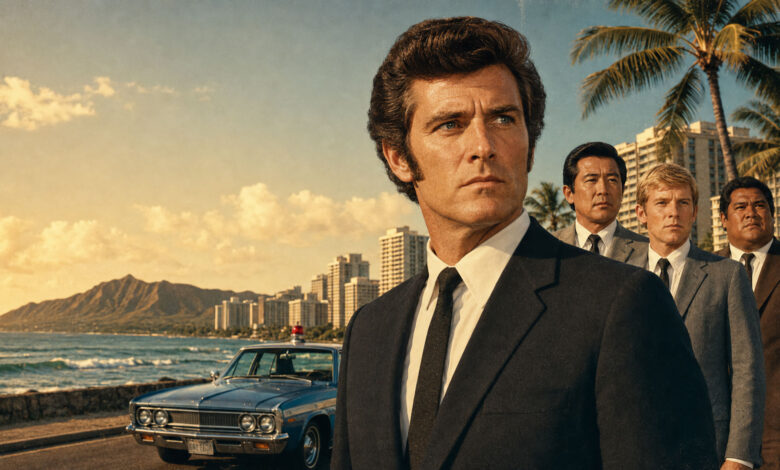
Long before television detectives came with trauma boards, podcast-ready murders and an apparently limitless supply of moody Scandinavian knitwear, Steve McGarrett was standing on a Hawaiian balcony in a dark suit, staring down organised crime as if humidity were a personal insult.
The original Hawaii Five-O is a police procedural created by Leonard Freeman and built around a fictional state police unit operating across the Hawaiian Islands. At its centre is Jack Lord’s McGarrett: immaculate, relentless and so intensely upright that even his hair appears to have taken an oath of office. Working directly for Governor Paul Jameson, McGarrett and his team investigate murder, kidnapping, espionage, racketeering and every other variety of trouble capable of arriving in paradise with a suitcase. The sea is blue, the mountains are green, the shirts are loud—and somewhere just out of frame a criminal mastermind is preparing to poison a diplomat.
The series ran for twelve seasons from 1968 to 1980, with mostly self-contained cases, patient interrogations and long drives to suspects’ houses. Some attitudes and conventions have dated, but its authority, atmosphere and sense of place remain potent. It made Morton Stevens’ theme one of television’s most recognisable pieces of music and gave popular culture the instruction, “Book ’em, Danno.” This is not the faster, chattier 2010 reboot. This is the Jack Lord original: stern, sunlit and convinced that crime can be defeated by preparation, persistence and a beautifully pressed suit.
Hawaii Five-O Transmission Details
- Show: Hawaii Five-O
- Years Active: 1968–1980
- Episodes: Usually listed as 281, although some catalogues count 282 because the feature-length pilot and multi-part stories are handled differently
- Where to Watch:
- US: Paramount+, selected classic-television channels and digital purchase
- UK: Digital purchase and DVD; streaming availability is inconsistent and should be checked before subscribing
- Creator: Leonard Freeman
- Original Networks: CBS in the US; ITV began showing the series in the UK in July 1970
- Main Cast: Jack Lord, James MacArthur, Kam Fong, Zulu, Richard Denning, Harry Endo and Khigh Dhiegh
- Later Team Members: Al Harrington, Herman Wedemeyer, William Smith, Sharon Farrell and Moe Keale
- Theme Music: Morton Stevens
- Related Series: Hawaii Five-0, the 2010 reimagining starring Alex O’Loughlin and Scott Caan
- Sub-Genre Tags: Police Procedural, Crime Drama, Espionage, Organised Crime, Action and Classic Television
- Missing Episode Note: “Bored, She Hung Herself” was withdrawn after its original transmission and is generally absent from official repeats and home-video editions
Hawaii Five-O Signal Strength (aka: Is It Worth Your Binge?)
Yes—provided you meet the programme on its own terms.
If your preferred crime drama moves at the speed of a trailer, you may initially wonder why McGarrett is spending so long walking across an office to answer a telephone. Give it time. The original Hawaii Five-O is not slow because it has forgotten the plot; it is deliberate because it expects procedure, observation and professional competence to be interesting. Often, they are. Cases are allowed to gather weight, suspects are given room to lie badly, and clues tend to be discovered by police work rather than a miraculous enhancement button.
The best episodes combine hard-edged plotting with an atmosphere no studio-bound procedural could reproduce. Honolulu is not merely a postcard backdrop. Harbours, hotels, military installations, residential streets, plantations, beaches and volcanic landscapes all become part of the investigation. Even when the story is pulpy, the location photography gives it texture and scale.
The obvious barrier is age. Twelve seasons made across the 1960s and 1970s contain language, stereotypes, gender politics and cultural assumptions that can sit awkwardly with a modern audience. The series offered Hawaiian and Asian American performers a degree of visibility rare on US network television at the time, but it could also view the islands through an exoticising mainland lens. Both things are true, and pretending otherwise does the show no favours.
There is also very little modern-style character serialisation. McGarrett does not spend half a season deciding whether the job has cost him his soul; he already knows the job needs doing and would prefer everyone to stop blocking the doorway. Personal consequences do occur—sometimes brutally—but the reset button is usually pressed before the next case.
For a first reconnaissance, sample the pilot “Cocoon”, “Full Fathom Five”, “Yesterday Died and Tomorrow Won’t Be Born”, the three-part “V for Vashon”, “Hookman” and “A Death in the Family”. If the theme tune has not permanently occupied part of your brain by then, Five-O may not be your unit.
Vibe Check
- Tone: Formal, hard-edged and so professionally serious that McGarrett’s hair appears to hold security clearance
- Visuals: Surf, palms, harbours, hotels, mountain roads and Honolulu changing visibly across twelve years
- Bingeability: Moderate to high; best watched several cases at a time rather than treated as a 281-episode endurance exercise
- Action Level: Steady, grounded and occasionally international
- Procedural Detail: High; interviews, surveillance, forensics and patient police work all receive room
- Conspiracy Scale: From local confidence rackets to Cold War espionage and Wo Fat’s international schemes
- Humour Level: Restrained, with most of the comedy arriving when lesser mortals encounter McGarrett’s concentration
- Family Work-Life Balance: Danno and Chin manage families; McGarrett appears to have replaced domestic life with duty rosters
- Operational Security: Excellent until Wo Fat enters the jurisdiction
Spoiler Mode: Plot Brief for Pub Chat
Full-series spoilers follow, including major character departures and the finale.
The premise is simple enough to fit on McGarrett’s business card. Five-O is a fictional state police organisation answerable to Governor Paul Jameson and called in for major crimes that cross jurisdictions or threaten Hawaii more broadly. Steve McGarrett, a former naval intelligence officer, runs the unit from the ʻIolani Palace. His principal deputy is Danny Williams, forever known as Danno, with Chin Ho Kelly and Kono Kalakaua forming the original core team.
The feature-length pilot, “Cocoon”, establishes the programme’s international reach. McGarrett investigates the fate of a fellow intelligence operative and collides with Wo Fat, a Chinese agent whose schemes bring Cold War espionage into the Pacific. Wo Fat is not in every other episode; that scarcity is part of his value. He returns when the series wants the threat to feel larger, stranger and more personal. Khigh Dhiegh plays him with unnerving composure, making him less a moustache-twirling weekly villain than an alternative centre of gravity. McGarrett embodies law, discipline and the state; Wo Fat embodies secrecy, manipulation and a world in which governments themselves play dirty.
Most episodes, however, are standalone investigations. “Full Fathom Five” sends Five-O after a confidence scheme preying on wealthy widows. “Tiger by the Tail” begins with a publicity-seeking staged kidnapping that becomes horribly real. “Strangers in Our Own Land” places land rights, political grievance and the pressures reshaping Hawaii inside a murder inquiry. “Yesterday Died and Tomorrow Won’t Be Born” removes McGarrett from command after he is shot, forcing Danno to lead the hunt while the team fears its chief may die. The plots range widely, but they repeatedly return to the idea that paradise attracts predators as efficiently as it attracts tourists.
The personnel gradually changes. Kono leaves after the fourth season, and Ben Kokua joins the unit. Duke Lukela, initially a recurring Honolulu police officer, becomes an increasingly important ally and eventually a member of Five-O. These changes are usually handled as professional transitions rather than emotional season finales. The series was made when cast departures did not automatically require a funeral, a montage and an acoustic cover version.
Chin Ho’s exit is the painful exception. In the tenth-season episode “A Death in the Family”, he is killed while working undercover. The death lands because Kam Fong had made Chin a dependable, modest presence for a decade. McGarrett’s grief is expressed in the only language he fully trusts: pursuing the people responsible until justice is no longer optional. It is one of the clearest moments in which the show allows the cost of the work to remain visible.
Danno stays through season eleven, then James MacArthur leaves before the final year. Season twelve introduces Kimo Carew, Lori Wilson and Truck Kealoha alongside Duke, but the chemistry inevitably changes. William Smith’s Kimo is more openly confrontational than Danno, and the final team never has enough time to acquire the lived-in ease of the original group. Jack Lord remains the fixed point, holding the programme together through force of professional will—McGarrett’s and, by all accounts, his own.
The long contest with Wo Fat finally concludes in “Woe to Wo Fat”. The plot involves an elaborate scheme centred on a scientist and psychological manipulation, but the important point is symbolic: after twelve seasons, McGarrett captures the adversary who has haunted the series since the pilot. Wo Fat ends behind bars, and the show closes its principal circle. There is no retirement on a beach and no prolonged farewell to the office. McGarrett completes the mission. For him, that is the emotional resolution.
Hawaii Five-O Character Shout-Outs
- Steve McGarrett: The human equivalent of an official seal embossed on heavy paper; controlled, incorruptible and capable of convening a grand jury with one stare
- Danny “Danno” Williams: McGarrett’s warm, capable deputy and the recipient of television’s most famous booking instruction
- Chin Ho Kelly: Calm, resourceful and grounded by Kam Fong’s own experience with the Honolulu Police Department
- Kono Kalakaua: Physically confident, locally connected and useful whenever a waterfront suspect requires help remembering his manners
- Ben Kokua: Thoughtful, observant and wisely written as a new team member rather than an imitation of Kono
- Duke Lukela: A dependable Honolulu police connection who gradually earns his place at the centre of Five-O
- Governor Paul Jameson: The political authority behind the unit and the man most likely to discover McGarrett has already mobilised three departments
- Che Fong: Forensic specialist, scientific secret weapon and resident of an era when television laboratories contained actual instruments
- Wo Fat: Cultured, patient and dangerous; the Cold War strategist who recognises McGarrett as his only worthy opponent
- Kimo Carew, Lori Wilson and Truck Kealoha: Final-season recruits asked to refresh machinery that had been running for eleven years
Hawaii Five-O Memorable Moments
- The opening sequence: A curling wave, pounding music and the rapid zoom towards Jack Lord on the Ilikai Hotel balcony
- “Cocoon”: The feature-length pilot introduces Wo Fat, Cold War espionage and a threat extending far beyond ordinary island policing
- “Yesterday Died and Tomorrow Won’t Be Born”: McGarrett is shot and Danno must command the unit while hunting the gunman
- The “V for Vashon” trilogy: A multi-generational struggle with an entrenched crime family gives Five-O room to work at near-serial scale
- “Hookman”: A distinctive assassin pursues revenge in an episode strong enough to be remade by the 2010 series
- Lewis Avery Filer: Hume Cronyn’s elderly master thief treats McGarrett as an intellectual opponent and allows the programme to loosen its tie
- “A Death in the Family”: Chin Ho’s death destroys the reassuring assumption that every familiar officer will return next week
- “Woe to Wo Fat”: McGarrett finally puts his defining adversary behind bars in the last episode
- “Book ’em, Danno”: The instruction that became shorthand for McGarrett, Five-O and the satisfying arrival of handcuffs
Performance Highlights
- Jack Lord: Gives McGarrett enormous authority through stillness, precise reactions and the sense that every suspect has already disappointed him administratively
- James MacArthur: Supplies warmth and emotional balance without weakening Danno’s credibility as the unit’s capable second-in-command
- Kam Fong: Uses understatement and real police experience to make Chin Ho feel like a working detective rather than a television construction
- Zulu: Brings physical presence, local knowledge and relaxed energy to Kono during the foundational early seasons
- Al Harrington: Joins an established ensemble without imitating his predecessor, making Ben Kokua thoughtful and quietly assured
- Herman Wedemeyer: Develops Duke Lukela from a useful recurring officer into part of Five-O’s institutional memory
- Khigh Dhiegh: Gives Wo Fat intelligence, patience and controlled menace even when the material carries heavy Cold War baggage
- Hume Cronyn: Plays Lewis Avery Filer with enough charm to make intellectual theft feel almost sociable
- Guest Cast: Ed Asner, Ricardo Montalbán, Helen Hayes, Leslie Nielsen and many others arrive with criminal plans, family secrets or exceptionally poor holiday judgement
Skull Face’s Take
The original Hawaii Five-O is what happens when a police procedural develops a magnificent sense of geography.
Strip away the beaches and you still have a solid, sometimes excellent crime drama: strong cases, clear stakes, a formidable lead and an ensemble that understands the value of looking like it has done this job before. Add Hawaii, and the series becomes something more distinctive. It records Honolulu and Oʻahu across twelve years of enormous change, often capturing streets, buildings and landscapes that no longer exist in the same form. A weekly CBS drama accidentally became a moving historical archive—with car chases.
I like its confidence. The show does not beg to be loved, and McGarrett would consider audience engagement metrics a misuse of police resources. It opens with the greatest theme tune in the business, puts Jack Lord in the middle of a widescreen view and assumes you will follow. Usually, you do.
I also admire the craft hiding beneath the stern surface. Location shooting at this scale was difficult and expensive. Hawaii did not possess the established television-production infrastructure of Los Angeles, so the series had to develop crews, solve logistical problems and turn the islands into a functioning weekly set. The result is not polished in the weightless modern sense. It has weather, glare, traffic, architecture and actual distance. People do not merely say they are driving across Honolulu; they visibly drive across Honolulu, sometimes for long enough to refinance the car.
Not every episode survives equally well. There are plots built on stereotypes, female characters reduced to victims or decoration, and moments when “foreign” appears to be treated as a complete personality. The final season feels like a machine running after several crucial parts have been replaced. Even in stronger years, the procedural repetition can become numbing if you attempt industrial-scale bingeing.
So do not watch it like a streaming thriller designed to be inhaled over a weekend. Watch a few episodes at a time. Let the cases stand alone. Notice how Lord calibrates McGarrett’s authority, how the locations change and how often the supporting cast makes a straightforward scene feel grounded. At that pace, the series’ virtues accumulate—and when the drums begin again, skipping the titles remains a criminal offence.
Why Hawaii Five-O Has Drama/Action Icon Potential
First, it possesses an instantly recognisable audiovisual identity. The theme tune does not merely accompany the programme; it announces it. The opening titles convert less than a minute of screen time into a brand so durable that the 2010 reboot recreated the essential imagery and retained the music. Plenty of successful shows are remembered fondly. Far fewer can be identified from their first two seconds of percussion.
Second, Steve McGarrett is a clean silhouette of a character. Dark hair, dark suit, erect posture, command voice. Jack Lord understands that icons need clarity. McGarrett believes in law, loyalty and evidence, and the show tests those beliefs without muddying them into fashionable ambiguity. That can make him inflexible, but it also makes him memorable.
Third, the location is inseparable from the action. Hawaii is not decorative wallpaper. The islands shape the crimes, the politics, the routes of escape and the social tensions. Tourism, military presence, land, shipping and Hawaii’s position in the Pacific all feed the stories. The show arrived only nine years after Hawaii became a US state, and even its fictional police force reflects a mainland audience trying to understand that new political and cultural reality.
Fourth, the series created language that escaped the screen. “Book ’em, Danno” became a universal punchline, while “Five-O” entered popular slang as a term for the police. The title is generally understood as a reference to Hawaii being the fiftieth state, but after twelve seasons it sounded like an institution that must surely exist.
Finally, longevity matters. When the programme ended in 1980, it was the longest-running American police drama on television. Its twelve-season footprint normalised the idea that a serious procedural could become part of the weekly landscape for more than a decade. Later franchises would run longer and multiply more aggressively, but Hawaii Five-O had already proved the durability of the model: dependable cases, a stable moral centre and a world viewers were happy to revisit.
Deep Dive Highlights
- Early production operated from a converted, notoriously leaky Quonset hut nicknamed “Mongoose Manor”
- Later seasons used production facilities at Fort Ruger and near Diamond Head
- Local crew members developed television-production expertise as the series continued
- Extensive location filming preserves a visual record of Honolulu’s development throughout the 1970s
- Five-O was fictional; Hawaii did not have a statewide police organisation exactly like McGarrett’s unit
- Kam Fong had previously served with the Honolulu Police Department
- Casting Kam Fong, Zulu, Al Harrington, Herman Wedemeyer and Harry Endo gave the series local texture uncommon on US network television at the time
- Wo Fat’s stories reflect Hawaii’s strategic Cold War position between the continental United States and Asia
- “Bored, She Hung Herself” was removed from normal circulation after a viewer reportedly died while attempting to imitate a technique shown in the episode
- The 2010 reimagining retained the theme, reconstructed title-sequence shots and remade “Hookman”
- Ed Asner later reprised original-series criminal August March in the 2010 programme
- The reboot used visual effects to create a brief appearance by Jack Lord’s McGarrett
- Final-season reruns were sometimes packaged under the alternative title McGarrett
- Episode totals vary because catalogues handle the pilot, multi-part stories and withdrawn episode differently
Legacy & Impact
The most obvious legacy is the 2010 reboot, which ran for ten seasons and translated the basic idea into modern action television. Yet the original’s influence reaches further. It demonstrated that a network procedural could be visually defined by a real location, support a long-running ensemble and sell international audiences a place as powerfully as it sold them a plot.
For Hawaii, the series was both opportunity and complication. It brought sustained production, employment and global visibility to the islands, helping develop a local screen industry that later projects could use. It also exported an image of Hawaii shaped for mainland television: beautiful, strategically important, culturally varied and endlessly available for dramatic adventure. That image could invite curiosity while simplifying the realities it borrowed.
The programme’s formal grammar became iconic. Morton Stevens’ theme has been covered, played by marching bands and detached from the show so thoroughly that people recognise it without knowing who Wo Fat is. Reza Badiyi’s opening zoom to Jack Lord remains one of television’s great star introductions. “Book ’em, Danno” survives as a catchphrase even among people who have never watched Danno book anybody.
The original series also belongs to an important transitional moment in American crime television. It retains the moral clarity and episodic structure of earlier procedurals, but its location realism, violence and engagement with organised crime, narcotics, politics and espionage point towards the tougher dramas of the 1970s. McGarrett is not a rule-breaking antihero; he is almost the opposite. But the world around him is recognisably less tidy than the one inhabited by many earlier television policemen.
Its flaws form part of that history too. Watching now means encountering the boundaries of what mainstream US television could imagine about race, gender, colonialism and authority. Some episodes challenge prejudice or engage seriously with Hawaiian concerns; others reproduce the era’s worst shortcuts. The answer is neither to dismiss twelve years of work nor to place it behind glass as an untouchable classic. It is to watch attentively.
At its best, Hawaii Five-O remains thrilling because it combines absolute dramatic conviction with a setting alive in every frame. A wave breaks. The drums start. Jack Lord turns towards the camera. Somewhere in Honolulu, a criminal has made a catastrophic scheduling error.
Want to Go Deeper?
- Watch Hawaii Five-O Classic on Paramount+ (Begin with “Cocoon” and prepare to surrender the next twelve seasons to McGarrett)
- Explore Hawaii Five-O on IMDb (Cast, credits and episode navigation for anyone attempting to count the episodes personally)
- Read the classic-series overview (Production history, location details and enough background to make “Mongoose Manor” sound almost glamorous)
- Compare the 1973 and 2013 versions of “Hookman” (One has patience and Jack Lord; the other has modern stunt work and a considerably larger vehicle-repair bill)
Recommended TV Products

Watch Law & Order: Special Victims Unit on Prime Video
From the creator of "Law & Order", comes a powerful series chronicling the life and crimes of the Special Victims Unit of the NYPD.
Watch Now
Watch Reacher Season 4 on Prime Video
A chance encounter with a distraught stranger on the Philadelphia subway draws Jack Reacher into a deadly mystery.
Watch Now
The Terminal List Season 2: Coming Soon
Season Two finds James Reece searching for a new purpose after finishing his list. But when the CIA corners him, Reece must clear his name by stopping a resurgent terrorist group that has turned an ally to their cause. In this globe-trotting espionage thriller, Reece will uncover a conspiracy that reaches from Moscow to Langley, even to his own family's history.
Watch the TrailerAs an Amazon Associate I earn from qualifying purchases.