Byte-Sized Overview
Jim Rockford is a private investigator who lives in a trailer beside the beach, charges $200 a day plus expenses and would greatly prefer it if every case could be solved without being punched, arrested or denied payment. Unfortunately, his clients regard all three outcomes as part of the standard package.
The Rockford Files follows a wrongfully convicted former prisoner who rebuilds his life as a low-cost investigator in Los Angeles. Jim specialises in missing people, insurance fraud, cold cases and apparently straightforward enquiries that soon acquire organised crime, political corruption or a man waiting behind a door with a blunt object. He owns no elegant office, has little interest in firearms and relies upon observation, impersonation, improvised business cards and the ability to sound completely confident while inventing a company that did not exist thirty seconds earlier.
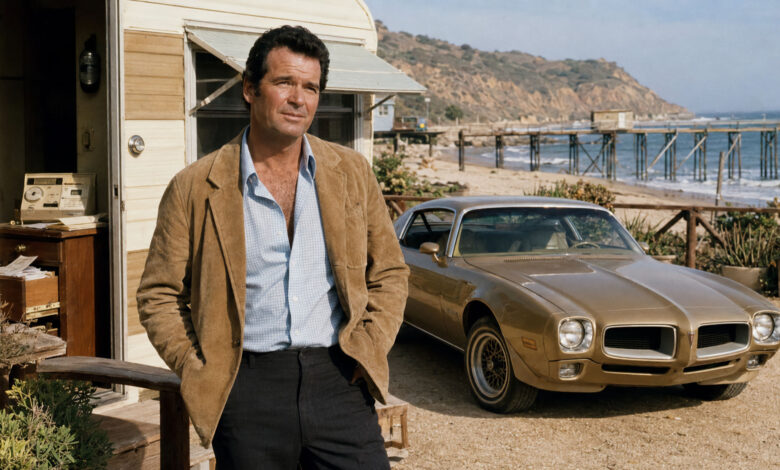
James Garner makes Rockford one of television’s most likeable detectives. Jim is clever without being smug, brave without enjoying danger and cynical without losing his decency. He gets frightened, bruised and occasionally outmanoeuvred. His gold Pontiac Firebird is more glamorous than his home, his answering machine receives more reliable work than he does, and his father Rocky remains convinced that a sensible career in trucking would resolve most of life’s difficulties.
Created by Roy Huggins and Stephen J. Cannell, the series combines detective plotting with character comedy, social observation and a distinctly unpolished view of 1970s Los Angeles. Police officers worry about promotions, lawyers become tired of emergency calls, criminals run businesses with administrative problems and Jim frequently solves the case without collecting his fee. It is warm, sharp and enormously influential. Also, the answering-machine messages alone have more personality than several complete detective franchises.
The Rockford Files Transmission Details
- Show: The Rockford Files.
- Years Active: 1974–1980 for the original series; 1994–1999 for eight reunion television films.
- Seasons: 6.
- Episodes: 123, including the feature-length pilot and two-part stories counted in their broadcast format, followed by eight reunion films.
- Original US Network: NBC, with the pilot broadcast on 27 March 1974 and the weekly series running from 13 September 1974 to 10 January 1980. The reunion films were shown by CBS.
- Original UK Broadcaster: BBC1, beginning on 18 March 1975. Later repeats appeared across BBC1, BBC2 and several commercial channels.
- Where to Watch: Rights vary considerably by country and may change faster than one of Jim’s improvised identities.
- US: Available free with advertising through The Roku Channel and by subscription through Philo at the time of writing. Digital purchase and physical box-set options may also be available.
- UK: No complete subscription-streaming home is currently listed. DVD and Blu-ray editions remain the most dependable way to obtain the full series and reunion films.
- Creators: Roy Huggins and Stephen J. Cannell.
- Key Executive Producers: Stephen J. Cannell and Meta Rosenberg, with James Garner, Juanita Bartlett, David Chase and Chas. Floyd Johnson among the central creative and producing figures across the run.
- Main Cast: James Garner, Noah Beery Jr., Joe Santos, Gretchen Corbett and Stuart Margolin.
- Recurring Cast: Luis Delgado, Bo Hopkins, Tom Atkins, James Luisi, Pat Finley, Kathryn Harrold, Isaac Hayes, Rita Moreno and Dennis Dugan.
- Theme Music: “The Rockford Files” by Mike Post and Pete Carpenter, a chart hit and Grammy-winning instrumental containing harmonica, guitar, synthesiser and enough momentum to improve almost any drive along the Pacific Coast Highway.
- Related Productions: Eight Rockford Files television films starring Garner were broadcast from 1994 to 1999. A contemporary NBC series starring David Boreanaz as Jim Rockford has been ordered for the 2026–27 television season.
- Sub-Genre Tags: Private detective drama, crime procedural, mystery, character comedy, Los Angeles noir, ex-con drama, car chases, legal drama and reluctant hero.
The Rockford Files Signal Strength (aka: Is It Worth Your Binge?)
Absolutely. The Rockford Files is one of those older programmes that initially looks relaxed and then reveals how much modern television quietly borrowed from it.
The cases are satisfying, but the character relationships provide the real continuity. Jim and Rocky argue like people who have repeated the same argument for twenty years and intend to continue for another twenty. Dennis Becker complains whenever Jim asks for police information, supplies it anyway and then becomes furious when the favour develops consequences. Beth Davenport offers legal intelligence, emotional support and the increasingly exhausted recognition that Jim is about to ignore her advice. Angel Martin produces a different kind of continuity: if Angel has introduced Jim to an opportunity, money will disappear and violence will arrive.
James Garner’s performance makes the series unusually easy to watch. Jim is capable but not invincible. He dislikes fighting because fighting hurts, rarely carries a gun because guns make situations worse and will retreat when retreat is sensible. None of this makes him cowardly. His courage lies in returning after he has had time to understand exactly how dangerous the situation is, which is both more believable and more impressive than charging forward without noticing.
The programme is also funny without turning the crimes into jokes. Much of the humour comes from work: unpaid invoices, difficult clients, bureaucracy, police resentment and criminals forced to organise meetings. Rockford’s false identities and telephone performances are delightful because the con is usually built from confidence, a pocket printing press and the reasonable assumption that nobody wants to admit they have never heard of the Department of Interdepartmental Relations.
The Los Angeles setting has aged beautifully. The series uses streets, beaches, industrial yards, cheap motels, expensive houses and half-developed land rather than treating the city as a parade of famous landmarks. Jim’s trailer at Paradise Cove communicates everything about him. He values freedom, lives modestly and has selected a location whose view is considerably more impressive than its security arrangements.
There are 1970s pacing rhythms, and some episodes take their time establishing clients, suspects and financial arrangements. That patience usually pays off because the guest characters feel as though they possess lives beyond the case. The best scripts combine mystery with specific worlds such as trucking, professional sport, organised labour, finance, entertainment and legal practice. Even weaker plots remain watchable when Garner, Beery, Santos or Margolin enters the scene.
Six seasons and 123 episodes represent a serious binge, but the episodic format allows breaks without losing the plot. The eight later films provide an affectionate return rather than an essential conclusion. Start with the pilot or one of the celebrated middle-season episodes and the signal should come through immediately. If it does not, leave a message after the tone and Jim will return your call when the latest client pays the expenses.
Vibe Check
- Tone: Wry, humane and suspicious of anybody who describes an illegal proposal as mutually beneficial.
- Visuals: Malibu beaches, faded motels, busy Los Angeles streets, police offices, industrial yards and one magnificently mobile gold Firebird.
- Bingeability: High, although the relaxed rhythm makes it equally good for one case at a time.
- Mystery Level: Strong, with more emphasis on motive, leverage and human behaviour than laboratory miracles.
- Action Level: Regular but grounded. Jim can fight, drive and shoot, but would prefer a convincing telephone call and an unlocked side entrance.
- Humour Level: Excellent, particularly when Angel explains why the latest disaster is technically somebody else’s fault.
- Emotional Weight: Quiet but substantial. Prison, loyalty, ageing, professional disappointment and family obligation sit beneath the jokes.
- Car-Chase Quality: Exceptional. The J-turn known as the Rockford turn did not require a computer-generated municipal collapse.
- Client Payment Reliability: Approaching theoretical.
- Answering-Machine Workload: Greater than several supporting detectives receive across an entire season.
Spoiler Mode: Plot Brief for Pub Chat
Major character and episode spoilers begin here. Jim would advise charging in advance before reading any further.
Jim Rockford spent five years in San Quentin for a robbery he did not commit. He received a pardon after new evidence cleared him, but prison remains a permanent part of his life rather than a colourful detail added to the business card. The experience left him wary of police power, skilled at reading criminals and acquainted with men such as Evelyn “Angel” Martin, whose friendship is genuine even when his business proposals are not.
After his release, Jim becomes a licensed private investigator and establishes his home and office in a mobile home at Paradise Cove in Malibu. His fee is $200 per day plus expenses, although the amount he actually receives depends upon client honesty, sudden death and whether Angel has already redirected the available money. Jim mostly accepts cold cases, missing-person enquiries and work that should not create conflict with active police investigations. This rule is practical, clearly stated and violated with remarkable consistency.
The feature-length pilot begins when Sara Butler hires Jim to investigate the murder of her father, a case the police have abandoned. The story establishes Rockford’s methods: persistent questions, improvised identities, careful observation and a tolerance for physical punishment that he does not mistake for enthusiasm. Lindsay Wagner plays Sara, while Robert Donley portrays Rocky before Noah Beery Jr. assumes the role for the weekly series.
Rocky is a semi-retired truck driver, former Seabee and devoted father who regards private investigation as an unstable interruption to Jim’s potential trucking career. He calls his son “Jimmy”, worries about his health and frequently becomes involved in cases despite opposing the occupation responsible for them. Their relationship is one of the series’ central achievements. They become irritated, frightened and protective without requiring speeches to prove that they love one another.
In Gearjammers, Rocky witnesses activity connected to a truck-hijacking operation and becomes a target. The two-part story puts his knowledge of drivers and haulage at the centre of the mystery while forcing Jim to protect a father who has never been especially cooperative about remaining protected. Episodes involving Rocky work because he is not merely a relative waiting at home. He has friends, principles, practical skills and an alarming tendency to enter the case while attempting to prevent Jim doing exactly that.
Sergeant Dennis Becker is Jim’s closest connection inside the Los Angeles Police Department. Becker knows Jim is intelligent and usually decent, but every request for a licence plate, arrest record or unofficial favour threatens his career. Jim often calls while Dennis is surrounded by colleagues, requiring both men to conduct an absurdly indirect conversation whose meaning is obvious to everybody nearby. Becker’s superior, Lieutenant Doug Chapman, dislikes Rockford and later resents Becker’s promotion. The friendship survives because Jim and Dennis understand one another even while complaining about the burden.
The Becker Connection turns the usual arrangement around when Dennis is framed after drugs disappear from police custody. Jim investigates for his friend, discovering corruption while Becker experiences the institutional suspicion normally directed towards Rockford. The episode works as both mystery and repayment. Dennis has taken professional risks for Jim for years; Jim now risks himself when the police are least inclined to accept his help.
Attorney Beth Davenport is Jim’s lawyer, former romantic partner and one of the few people permitted to tell him that his plan is legally disastrous before representing him when it becomes legally disastrous. Beth is intelligent, independent and never reduced to waiting for Jim’s personal life to become convenient. Their affection remains visible, but the series resists turning every scene into a delayed romance.
In So Help Me God, Jim is summoned before a grand jury and held in contempt after refusing to provide information he does not possess. The episode strips away the usual detective mechanics and places him inside a legal system whose secrecy and coercive power recall his wrongful imprisonment. Beth tries to navigate rules designed to prevent ordinary defence protections, while Jim discovers that innocence provides very little insulation against a determined prosecutor. James Garner later won an Emmy for the season containing the episode, and it remains one of the programme’s clearest examinations of authority.
Angel Martin is the opposite of a reliable investigative partner. He lies under pressure, invents opportunities, betrays Jim when frightened and returns when he requires help. Yet the friendship is real. They shared prison, understand one another’s survival instincts and possess a bond strong enough to withstand behaviour that would end most acquaintances before lunch.
The Great Blue Lake Land and Development Company gives Angel one of his greatest schemes. After swindlers cheat him in a real-estate transaction, Jim and Angel construct an elaborate counter-con involving worthless land, invented prosperity and the greed of the original criminals. It is the programme at its most playful, allowing Rockford to use performance and planning rather than fists. Angel remains Angel, so success does not improve the administrative arrangements.
In The Oracle Wore a Cashmere Suit, a fraudulent psychic becomes connected to murder and corruption. The episode combines con artistry with Jim’s ability to recognise when somebody is selling certainty to frightened people. Rockford is not hostile to human weakness; he is hostile to professionals who invoice it.
Rita Capkovic, played by Rita Moreno, is a former sex worker repeatedly endangered by people who underestimate her. In The Paper Palace, she becomes involved in a murder investigation and attempts to build a safer life. Moreno gives Rita humour, anger and vulnerability, turning what could have been a colourful guest role into one of the programme’s most memorable recurring characters. Her work earned an Emmy, and Rita later returns in the reunion films.
Gandolph “Gandy” Fitch, played by Isaac Hayes, is a former San Quentin acquaintance who believes Jim owes him assistance. In The Hammer of C Block, Gandy hires Rockford to investigate the murder for which he was imprisoned. He is intimidating, proud and not especially interested in Jim’s preferred boundaries. Their relationship is abrasive but rooted in prison loyalties, and Hayes makes Gandy considerably more than a guest tough man.
The series repeatedly punctures the fantasy of the glamorous private eye. Jim is beaten by larger men, arrested by impatient officers and deceived by clients who have withheld the one fact that would have made the case survivable. His gun usually remains in a coffee jar inside the trailer. When violence becomes unavoidable, he fights to escape rather than to demonstrate mastery. His greatest weapon is social engineering before the term became common: he identifies what somebody expects an official to sound like, then becomes that official over the telephone.
That talent produces recurring false identities, including the pompous Fred Beamer, a name later borrowed by a fan who impersonates Jim in The Great Impersonation. Rockford’s miniature printing press creates business cards on demand, allowing him to become an insurance representative, government investigator, service engineer or corporate employee long enough to reach the next clue. The disguises are rarely elaborate. Most institutions protect themselves through confidence, and Jim has enough confidence to walk past reception while complaining about the paperwork.
The House on Willis Avenue, written by Juanita Bartlett and David Chase, begins with the death of Jim’s mentor and develops into a two-part investigation of a private data operation assembling extensive personal information. Decades before digital surveillance became an everyday concern, the story imagines computers linking financial, medical and personal records into profiles capable of control and blackmail. The machinery is vintage, but the anxiety has aged alarmingly well.
Another recurring figure is Lance White, played by Tom Selleck. Lance is handsome, optimistic, well dressed and blessed with the sort of effortless luck that Jim considers personally offensive. In White on White and Nearly Perfect, every witness trusts Lance, every clue appears at the correct moment and even criminals behave as though they have read the script. Jim’s irritation gives the episode its comedy, while Selleck’s performance affectionately parodies the flawless television detective shortly before Magnum, P.I. makes him one.
Richie Brockelman, played by Dennis Dugan, is a younger private investigator whose cheerful manner conceals real ability. He crosses into The Rockford Files after appearing in his own short-lived series, and the two-part The House on Willis Avenue effectively gives him a second introduction. Richie admires Jim without entirely understanding how much pain professional experience has added to the older man’s caution.
Megan Dougherty, a blind psychologist played by Kathryn Harrold, becomes one of Jim’s most significant later romantic connections. She is independent, perceptive and unimpressed by attempts to protect her through exclusion. Their relationship has adult warmth, but Jim’s work and emotional evasiveness continue to make permanence difficult. The reunion film Punishment and Crime later returns Megan to his life.
John Cooper, played by Bo Hopkins, joins the later seasons as a disbarred attorney and friend whose legal knowledge remains useful even after the profession has withdrawn its official approval. Like many people in Jim’s orbit, Coop understands systems from both sides of their boundaries. His presence helps replace some of the legal function lost when Beth appears less frequently, without copying her personality or relationship with Jim.
The programme does not build towards a planned series finale. Production stops during the sixth season after Garner’s doctors order him to rest. Years of performing fights, falls and driving sequences have damaged his knees and back, while the schedule contributes to an ulcer. Deadlock in Parma becomes the final broadcast episode in January 1980, but it is an ordinary case rather than a farewell. Jim does not close the agency, leave Malibu or finally receive every unpaid invoice. Life simply stops between files.
The abrupt ending leads into a bitter financial dispute between Garner and Universal. Garner maintains that the studio has concealed profits from the series, while the studio claims substantial losses. The conflict lasts for years and prevents an immediate return to the character. A private settlement eventually clears the way for reunion films.
The Rockford Files: I Still Love L.A. brings Jim back in 1994. He remains at Paradise Cove, older but recognisably himself, with Angel still generating trouble and Dennis still connected to law enforcement. Noah Beery Jr. dies shortly before the first film airs, and the production dedicates it to him. Rocky’s off-screen absence becomes part of the emotional landscape, with his death later acknowledged within the story.
Seven further films follow through 1999: A Blessing in Disguise, If the Frame Fits, Godfather Knows Best, Friends and Foul Play, Punishment and Crime, Murder and Misdemeanors and If It Bleeds… It Leads. They reunite Garner with Joe Santos and Stuart Margolin in every instalment, while other familiar figures return when the story permits. Jim’s rate has risen to $450 a day plus expenses, although inflation has apparently done nothing to improve collection.
The films do not manufacture a definitive ending either. That is appropriate. Jim Rockford is not a detective moving towards one final enemy or a secret explanation of his identity. He is a working man whose files arrive one at a time. Somewhere beyond the last film, the answering machine is probably holding a message from a creditor, Angel has discovered an investment and Rocky’s voice is still telling Jimmy to consider the trucking business.
The Rockford Files Character Shout-Outs
- Jim Rockford: Wrongfully imprisoned private investigator, reluctant action hero and master of sounding officially irritated on telephones belonging to other people.
- Joseph “Rocky” Rockford: Jim’s father, retired truck driver and firm believer that stable employment would prevent most shootings.
- Dennis Becker: LAPD detective whose friendship with Jim is measured in confidential favours, anxious glances and arguments conducted beside filing cabinets.
- Beth Davenport: Lawyer, confidante and former girlfriend with the professional burden of knowing exactly how illegal Jim’s good ideas are.
- Evelyn “Angel” Martin: San Quentin survivor, confidence trickster and friend whose loyalty usually arrives after every cheaper option has failed.
- Doug Chapman: Police lieutenant who regards Jim as an infection and Becker’s continued friendship with him as a failure of departmental hygiene.
- Peggy Becker: Dennis’s wife, who understands both men and occasionally displays greater investigative judgement than either of them.
- John Cooper: Disbarred lawyer whose knowledge remains useful even after the California Bar has declined to endorse the arrangement.
- Megan Dougherty: Psychologist, romantic interest and perceptive equal who refuses to let blindness become the defining fact of any room.
- Gandolph Fitch: Former prisoner, formidable client and man capable of turning “you owe me” into a complete investigative contract.
- Rita Capkovic: Tough, funny survivor who wants a safer life but repeatedly encounters people determined to make one difficult.
- Lance White: Immaculate detective whose optimism, good fortune and hair cause Jim more irritation than most armed criminals.
- Richie Brockelman: Young investigator with enthusiasm, intelligence and insufficient experience of clients who disappear before payment.
The Rockford Files Memorable Moments
- The first answering-machine message establishing that Jim’s financial life has already begun without him.
- Jim taking Sara Butler’s case in the pilot and exposing the methods that will define the series.
- The gold Pontiac Firebird executing the reverse 180-degree move that becomes known as the Rockford turn.
- Rocky entering a dangerous trucking case in Gearjammers while insisting that Jim should avoid dangerous work.
- Angel and Jim constructing the elaborate land fraud in The Great Blue Lake Land and Development Company.
- Jim being trapped by grand-jury procedure in So Help Me God.
- Dennis Becker discovering that police suspicion feels different when he is the officer under investigation in The Becker Connection.
- Rita Capkovic fighting to escape her past in The Paper Palace.
- Gandy Fitch arriving with a prison grievance and a murder case in The Hammer of C Block.
- The private surveillance operation in The House on Willis Avenue, where old computers produce extremely modern unease.
- Jim watching Lance White receive trust, admiration and conveniently timed clues in White on White and Nearly Perfect.
- Rockford using his pocket press to create a new professional identity before the ink has developed confidence.
- Any telephone conversation in which Dennis says he cannot provide information while clearly preparing to provide it.
- Rocky calling Jim “Jimmy” at precisely the moment the professional detective would prefer witnesses to believe he is formidable.
- Angel returning after a betrayal and explaining that the circumstances have been misunderstood in a way favourable only to Angel.
- The repeated discovery that $200 a day plus expenses is less a payment policy than an aspirational statement.
- Jim’s return to Paradise Cove in I Still Love L.A. after almost fifteen years away from the screen.
- The reunion films acknowledging Rocky’s absence without attempting to replace the relationship that shaped the original series.
Performance Highlights
- James Garner: Makes intelligence look casual and decency look difficult. His comic timing, physical credibility and ability to express calculation without visible effort turn Jim Rockford into one of television’s defining performances.
- Noah Beery Jr.: Gives Rocky warmth, stubbornness and a complete life beyond being the hero’s father. His arguments with Garner feel affectionate because neither actor softens the irritation.
- Joe Santos: Builds Becker from a police contact into a convincing friend and ambitious detective. His exasperation is funny, but the professional danger beneath it is always clear.
- Gretchen Corbett: Makes Beth an equal rather than an accessory. She can challenge Jim legally, emotionally and intellectually without the series requiring her to win every argument to prove the point.
- Stuart Margolin: Turns Angel into a masterpiece of anxious self-preservation. Even his posture appears to be calculating which friend will remain useful after the exits close.
- James Luisi: Gives Chapman an abrasive certainty that makes every police-station visit more difficult and every small defeat unusually satisfying.
- Rita Moreno: Combines vulnerability, humour and fury in Rita Capkovic. Her Emmy-winning work ensures the character never becomes a stereotype or a lesson delivered for Jim’s benefit.
- Isaac Hayes: Brings controlled menace and wounded pride to Gandy Fitch, creating a prison connection who can frighten Jim while remaining emotionally legible.
- Kathryn Harrold: Plays Megan with independence and dry intelligence, producing one of the show’s warmest adult relationships without sentimentality.
- Bo Hopkins: Gives Coop easy charm and bruised professional dignity, fitting naturally into an ensemble whose members all understand life after institutional rejection.
- Tom Selleck: Commits completely to Lance White’s unreasonable perfection. The performance is both a parody of television heroism and an early demonstration of Selleck’s relaxed leading-man appeal.
- Dennis Dugan: Makes Richie Brockelman enthusiastic without being foolish, allowing the younger investigator to complement Rockford rather than simply annoy him.
Skull Face’s Take
The Rockford Files has aged better than many series that once looked more glamorous. Its cars, clothes and telephones are unmistakably 1970s, but its understanding of work, money and power remains fresh.
Jim is the reason. He does not investigate because he is obsessed with crime or spiritually unable to rest while injustice exists. Investigation is his job. He quotes a rate, submits expenses and would like payment. This practical foundation makes his decency more meaningful. He often continues after the client can no longer pay because he has become angry at the harm involved, but the programme never pretends that moral commitment covers the rent.
Garner removes the vanity from heroism. Rockford gets scared, backs away and attempts to talk people out of violence. He is hit from behind often enough to consider rearranging the furniture around every doorway in Los Angeles. When forced to fight, he looks as if he is trying to finish before something breaks. Given the injuries Garner accumulated performing the action, that impression eventually became less acting than occupational forecasting.
The supporting characters create a wonderfully complete social world. Rocky represents family, labour and the stable life Jim could have chosen. Becker shows the strain placed upon friendship by professional rules. Beth understands the law’s protections and failures. Angel demonstrates that prison friendship may involve affection, betrayal and the urgent relocation of borrowed property.
The writing also respects guest characters. Clients are not simply frightened people carrying exposition. They lie from embarrassment, self-interest, fear and class anxiety. Criminals may be powerful but still have partners, accountants and personal grievances. The series often reveals Los Angeles through work rather than tourism, showing the city’s garages, offices, trucking yards, restaurants and speculative developments.
Some elements have dated. Female characters are occasionally introduced through the assumptions of 1970s television, certain ethnic portrayals require their period to be remembered and a run of 123 episodes inevitably produces plots whose machinery is more serviceable than inspired. Yet the central tone remains unusually modern because the show is sceptical of macho certainty. Jim’s competence never requires everybody else to become stupid.
The answering-machine openings are a perfect statement of intent. Before the crime begins, viewers hear about creditors, missed appointments, peculiar friends and administrative trouble. Jim possesses an entire off-screen life made from messages he did not want. That is character building in about twenty seconds, leaving the remaining hour available for car chases and unpaid labour.
Skull Face recommends the series without hesitation. Keep the Firebird fuelled, avoid Angel’s investment opportunities and obtain the fee before the client remembers an important detail involving organised crime.
Why The Rockford Files Has Drama/Action Icon Potential
The Rockford Files already has several pieces of permanent television iconography. Jim’s answering machine, beachside trailer, checked jackets and gold Pontiac Firebird form a complete visual identity before he begins an investigation. The Mike Post and Pete Carpenter theme adds an instantly recognisable sound, cheerful enough to promise entertainment and restless enough to suggest another creditor has found the telephone number.
The Firebird gives the series action imagery as strong as any detective programme of its era. Jim’s driving reflects his character: skilful, practical and usually directed away from somebody with a weapon. The reverse 180-degree turn associated with the show became known as a Rockford turn, an unusually direct contribution by a fictional private investigator to the vocabulary of alarming road behaviour.
More important is the character model. Rockford influenced later investigators who combine competence with financial pressure, humour and institutional distrust. He is not wealthy, officially supported or invulnerable. His history as a wrongfully convicted prisoner gives every police confrontation additional weight, while his ability to manipulate bureaucracy turns social performance into action.
The series can move between drama and comedy without either becoming a disguise. A scene with Rocky may be funny because father and son are irritating one another, then become serious when danger exposes how much each fears losing the other. Angel can produce enormous comic energy while remaining a believable product of prison and insecurity. Becker’s complaints are entertaining because the professional consequences are real.
The eight reunion films demonstrated that the format could survive ageing. Jim did not need to become an action figure preserved from 1974. He could move more slowly, charge a higher fee and carry the accumulated weight of lost friends. The essential appeal remained his intelligence, voice and refusal to behave like the heroic image other people expected.
NBC’s new series order confirms that the iconography still has commercial force. A modern Rockford Files faces a difficult task because the original depends so heavily upon Garner’s particular warmth and rhythm. Reproducing the trailer, car and answering machine will be easy. Reproducing a hero who can be frightened, funny, irritated and decent in the same scene will decide whether the name remains a living idea rather than attractive branding.
Deep Dive Highlights
- Roy Huggins conceived Jim Rockford as a modern counterpart to Bret Maverick, the charming and reluctant Western hero James Garner had played in Maverick.
- Stephen J. Cannell wrote the pilot and co-created the series with Huggins. He went on to create or develop programmes including The A-Team, The Greatest American Hero, Hunter and 21 Jump Street.
- Huggins used the pseudonym John Thomas James for his story credits on the early episodes.
- The feature-length pilot was broadcast on NBC on 27 March 1974. It later became known as Backlash of the Hunter in syndication.
- The weekly series premiered on 13 September 1974 and ran for six seasons.
- Noah Beery Jr. replaced Robert Donley as Rocky after the pilot and appeared throughout the regular series.
- Jim’s standard rate was $200 per day plus expenses. The reunion films increased it to $450, although collection remained less dependable than inflation.
- His telephone number was shown as 555-2368, and the opening answering-machine gag changed for almost every episode.
- Mike Post and Pete Carpenter’s theme reached the US Top 10 and won the Grammy Award for Best Instrumental Arrangement.
- Tranmere Rovers have used the theme as walk-out music for decades, proving that Jim’s unpaid detective work has made a contribution to English football.
- Jim’s Pontiac Firebird Esprit was selected to appear less powerful than the Trans Am while still handling the programme’s demanding driving sequences.
- The reverse 180-degree manoeuvre popularly known as the Rockford turn became closely associated with the series, although stunt drivers and law-enforcement trainers use other names for the technique.
- Garner performed many of his own physical and driving stunts. The accumulated injuries contributed to production ending during season six.
- Juanita Bartlett wrote dozens of episodes and served as a producer and story editor, becoming one of the programme’s most important creative voices.
- David Chase wrote or co-wrote numerous episodes before later creating The Sopranos.
- The House on Willis Avenue is frequently noted for anticipating modern concerns about networked personal data and private surveillance.
- James Garner won the Emmy for Outstanding Lead Actor in a Drama Series for his work on the programme.
- The series won Outstanding Drama Series, while Noah Beery Jr. and Rita Moreno also received acting Emmys for their performances.
- The original run ended without a planned finale after Garner’s health forced production to stop.
- Garner later pursued a long legal dispute with Universal over profits from the series. The eventual settlement opened the way for his return as Rockford.
- Eight reunion television films aired on CBS between 1994 and 1999.
- James Garner, Joe Santos and Stuart Margolin appeared in all eight reunion films.
- The programme first reached British viewers on BBC1 on 18 March 1975 and remained a familiar presence through later BBC and commercial-channel repeats.
- TV Guide placed The Rockford Files at number 39 in its 2002 list of the 50 greatest television programmes.
- At the time of writing, The Roku Channel and Philo carry the series in the United States, while no complete UK streaming service is listed.
- NBC has ordered a contemporary series starring David Boreanaz for its 2026–27 schedule.
Legacy & Impact
Before Jim Rockford, television detectives often carried institutional authority, expensive offices or the confidence of men who expected a punch to improve the conversation. Rockford had a prison record, a trailer and an invoice nobody intended to pay. That difference changed the emotional possibilities of the genre.
The series made vulnerability compatible with masculinity. Jim could be frightened without becoming cowardly, affectionate without delivering speeches and physically hurt without treating injury as a temporary lighting effect. Garner’s performance suggested that courage begins after a person has correctly assessed the danger, not before they have noticed it.
Its influence can be seen in later private-eye and crime dramas built around imperfect professionals, recurring social worlds and humour arising from character rather than detachable jokes. Stephen J. Cannell carried lessons from the show into a long career of accessible, character-led television. David Chase learned inside a production that could combine episodic cases with consistent relationships years before he constructed a very different portrait of work, family and criminal behaviour in The Sopranos.
The answering-machine device became one of television’s greatest opening rituals. It delivered a joke, expanded Jim’s unseen life and prepared viewers for a world where bureaucracy was often more persistent than murder. Modern technology has made the physical machine obsolete, but the idea remains perfect. Every hero has a life continuing outside the plot, and Jim’s life has left a message about an overdue payment.
The programme also preserves a textured record of 1970s Los Angeles. Location filming captures a city of beachfront property, industrial development, traffic, small businesses and widening financial inequality. Jim moves between wealthy clients and struggling acquaintances without entirely belonging to either world. His trailer is modest but sits beside an extraordinary view, making it both economic necessity and declaration of independence.
The reunion films protected that legacy by allowing the characters to age. Rocky’s absence is felt, friendships have history and Jim remains capable without pretending that fifteen years have passed harmlessly. They are not uniformly as sharp as the original series, but they return Garner to a role whose rhythms still fit him.
The new NBC interpretation will inevitably renew arguments about whether anybody should replace James Garner. The wiser test is whether the new programme understands why Jim Rockford worked. Charm is necessary, but so are fear, financial pressure, loyalty, irritation and the sense that solving a case does not repair the system that produced it.
The original requires no remake to secure its position. Six seasons, eight films, major awards, an unforgettable theme and one of television’s finest lead performances have already done that. The files remain open because Jim feels less like a manufactured hero than a man who has stepped away from his dinner to answer the telephone. He will help, but he would really prefer a deposit.
Want to Go Deeper?
- Check current US availability on JustWatch (Useful when the rights have moved again without leaving a message.)
- Check current UK availability on JustWatch (At present, the investigation points towards physical media rather than a streaming subscription.)
- Explore The Rockford Files at the Television Academy (Emmy wins, nominations and proof that relaxed acting can conceal exceptionally precise work.)
- Read the Television Academy’s James Garner profile (A wider look at Garner’s career, awards and later Rockford films.)
- See NBC’s guide to its 2026–27 programmes (The official home for news of David Boreanaz’s contemporary Rockford.)
- Browse the episode and air-date guide (For viewers who want every file in order before Angel rearranges the paperwork.)
Recommended TV Products

Watch Law & Order: Special Victims Unit on Prime Video
From the creator of "Law & Order", comes a powerful series chronicling the life and crimes of the Special Victims Unit of the NYPD.
Watch Now
The Terminal List Season 2: Coming Soon
Season Two finds James Reece searching for a new purpose after finishing his list. But when the CIA corners him, Reece must clear his name by stopping a resurgent terrorist group that has turned an ally to their cause. In this globe-trotting espionage thriller, Reece will uncover a conspiracy that reaches from Moscow to Langley, even to his own family's history.
Watch the Trailer
Watch Lioness Season 3 on Prime Video
Inspired by a U.S. Military program, three agents embark on a dangerous undercover mission following the 9/11 terrorist attack.
Watch NowAs an Amazon Associate I earn from qualifying purchases.