Byte-Sized Overview
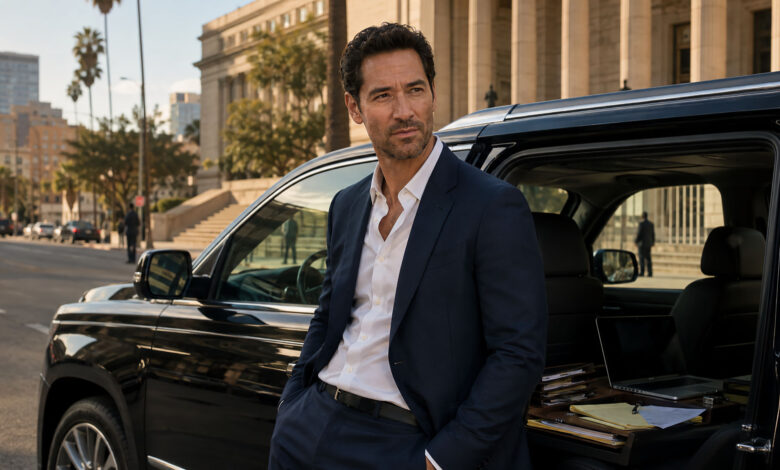
Mickey Haller is a Los Angeles defence lawyer who works from the back seat of a Lincoln, thinks best while moving through traffic and regards an apparently impossible case as a personal invitation to become extremely persuasive.
The Lincoln Lawyer begins as Mickey returns to legal practice after addiction and injury have taken him away from the courtroom. The murder of fellow lawyer Jerry Vincent unexpectedly leaves Mickey an entire practice, including a headline trial involving video-game executive Trevor Elliott. Winning it could restore Mickey’s reputation. Surviving the people interested in how Jerry handled the case would also be helpful.
Manuel Garcia-Rulfo plays Mickey as charming, strategic and slightly dangerous to everyone’s blood pressure. He believes every client deserves a defence, every prosecution theory has a weak point and every conversation contains information that might become useful during cross-examination. His office is held together by two ex-wives, an investigator with motorcycle-club connections, a driver rebuilding her own life and a daughter who knows precisely when her father is using courtroom logic at home.
Created for television by David E. Kelley and developed by Ted Humphrey from Michael Connelly’s novels, the series combines courtroom manoeuvring with Los Angeles crime, family drama and glossy legal mystery. Cases turn upon planted evidence, hidden financial pressure, corrupt investigators and the uncomfortable distinction between proving innocence and creating reasonable doubt. Mickey usually finds the winning argument, although the journey may involve jail, gunfire, several ethical concerns and a Lincoln requiring professional cleaning.
It is smart, warm and exceptionally bingeable. It also confirms that a mobile office is only convenient until the police open the boot.
The Lincoln Lawyer Transmission Details
- Show: The Lincoln Lawyer.
- Years Active: 2022–present.
- Seasons: 4 released; a fifth and final season is in production.
- Episodes: 40 released, with ten episodes in each season. The final season will add another ten.
- Original Broadcaster: Netflix, beginning worldwide on 13 May 2022.
- Where to Watch:
- US: Netflix.
- UK: Netflix.
- Creator for Television: David E. Kelley.
- Developer and Co-Showrunner: Ted Humphrey.
- Co-Showrunner: Dailyn Rodriguez from season two onwards.
- Based On: Michael Connelly’s Mickey Haller novels. The released seasons primarily adapt The Brass Verdict, The Fifth Witness, The Gods of Guilt and The Law of Innocence.
- Key Executive Producers: David E. Kelley, Ted Humphrey, Dailyn Rodriguez, Michael Connelly, Ross Fineman, Barry Jossen, Tana Jamieson, Matthew J. Lieberman and Gladys Rodriguez.
- Main Cast: Manuel Garcia-Rulfo, Neve Campbell, Becki Newton, Jazz Raycole, Angus Sampson and Yaya DaCosta.
- Recurring and Later Cast: Elliott Gould, Krista Warner, Christopher Gorham, Ntare Guma Mbaho Mwine, Lana Parrilla, Fiona Rene, Devon Graye, Holt McCallany, Cobie Smulders and Constance Zimmer.
- Composer: David Buckley.
- Production Company: A+E Studios, with David E. Kelley Productions, Hieronymus Pictures, Algorithm Entertainment and Fineman Entertainment.
- Related Productions: Michael Connelly’s Mickey Haller also appeared in the 2011 film The Lincoln Lawyer, played by Matthew McConaughey. The television series is a separate adaptation and continuity. A potential spin-off centred upon Cobie Smulders’ Emi Finch entered development in 2026.
- Sub-Genre Tags: Legal drama, courtroom drama, crime thriller, mystery, Los Angeles noir, defence attorneys, conspiracy thriller, family drama and novel adaptations.
The Lincoln Lawyer Signal Strength (aka: Is It Worth Your Binge?)
Yes. The Lincoln Lawyer has the confidence of an expensive legal professional and the episode endings of somebody who knows you have already cancelled tomorrow morning.
Each season builds around one major case while allowing smaller clients, family problems and criminal investigations to intersect with it. This structure gives the courtroom stories enough room to develop without turning every episode into one prolonged hearing. Mickey may be preparing a murder defence in one scene and extracting a client from an avoidable disaster in the next. The smaller cases show his instincts, fund the office and occasionally provide exactly the legal trick required by the larger trial.
Manuel Garcia-Rulfo is an engaging centre. Mickey can perform for a jury, charm a witness and manipulate an opponent, but the performance never entirely hides the recovering addict and absent father beneath it. His Mexican heritage is integrated naturally through family, language and identity, adding texture to a character who was described differently in earlier adaptations. Garcia-Rulfo makes the role his own without attempting to reproduce Matthew McConaughey’s film performance.
The office ensemble is the programme’s secret advantage. Lorna Crane is Mickey’s second ex-wife, office manager and eventual lawyer. Cisco is Lorna’s fiancé and later husband, an investigator whose size and motorcycle connections create useful shortcuts through reluctant conversations. Izzy Letts begins as a client and becomes Mickey’s driver, confidante and developing paralegal. Maggie McPherson, Mickey’s first ex-wife, works as a prosecutor and remains both his most important emotional relationship and the person least impressed by defence-attorney improvisation at family dinner.
Season one is the most immediately accessible. Mickey inherits Jerry Vincent’s caseload and the Trevor Elliott trial, providing a clean professional comeback story wrapped around murder, jury manipulation and legal corruption. Season two becomes more romantic and morally slippery through Lisa Trammell, a client Mickey cannot view with complete professional distance. The split release interrupts its momentum slightly, but the trial and final revelation reward attention.
Season three is darker and arguably the strongest dramatic run. Gloria Dayton’s murder makes the case personal, Mickey’s driver Eddie becomes collateral damage and the conspiracy reaches law enforcement. The courtroom conclusion forces characters to expose not only what they did but what they allowed. Season four reverses the entire premise by placing Mickey in the defendant’s chair, making every reassuring line he has used on clients sound considerably less convincing from inside a jail cell.
The legal detail is dramatised, naturally. Real trials do not regularly produce perfectly timed revelations, witnesses are discouraged from treating cross-examination as a late opportunity for full confession and judges may react poorly if counsel turns every evidential objection into prestige television. Yet the series usually understands the strategic purpose behind its courtroom moves. Mickey wins by controlling what the jury believes the case is about, not because a laboratory sends him a flashing message marked INNOCENCE CONFIRMED.
Forty episodes make the series a substantial but manageable binge. Every released season resolves its primary case while leaving a new danger, relationship or body in the vehicle. The fifth season is intended to provide a planned conclusion, which is reassuring because Haller and Associates has reached the point where another uncontrolled cliffhanger might affect its insurance premium.
Vibe Check
- Tone: Polished, witty and morally flexible until somebody Mickey loves becomes evidence.
- Visuals: Sunlit Los Angeles, glass offices, crowded courtrooms, hillside homes and immaculate cars transporting alarming case files.
- Bingeability: Extremely high. Closing arguments have less control over viewers than the closing thirty seconds of each episode.
- Courtroom Detail: Strategically convincing, dramatically compressed and unusually interested in jury psychology.
- Mystery Level: Strong, with each season hiding a second case inside the one formally listed on the docket.
- Action Level: Moderate but consequential. Violence arrives suddenly and tends to create legal work for everyone left standing.
- Romance Level: Complicated. Mickey has two ex-wives, several relationships and the scheduling confidence of a man unaware that calendars preserve evidence.
- Humour Level: Warm and regular, especially when Lorna, Cisco and Izzy have already recognised the flaw in Mickey’s brilliant plan.
- Office Stability: Improving professionally, deteriorating whenever the senior partner is arrested for murder.
- Vehicle Security: The front seats are excellent. The boot requires a complete procedural review.
Spoiler Mode: Plot Brief for Pub Chat
Major spoilers for all four released seasons begin here. Anything you say may be used against you in the next ten episodes.
Mickey Haller begins the series returning from eighteen months away from legal practice. A surfing accident led to pain medication, addiction and rehabilitation, damaging both his career and his relationship with his daughter Hayley. He is sober but uncertain whether the courtroom instincts that once defined him have survived.
The murder of defence lawyer Jerry Vincent changes everything. Judge Mary Holder informs Mickey that Jerry left his practice to him, including dozens of clients and the approaching murder trial of technology entrepreneur Trevor Elliott. Trevor is accused of shooting his wife Lara and her lover Jan Rilz inside the Elliott home. He insists the trial proceed immediately, giving Mickey little time to understand a file his murdered predecessor may have been hiding from somebody.
Mickey rebuilds his team. Lorna Crane, his second ex-wife, manages the office and knows his habits too well to accept most explanations on first submission. Her fiancé Cisco handles investigations and carries unresolved obligations to the Road Saints motorcycle club. Maggie McPherson, Mickey’s first ex-wife and Hayley’s mother, is a deputy district attorney pursuing human trafficker Angelo Soto. Their opposing professions have always complicated their relationship. Mickey believes the state must prove every case properly; Maggie frequently has to watch guilty people exploit the space he creates.
Izzy Letts enters as a client accused of stealing an expensive necklace. Mickey secures her release, recognises a fellow recovering addict and hires her to drive his Lincoln. She becomes much more than transportation. Izzy listens while Mickey thinks, notices what others miss and understands the discipline required to remain sober when a difficult day offers easier alternatives.
Detective Raymond Griggs investigates Jerry’s death and initially suspects Mickey may be connected. Mickey discovers that Jerry had secretly paid a juror in Trevor’s trial. The apparently neutral juror is McSweeney, placed inside the panel to influence deliberations. Mickey exposes the compromised jury without sacrificing Trevor’s defence, then constructs reasonable doubt around the impossibly short period in which Trevor would have needed to dispose of blood, clothing and the murder weapon.
The jury acquits Trevor. Mickey nevertheless realises his client is guilty. Lara was the true technical mind behind Trevor’s company and intended to expose both her contribution and the criminal financing supporting it. Trevor killed Lara and Rilz, then used a drone to dispose of the gun and bloody clothes. Attorney-client privilege prevents Mickey revealing the confession. Trevor’s freedom is brief: Carol Dubois, who loved Rilz, shoots him after a public appearance.
Jerry’s murder leads to Judge Holder. She has been accepting money to rig juries and arranged Jerry’s death after he discovered the scheme. McSweeney attacks Mickey during a hike, but Mickey survives and Holder is arrested. The victory restores his professional confidence, though it also confirms that the legal system he serves contains corruption behind the bench as well as before it.
Maggie’s Soto prosecution suffers when Detective Lankford’s misconduct destroys the credibility of evidence and forces difficult compromises. The case strains her career and her renewed closeness with Mickey. Hayley also challenges her father about representing people who may be guilty. Mickey explains that his work protects the rules for everyone, but the Trevor result demonstrates how hollow the principle can feel when a guilty client uses it successfully.
Season two begins with Mickey enjoying his restored profile. He meets chef and community activist Lisa Trammell, whose restaurant and neighbourhood face pressure from property developer Mitchell Bondurant. Mickey becomes romantically involved with Lisa, then has to represent her when Bondurant is found murdered in a car park.
The prosecution, led by Andrea Freeman, builds a strong circumstantial case. Lisa publicly confronted Bondurant, threatened him, cannot account for crucial movements and owns a hammer consistent with the weapon. A podcast producer named Henry Dahl turns the case into entertainment, exploiting Lisa’s story and Mickey’s fame. Mickey’s personal involvement gives the prosecution an obvious line of attack and gives Lorna several opportunities to use the expression she reserves for preventable professional disasters.
Bondurant had financial disputes involving developer Alex Grant, who is connected to the Armenian criminal organisation and a construction fraud. Inspector Walter Kim also had reason to fear exposure. Mickey ultimately creates enough doubt around the evidence and the hammer to win Lisa’s acquittal. The apparent triumph collapses almost immediately.
Mickey realises Lisa has lied about her former husband Jeff. The repeated appearances of a man claiming to be Jeff were part of a manipulation, while the real Jeff has been missing for years. Mickey finds evidence suggesting Lisa killed him and buried his body beneath the coriander in her garden. She did not murder Bondurant, but she is far from innocent. Police arrive to search the property, and Mickey ends the relationship with the uncomfortable knowledge that his legal judgement worked perfectly while his personal judgement had gone on annual leave.
Walter Kim is identified as Bondurant’s likely killer, acting to prevent the discovery of fraud linked to Grant. Kim disappears and is presumed dead. The case leaves Mickey with enemies among people accustomed to resolving risk outside court.
The season also follows Lorna completing law school and preparing for the bar, Cisco confronting the Road Saints debt he hoped to leave behind and Izzy creating a dance studio while wrestling with the cost of independence. Mickey’s mother Elena arrives with theatrical energy and the useful reminder that his talent for performance may be hereditary.
Gloria Dayton, known as Glory Days, returns with information about drug dealer Hector Moya. She previously helped Mickey in the Jesus Menendez case, where corrupt Detective Lankford had contributed to an innocent man’s conviction. At the end of season two, Mickey learns that Gloria has been murdered. Julian La Cosse, a manager who connected clients with sex workers, is arrested for the crime and asks Mickey to defend him.
Season three makes Gloria’s death the centre of a wider conspiracy. Mickey feels responsible because his earlier instructions placed her in contact with dangerous people. He investigates Hector Moya, now serving a long federal sentence after a gun is found in his room. Gloria gave the police the information leading to the weapon, but she was being manipulated by Drug Enforcement Administration agent James DeMarco.
DeMarco used Gloria as an informant and arranged for evidence to be planted against Moya. When Gloria considered revealing what happened, she became a threat. Former police detective Neil Bishop works with DeMarco and later serves as the prosecution’s investigator in Julian’s case. Bishop is not the architect, but years of compromised choices have placed him inside DeMarco’s control.
Mickey hires Eddie Rojas, one of Hayley’s former babysitters, as a new driver after helping him with a carjacking charge. Eddie is cheerful, loyal and eager to prove himself. He dies when a truck deliberately crashes into Mickey’s car, an attack intended for the lawyer. Mickey survives, but the loss removes any remaining distance between the case and the people working it.
Julian is attacked in custody and nearly dies. The prosecution continues under William Forsythe, whose mild manner conceals a disciplined courtroom opponent. Andrea Freeman, meanwhile, begins a relationship with Mickey while facing her own professional failure after a domestic-violence victim she tried to help is killed. Their connection is genuine, but Mickey’s continuing emotional orbit around Maggie and the demands of the Gloria case prevent easy stability.
In court, Mickey forces the conspiracy into view. Bishop testifies that DeMarco killed Gloria and used him to support the cover-up. Overcome by guilt and the consequences of his choices, Bishop shoots himself on the witness stand. The revelation destroys the case against Julian. DeMarco disappears, then is found dead and displayed with a message indicating that Hector Moya has imposed his own verdict.
Mickey has cleared Julian and exposed the truth about Gloria, but the resolution provides very little satisfaction. Eddie and Bishop are dead, Julian has been brutalised by the system and Gloria cannot benefit from the justice performed in her name. The season closes with Mickey driving home, only to be stopped by police. They open the boot of his Lincoln and find the body of con man and chronically unpaid client Sam Scales.
Season four begins with Mickey charged with Sam’s murder and held without bail at the Twin Towers Correctional Facility. The evidence is carefully arranged: Sam’s blood is in the car, Mickey had publicly threatened him over unpaid fees and the body was discovered inside the vehicle most closely associated with his identity. Mickey insists upon representing himself and refuses to surrender his right to a speedy trial, proving that lawyers are not automatically easier clients when the lawyer and client share a nervous system.
Experienced prosecutor Dana Berg takes the case. Mickey previously defeated her, and she approaches the new trial with skill, aggression and no interest in accepting his preferred interpretation of events. Maggie returns to Los Angeles and eventually joins the defence, experiencing the justice system from the side she has spent her career opposing. The shift deepens her understanding of Mickey, even when it does not make his decisions less infuriating.
While Mickey remains in custody, Lorna and Izzy struggle to keep Haller and Associates operating. Clients leave, income falls and Lorna has to practise as a lawyer while managing a firm publicly associated with homicide. Izzy studies to qualify as a paralegal and begins a relationship with classmate Grace. Cisco searches Mickey’s old enemies, which is less a shortlist than an ambitious filing project.
The investigation discovers that Sam was operating another scam under the name Kirk Lennon. He created AirKing Trucking and became involved with BioGreen, an alleged biofuel company linked to Armenian criminal Alex Grant, also known as Gazarian. Sam was skimming money from criminals already using the business for fraud. Gazarian had him killed and arranged for Mickey to be framed, partly exploiting the lawyer’s previous conflict with the organisation.
Mickey’s longtime mentor David “Legal” Siegel dies from a heart attack during the case. Legal had been the partner of Mickey’s late father and served as a source of advice, history and blunt affection. Mickey chooses to preserve his speedy-trial demand even though returning to jail means missing the funeral. In a dream, Legal tells him to do what he has always done: figure it out. The loss removes Mickey’s surrogate father at the exact moment he is forced to rely upon the team he has built.
Gazarian is eventually killed by fellow criminals who object to the attention surrounding Sam’s murder. His girlfriend Jeanine knows that Gazarian ordered the killing because Sam was stealing from the biofuel operation, but she is terrified of testifying. Without her, Mickey can explain the frame but cannot prove it cleanly.
Mickey, Lorna, Maggie, Izzy and Grace create leverage between the district attorney’s office and the FBI. By making federal agents believe Jeanine will testify publicly and endanger their larger investigation, they force the authorities to place her in protective custody and prevent the murder prosecution continuing. The district attorney offers to dismiss the charges if Mickey remains silent until the federal case ends.
Mickey refuses a quiet dismissal. His practice and reputation require a public acknowledgement that he was framed, and he is willing to risk trial rather than live beneath permanent suspicion. The district attorney agrees, forcing Berg to participate in his exoneration. Walking through the courthouse, Mickey finally breaks down in Maggie’s arms as the full proximity of prison and loss reaches him.
Maggie and Hayley return to San Diego, although Maggie admits that she misses Los Angeles and Mickey. The possibility of reconciliation remains unresolved. Mickey takes his powder-blue Lincoln Continental to buy groceries, a remarkably domestic decision that immediately attracts gunfire. A mysterious woman pushes him out of the line of fire and helps save his life from the remaining Armenian threat. She then introduces herself as Emi Finch, the half-sister Mickey never knew existed.
The fifth and final season will follow Emi asking Mickey to help free a woman wrongfully convicted of murder six years earlier. The case draws upon Resurrection Walk while replacing the novel’s major Harry Bosch role with a new family relationship created for the series. Mickey has just experienced wrongful prosecution himself, so his final major case will test whether that trauma has changed the way he practises law, trusts his family and defines a victory.
The Lincoln Lawyer Character Shout-Outs
- Mickey Haller: Defence lawyer, recovering addict and courtroom strategist who can identify the weakness in any case except the one involving his personal relationships.
- Maggie McPherson: Prosecutor, first ex-wife and emotional centre of Mickey’s life, professionally committed to a system he spends each day testing.
- Lorna Crane: Second ex-wife, office manager and lawyer whose colourful wardrobe is considerably better organised than Mickey’s risk assessment.
- Dennis “Cisco” Wojciechowski: Investigator, former Road Saint and reassuring presence until he asks a witness to continue the conversation somewhere quieter.
- Izzy Letts: Driver, office anchor and future paralegal whose recovery gives her an unusually precise understanding of Mickey’s strengths and evasions.
- Hayley Haller: Mickey and Maggie’s daughter, moral questioner and the only member of the family who can end a closing argument by leaving the dinner table.
- David “Legal” Siegel: Mentor, surrogate father and veteran attorney who knows where Mickey learned every trick and which ones still require work.
- Andrea Freeman: Skilled prosecutor whose courtroom rivalry with Mickey develops into a relationship neither profession has made administratively convenient.
- Gloria Dayton: Informant and survivor whose death exposes the human cost of using vulnerable people as pieces in larger cases.
- Julian La Cosse: Gloria’s accused manager, a frightened client forced to survive both wrongful prosecution and violence in custody.
- Neil Bishop: Former detective whose compromises place him inside a conspiracy he eventually exposes at devastating cost.
- Dana Berg: Formidable prosecutor determined to convict Mickey when the defence lawyer becomes the defendant.
- Emi Finch: Mickey’s newly discovered half-sister, capable of interrupting a family introduction to save him from gunfire.
The Lincoln Lawyer Memorable Moments
- Mickey entering Jerry Vincent’s office and discovering that his comeback has arrived with a murder investigation attached.
- Izzy completing her first drive for Mickey and gradually becoming indispensable to the practice.
- Mickey exposing the compromised juror without collapsing Trevor Elliott’s trial.
- The drone revelation explaining how Trevor disposed of the evidence.
- Mickey confronting Trevor after winning the acquittal and learning that professional victory can feel remarkably similar to defeat.
- Judge Holder being exposed as the force behind jury manipulation and Jerry’s murder.
- Mickey’s assault on the hiking trail and his desperate fight to survive McSweeney.
- Lisa Trammell hearing the not-guilty verdict in the Bondurant case.
- Mickey recognising what is growing in Lisa’s garden and what may be buried beneath it.
- Lorna completing law school and moving from managing legal work to performing it.
- Mickey learning that Glory Days has been murdered and promising to discover who did it.
- Eddie’s death in the deliberate collision meant for Mickey.
- Julian being attacked in custody while the case against him continues.
- Bishop confessing DeMarco’s crimes from the witness stand.
- The courtroom horror of Bishop taking his own life after giving Mickey the truth.
- Police opening the Lincoln’s boot and discovering Sam Scales.
- Mickey conducting his own defence from jail while Lorna tries to prevent the firm collapsing outside it.
- Legal’s final dream conversation, telling Mickey to figure it out without him.
- The team forcing the DA and FBI into an arrangement that protects Jeanine and clears Mickey.
- Mickey refusing a private dismissal and demanding public exoneration.
- Mickey breaking down in Maggie’s arms after the charges are finally removed.
- Emi saving Mickey from the shooting before announcing that she is his sister.
Performance Highlights
- Manuel Garcia-Rulfo: Gives Mickey charm, tactical intelligence and a persistent undertow of damage. Season four is particularly strong because Garcia-Rulfo lets the normally confident lawyer experience fear without losing the instincts that make him formidable.
- Neve Campbell: Makes Maggie principled rather than self-righteous. Her chemistry with Garcia-Rulfo carries years of love, frustration and professional disagreement without requiring the characters to explain their history in every scene.
- Becki Newton: Brings comic precision, intelligence and growing authority to Lorna. The progression from office manager to practising lawyer feels earned because Newton has shown Lorna doing half the job unofficially from the beginning.
- Jazz Raycole: Gives Izzy warmth and clear-eyed judgement. Her recovery story is handled without reducing her to a lesson for Mickey, and her move towards paralegal work expands naturally from the skills she already contributes.
- Angus Sampson: Makes Cisco imposing, gentle and quietly funny. His relationship with Lorna works because physical contrast never replaces genuine affection and shared competence.
- Elliott Gould: Connects the series to the tradition of California noir while making Legal far more than a source of exposition. His humour and paternal disappointment give Mickey a history outside the immediate plot.
- Yaya DaCosta: Makes Andrea a credible courtroom match and complicated romantic partner for Mickey. Her professional confidence survives personal vulnerability without either side feeling false.
- Fiona Rene: Gives Gloria dignity, wit and fear across multiple seasons. The emotional force of season three depends upon viewers remembering the person behind the informant file.
- Holt McCallany: Builds Bishop through restraint. His final testimony works because the character’s guilt has appeared in posture and silence long before it reaches words.
- Lana Parrilla: Makes Lisa persuasive enough for both Mickey and the audience to overlook the danger in her history. The garden revelation lands because Parrilla has never played her as a simple innocent.
- Constance Zimmer: Gives Dana Berg aggression, preparation and bruised pride. She remains a legal opponent rather than a cartoon villain even when the prosecution becomes deeply personal.
- Cobie Smulders: Makes a forceful late entrance as Emi Finch, establishing confidence, mystery and family significance within a few minutes of gunfire and groceries.
Skull Face’s Take
The Lincoln Lawyer is the rare legal drama that understands lawyers spend almost as much time managing people as citing law. Witnesses lie, clients omit, investigators worry and prosecutors select the version of events most likely to survive twelve strangers and a lunch break.
Mickey’s gift is framing. He does not merely find evidence; he identifies the story the jury is prepared to believe and rearranges the case around it. That makes the courtroom scenes satisfying even when the procedure has been compressed for television. A good cross-examination changes the meaning of something viewers already knew rather than producing a document from the legal equivalent of a magician’s sleeve.
The series is glossier than Michael Connelly’s Bosch world, but Los Angeles still functions as more than sunshine behind a windscreen. Wealth, development, policing and status shape the cases. Mickey’s Lincolns allow the city to move around him while Izzy, and later Eddie, turn travel into a working relationship. The arrangement is visually clever and dramatically useful. It is also a reminder that confidential legal practice should probably not depend upon traffic moving slowly enough to finish the conversation.
The ensemble prevents Mickey’s charm becoming exhausting. Lorna challenges his management, Cisco tests his information, Izzy recognises his recovery behaviour and Maggie refuses to confuse rhetorical brilliance with emotional honesty. Hayley sees the moral problem at the centre of his profession: defending the system can mean helping a guilty person escape it.
The best seasons make victory complicated. Trevor is acquitted and guilty. Lisa is acquitted of one murder but implicated in another. Julian is cleared after being nearly killed in custody. Mickey is exonerated only after losing Legal and experiencing the terror he has previously asked clients to control. These outcomes give the show more weight than a simple sequence of surprise witnesses.
It sometimes leans hard on coincidence, dangerous clients and conspiracies capable of reaching every level of the investigation. Mickey’s love life also has the scheduling logic of a man who believes conflict checks are optional outside the office. Yet the warmth of the team and clarity of the seasonal cases keep the machinery enjoyable.
Season four successfully changes the power balance. Mickey can no longer reassure himself that the system eventually works because he is personally trapped inside its delays, assumptions and leverage. The experience should give the final season an altered hero rather than merely another difficult case.
Skull Face finds for the defence. Costs are awarded to the viewer, payable in ten-episode instalments.
Why The Lincoln Lawyer Has Drama/Action Icon Potential
The series has an immediate visual identity: Mickey Haller in a tailored suit, working from the back seat of a Lincoln while Los Angeles moves beyond the glass. The car represents freedom, success and constant motion, but it also places the lawyer in a transitional space. Mickey is always travelling between court, family and danger without settling completely inside any of them.
The courtroom supplies the dramatic iconography. Mickey’s strength is not shouting louder than the prosecution. He watches jurors, changes rhythm and plants an interpretation before the opposing lawyer recognises which part of the case has moved. Garcia-Rulfo’s contained style makes the eventual closing argument feel like the completion of work performed across the season.
Action remains secondary but memorable. Mickey is assaulted, pursued, shot at and framed, while investigators move through parts of Los Angeles where a legal objection has limited defensive value. Because Mickey is not an action hero, violence carries consequence. Eddie’s death alters the season, Bishop’s suicide shatters the courtroom and Sam’s body transforms the Lincoln from office into crime scene.
The supporting cast gives the show potential beyond Mickey. Lorna has developed into a lawyer with her own cases, Izzy is moving towards professional qualification, Cisco can carry investigations and Maggie understands both prosecution and defence after season four. Emi creates a new family branch while offering a route into the role occupied by Harry Bosch in Connelly’s shared literary world.
That last point matters. The books connect Mickey to Bosch as half-brothers, but separate screen rights prevent the Netflix series simply importing the version played by Titus Welliver. Creating Emi allows the television programme to explore blood ties, investigative partnership and inherited damage on its own terms. A proposed spin-off suggests Netflix sees the character as more than a final-season device.
The planned fifth-season ending also strengthens the show’s long-term potential. A complete journey from professional recovery to wrongful prosecution and final reckoning gives Mickey an arc rather than an indefinite supply of clients. If the final season allows him to decide what sort of lawyer, father and partner he wants to be, the Lincoln can finish its route without running out of road.
Deep Dive Highlights
- The series is based on Michael Connelly’s novels about Los Angeles defence lawyer Mickey Haller.
- David E. Kelley created the adaptation for television, while Ted Humphrey developed it and became showrunner.
- Dailyn Rodriguez joined as co-showrunner and executive producer from season two.
- The project was originally developed for CBS with a different cast and a thirteen-episode commitment.
- CBS abandoned the production in 2020 during the disruption caused by the COVID-19 pandemic.
- Netflix revived it with a ten-episode order and cast Manuel Garcia-Rulfo as Mickey.
- Season one premiered on 13 May 2022 and primarily adapts The Brass Verdict, the second Mickey Haller novel.
- The television adaptation changes Mickey’s background to reflect Garcia-Rulfo’s Mexican heritage.
- The 2011 film starring Matthew McConaughey adapts the first novel. The Netflix programme is not a sequel to that film.
- Season two adapts The Fifth Witness and was released in two five-episode parts on 6 July and 3 August 2023.
- Season three adapts The Gods of Guilt and premiered on 17 October 2024.
- Season four adapts The Law of Innocence and premiered on 5 February 2026.
- All four released seasons contain ten episodes, bringing the current total to 40.
- David Buckley composed the series score.
- Production takes place extensively in Los Angeles, using the city’s roads, courthouses, offices and neighbourhoods as a central part of the programme’s identity.
- Michael Connelly serves as an executive producer and has written for the series.
- Mickey’s book half-brother is LAPD detective Harry Bosch. Rights and continuity issues keep the Netflix version separate from Amazon’s Bosch programmes.
- The series compensates by adapting some shared-story material and creating Emi Finch as a new half-sister for Mickey.
- Elliott Gould’s casting as Legal Siegel creates a direct connection to 1970s California noir through his role as Philip Marlowe in The Long Goodbye.
- Lorna’s professional development from office manager to qualified lawyer is one of the programme’s longest continuous supporting arcs.
- Netflix has confirmed that the fifth season will be the final season.
- The final ten episodes draw inspiration from Connelly’s 2023 novel Resurrection Walk and are currently in production.
- Cobie Smulders will return as a main cast member, with Neve Campbell, Krista Warner, Angelica Maria and Gigi Zumbado among the recurring performers.
- The final season adds performers including Corbin Bernsen, Diane Guerrero, Steve Howey, Tricia Helfer, Amy Aquino and Chris Diamantopoulos.
- A potential Emi Finch spin-off entered fast-track development in August 2026, although it had not received a final series order at the time of writing.
Legacy & Impact
The Lincoln Lawyer entered a crowded television field containing decades of courtroom dramas and several existing Michael Connelly adaptations. Its success came from locating a tone distinct from both. It is warmer and more colourful than Bosch, less procedural than network legal television and more interested in a working team than the solitary brilliance often assigned to screen lawyers.
Manuel Garcia-Rulfo’s Mickey Haller is central to that identity. His performance broadened the character’s cultural background while preserving the essential contradictions from the novels: Mickey believes in the defence function, enjoys winning, understands criminals and occasionally discovers that professional success has protected somebody dangerous. The series never asks him to resolve those contradictions permanently. They are the engine of the practice.
The programme also demonstrates the value of adaptation rather than strict transcription. It changes book order, combines plots, creates characters and redistributes functions where screen rights make the literary crossover impossible. Some readers will always want Harry Bosch beside Mickey. The television series instead builds its own family around Maggie, Lorna, Cisco, Izzy, Hayley and Legal, then introduces Emi as a new route into the theme of unknown blood connections.
Its portrayal of recovery is another quiet strength. Mickey and Izzy are not cured by employment or reduced to relapses waiting for a dramatic episode. Sobriety shapes routine, trust and self-knowledge. Mickey’s addiction explains his absence at the beginning, but the character is allowed to develop beyond it while still recognising the danger.
The visual association between Mickey and his Lincolns has become the programme’s strongest brand. The cars are office, refuge, status symbol and eventually evidence locker. When Sam Scales appears in the boot, the series violates what had seemed like Mickey’s safest professional space. Season four then rebuilds the image by returning him to the powder-blue Continental after his exoneration.
A planned final season gives the series an opportunity many streaming dramas never receive. Mickey can complete a defined journey, Lorna and Izzy can step fully into their professions, Cisco can move beyond supporting investigation and the relationship with Maggie can reach an answer rather than another scheduling conflict. Emi may continue separately if the proposed spin-off advances.
Whatever comes next, the series has already established a durable screen version of Mickey Haller. It proved that legal drama can be glossy without becoming weightless, procedural without becoming repetitive and character-driven without forgetting to deliver a verdict. The defence rests, although Mickey would probably request permission for one final rebuttal.
Want to Go Deeper?
- Watch The Lincoln Lawyer on Netflix (Four seasons, forty episodes and one vehicle boot that should have remained closed.)
- Read Netflix’s official season-four guide (Cast, adaptation details and the case in which Mickey becomes his own least manageable client.)
- Explore the season-four ending (Major spoilers, public exoneration and a family introduction conducted under fire.)
- See what Netflix has announced about the final season (Returning characters, new cast and the Resurrection Walk-inspired final case.)
- Visit Netflix’s official cast guide (Every client, colleague, prosecutor and person advised not to conceal the important part from Mickey.)
- Browse Michael Connelly’s official Mickey Haller page (The novels, the wider literary world and considerably more billable reading.)
Recommended TV Products
Watch Reacher Season 4 on Prime Video
A chance encounter with a distraught stranger on the Philadelphia subway draws Jack Reacher into a deadly mystery.
Watch Now
The Terminal List Season 2: Coming Soon
Season Two finds James Reece searching for a new purpose after finishing his list. But when the CIA corners him, Reece must clear his name by stopping a resurgent terrorist group that has turned an ally to their cause. In this globe-trotting espionage thriller, Reece will uncover a conspiracy that reaches from Moscow to Langley, even to his own family's history.
Watch the Trailer
Watch Law & Order: Special Victims Unit on Prime Video
From the creator of "Law & Order", comes a powerful series chronicling the life and crimes of the Special Victims Unit of the NYPD.
Watch NowAs an Amazon Associate I earn from qualifying purchases.