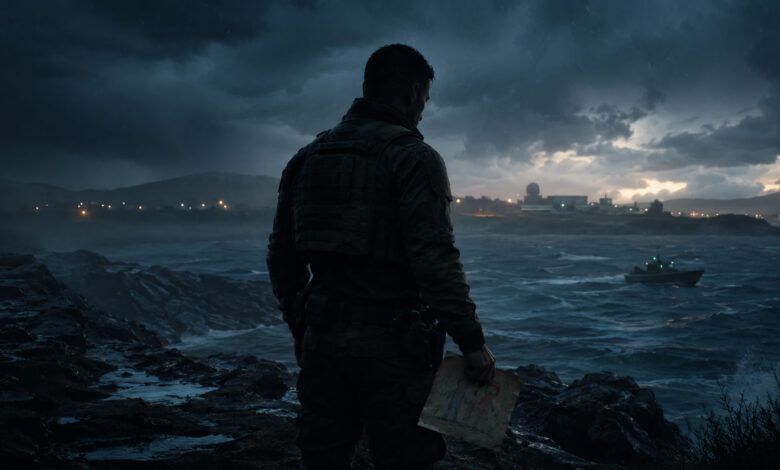
Byte-Sized Overview
A Navy SEAL returns from a disastrous mission with a dead platoon, unreliable memories and the growing suspicion that somebody has turned his life into a cover-up.
The Terminal List follows Lieutenant Commander James Reece as he investigates the ambush that destroyed Alpha Platoon. What begins as a military conspiracy thriller soon becomes a revenge campaign conducted by a man with elite training, very little left to lose and a handwritten collection of names that nobody wants to join.
It is grim, methodical and built with the confidence of a programme that knows exactly how much tactical equipment can fit inside one episode. Chris Pratt leaves most of his lighter screen persona at home and delivers a performance powered by grief, discipline and the sort of controlled fury that suggests every household object has already been assessed for possible operational use.
The Terminal List Transmission Details
- Show: The Terminal List
- Years Active: 2022–present
- Episodes: 8 episodes released in season one; an eight-episode second season premieres on 21 October 2026
- Where to Watch:
- US: Prime Video
- UK: Prime Video
- Creator and Showrunner: David DiGilio
- Based On: The James Reece novels by former Navy SEAL Jack Carr
- Main Cast: Chris Pratt, Constance Wu, Taylor Kitsch, Jeanne Tripplehorn, Riley Keough, Arlo Mertz, J. D. Pardo, Jai Courtney, Tyner Rushing and LaMonica Garrett
- Returning Season Two Cast: Chris Pratt, Constance Wu, Tom Hopper, Dar Salim and Luke Hemsworth, joined by an expanded international ensemble
- Related Series: The Terminal List: Dark Wolf, a seven-episode prequel centred on Ben Edwards
- Sub-Genre Tags: Military Thriller, Conspiracy Thriller, Revenge Drama, Psychological Action, Espionage and Special Operations
The Terminal List Signal Strength (aka: Is It Worth Your Binge?)
Yes, particularly if your preferred television hero responds to institutional corruption by opening a waterproof equipment case and checking the wind direction.
The Terminal List is not interested in being a cheerful action adventure. It begins with catastrophic loss and becomes steadily darker as Reece discovers that the official account of Alpha Platoon’s final mission does not match his memory. Unfortunately, his memory is also behaving like an unreliable witness with a head injury and a very evasive solicitor.
That uncertainty gives the early episodes their strongest tension. Reece cannot initially tell whether he has uncovered a conspiracy or whether trauma and neurological damage are causing him to construct one. People around him question his recollections. Evidence disappears. A surviving teammate dies in circumstances that do not make sense. Even Reece has moments when he cannot entirely trust Reece, which is inconvenient when he is also the man carrying the weapons.
Once the truth becomes clearer, the programme changes shape. The paranoid mystery becomes a revenge thriller, and the narrative starts moving through Reece’s list with the deliberate rhythm of a field manual. Surveillance is performed, routes are studied and targets discover that security contractors are less reassuring when the person approaching them helped train half the profession.
The action is heavy without becoming incomprehensible. Weapons have weight, tactical decisions have purpose and firefights are staged around position, movement and limited information. The military experience behind the production is visible in the way operators communicate and work together. Nobody pauses in a doorway to explain their emotional journey while rounds are incoming, which is considerate.
Its seriousness will not suit everyone. The colour palette appears to have been approved by a committee consisting entirely of storm clouds, while several episodes move at the pace of a careful reconnaissance patrol. Characters discuss loyalty, sacrifice and service with such solemnity that even the boats look emotionally burdened.
Yet the commitment is also the point. The Terminal List never treats Reece’s grief as a decorative excuse for action. His family remains present through memories, hallucinations and the drawing on which he writes his list. Every act of revenge brings him closer to the truth while taking him further from the man his wife and daughter knew.
The result is part military conspiracy, part psychological thriller and part extremely well-equipped tragedy. It is not subtle, but subtlety would probably be stopped at the perimeter and asked to show identification.
Vibe Check
- Tone: Grieving, suspicious and permanently five minutes away from controlled demolition
- Visuals: Naval facilities, California coastlines, secure corporate offices, woodland hideouts and enough tactical equipment to alarm a small government
- Bingeability: High, especially once Reece’s investigation becomes a full pursuit
- Action Level: Heavy, grounded and unusually interested in preparation
- Psychological Pressure: Severe; memories arrive without warning and rarely improve the afternoon
- Conspiracy Scale: Begins with one failed mission and expands until senior officials require secure legal advice
- Humour Level: Limited, although Ben occasionally remembers that friendship existed before betrayal and body armour
- Family Work-Life Balance: No longer recoverable
- Operational Security: Excellent until somebody trusts the government
Spoiler Mode: Plot Brief for Pub Chat
Lieutenant Commander James Reece leads Alpha Platoon, SEAL Team Seven, into Syria on a mission to capture or kill chemical-weapons specialist Dr Jahaan Kahani. Intelligence places Kahani beneath a laboratory complex, but the operation is an ambush. Communications fail, an explosive detonates inside the tunnel and Reece’s men are trapped under intense fire.
Reece and Ernest “Boozer” Vickers survive the immediate disaster, but the official debrief produces a problem. Reece remembers events differently from the helmet-camera footage. Details move around in his head. He experiences headaches, confusion and vivid interruptions from earlier moments with his wife, Lauren, and their daughter, Lucy.
Back in California, Reece is told that Boozer has killed himself. Reece is certain he saw and spoke to him after the mission, but the evidence says otherwise. His commanders treat the contradiction as trauma. Reece starts to wonder whether they are right, although he approaches this possibility with the calm restraint of a man quietly checking every lock in the house.
War correspondent Katie Buranek is already investigating irregularities surrounding the mission. Reece initially distrusts her, partly because she is a journalist and partly because distrust has become his most reliable survival skill. Their interests align when Reece attends a late-night medical appointment and is attacked before his scan can be completed.
He escapes and returns home to find Lauren and Lucy murdered. The killing is made to resemble the work of a traumatised veteran, but Reece knows the scene has been arranged. His grief becomes the force driving everything that follows. He begins writing names on the reverse of one of Lucy’s drawings: his terminal list.
Katie’s investigation leads towards Nubellum Pharmaceuticals and its parent company, Capstone Industries. Capstone’s chief executive, Steve Horn, has built an empire around military contracts, private security and the assumption that sufficient wealth can convert criminal liability into a difficult public-relations week.
The central secret is RD-4895, an experimental drug intended to prevent or reduce post-traumatic stress. Members of Alpha Platoon were given the drug without informed consent. Rather than protecting them, it caused brain tumours. Reece’s memory problems are not imagined, and medical evidence suggests his dead teammates suffered the same condition.
Once the tumours were discovered, the people responsible faced a choice between exposing the illegal trial or removing the evidence. They chose the option involving a false mission, compromised intelligence and an ambush designed to kill the platoon in combat.
Reece works through the conspiracy one participant at a time. NCIS agent Josh Holder is exposed as part of the cover-up. Capstone executive Saul Agnon provides another route towards Horn. Lawyer Marcus Boykin connects corporate money to the gunmen responsible for the attack on Reece’s family. Reece watches, verifies and acts, treating revenge with the procedural care other people reserve for tax returns.
The hunt takes him to Mexico, where he pursues the sicario Navajas. This is no anonymous target. Navajas killed Lauren and Lucy, and their confrontation is the point at which Reece’s campaign becomes most brutally personal. There is no attempt at arrest, rehabilitation or a strongly worded complaint.
Back in the United States, FBI agent Tony Layun leads the fugitive task force pursuing Reece. Layun begins with the reasonable belief that a highly trained killer working through a list should probably be stopped. As the evidence develops, however, he recognises that Reece was experimented upon, betrayed and then framed by people using federal authority to protect themselves.
Horn surrounds himself with Talos Tactical contractors, armoured vehicles and the confidence of a man who believes risk can be outsourced. Reece attacks his convoy using an explosively formed penetrator. It is a meticulously prepared operation and a clear demonstration that expensive protection is only useful when the attacker has not spent his adult life learning how to defeat expensive protection.
The conspiracy also reaches Reece’s military chain of command. Commander Bill Cox, Captain Leonard Howard and Rear Admiral Gerald Pillar helped administer or conceal the programme. Reece extracts information from Cox before drowning him in a manner that leaves little ambiguity about the maritime theme. Howard is forced to carry an explosive device into a meeting with Pillar, producing an internal review that concludes rather more suddenly than expected.
At the political level stands Secretary of Defense Lorraine Hartley. She approved RD-4895 because she believed it could protect service personnel from the psychological consequences of war. When the tumours emerged, she chose secrecy over accountability and allowed Alpha Platoon to be sent into the fatal ambush.
Katie confronts Hartley and obtains the admission required to expose her role. Reece assaults Hartley’s compound while the FBI closes in. Before he can complete that part of the list himself, Hartley takes her own life.
It appears the conspiracy has finally been dismantled, but financial evidence reveals one final payment and one final name. Ben Edwards, Reece’s closest friend, former teammate and CIA contact, helped feed the false intelligence that sent Alpha Platoon into the ambush.
Ben insists he believed the men were already condemned by their tumours and would rather die in combat than endure slow neurological collapse. He denies involvement in the murder of Lauren and Lucy and points to the help he gave Reece afterwards as evidence of his regret. The explanation makes the betrayal sadder, not smaller.
On Ben’s boat, the two men share a final moment of understanding. Ben knows what Reece has become and what the list requires. Reece kills him, then looks again at Lucy’s drawing. With every name crossed out, there is nobody left to punish and nobody waiting for him at home.
Reece releases the drawing into the sea and sails towards Mozambique. Season two will pick up his story after the list, with an official pardon and a new mission drawing him into a conspiracy extending from Moscow to Langley. It is due to arrive on 21 October 2026, suggesting that Reece’s attempt at a quiet retirement has lasted exactly as long as expected.
The Terminal List Character Shout-Outs
- James Reece: Navy SEAL commander, devoted family man and a compelling argument against leaving evidence of your conspiracy where he can find it
- Katie Buranek: War correspondent who keeps investigating after the story develops weapons, surveillance and a personal interest in killing her
- Ben Edwards: Reece’s closest friend, CIA operative and proof that brotherhood becomes complicated when covert payments enter the relationship
- Lauren Reece: James’s wife and the moral memory against which he measures the man he is becoming
- Lucy Reece: Reece’s daughter, whose drawing becomes both the physical list and the final remnant of the life taken from him
- Lorraine Hartley: Secretary of Defense who begins with an idealistic objective and arrives at catastrophic decisions through the secure entrance
- Tony Layun: FBI agent capable of pursuing Reece without becoming blind to the larger crime
- Liz Riley: Pilot, former Army aviator and loyal friend who understands that assisting Reece may involve unconventional flight plans
- Steve Horn: Capstone chief executive, military contractor and owner of the dangerous belief that every problem can be handled by another layer of private security
- Bill Cox: SEAL commander whose contribution to troop welfare would not survive an independent inquiry
- Gerald Pillar: Senior officer who confuses protection of the institution with protection of himself
- Josh Holder: NCIS agent who discovers that accepting money from a conspiracy is easier than explaining it to James Reece
The Terminal List Memorable Moments
- The tunnel ambush, where a carefully planned mission collapses into noise, darkness and conflicting memories
- Reece learning that Boozer supposedly died before their final conversation
- The attack during Reece’s attempted medical scan
- Reece returning home and discovering Lauren and Lucy
- Katie confirming that Alpha Platoon’s medical records point towards a shared neurological condition
- Reece stalking Marcus Boykin from a concealed mountain position
- The savage confrontation with Navajas in Mexico
- Reece building and deploying the device used against Horn’s protected convoy
- The mountain pursuit, with Reece using terrain and explosives to frustrate the FBI team
- Cox discovering that Reece has selected a very literal naval method of interrogation
- Howard entering Pillar’s office wearing the final accessory either man expected
- Hartley attempting to justify the drug programme while Katie dismantles the official version
- Layun recognising that catching Reece and understanding Reece are no longer the same task
- Reece discovering Ben’s name at the end of the financial trail
- The final scene on the boat, as Lucy’s drawing is released and Reece sails towards an uncertain future
Performance Highlights
- Chris Pratt: Removes the easy charm associated with many of his roles and replaces it with contained physical tension. His strongest moments are not the firefights but the seconds in which Reece cannot tell whether a memory is real.
- Constance Wu: Gives Katie determination without turning her into a reckless plot-delivery system. She is frightened when appropriate, persistent when necessary and increasingly furious at the machinery surrounding the cover-up.
- Taylor Kitsch: Makes Ben likeable enough for the final revelation to hurt. His relaxed friendship with Reece creates warmth in an otherwise severe drama, then becomes the emotional fuse leading to the finale.
- Jeanne Tripplehorn: Plays Hartley as a person who still believes in the original intention behind her decisions. That conviction makes her more interesting than a simple government villain and considerably more dangerous.
- J. D. Pardo: Prevents Tony Layun from becoming the standard obstructive federal agent. Layun is observant, capable and willing to revise his judgement when the evidence changes.
- Riley Keough: Appears largely through Reece’s fractured recollections, but gives Lauren enough presence to make those memories feel like a life rather than a convenient source of motivation.
- Arlo Mertz: Lucy’s warmth and trust provide the emotional contrast the series needs. The drawing could have been a blunt device; Mertz helps make it genuinely painful.
- Tyner Rushing: Brings toughness and uncomplicated loyalty to Liz Riley, one of the few people able to help Reece without attempting to manage him.
- Jai Courtney: Makes Steve Horn polished, entitled and quietly repellent. He carries himself like a man who has never encountered a consequence that could not be delegated.
Skull Face’s Take
The Terminal List is the television equivalent of a locked equipment case. It is dark, heavy and contains several items that should not be handled without training.
Its greatest success is the way it turns uncertainty into momentum. During the early episodes, Reece’s damaged memory makes every conversation unstable. He is capable enough to identify inconsistencies but impaired enough to question his own conclusions. The audience wants him to be right because the alternative is watching a traumatised man build a murder list from neurological symptoms.
Then the programme confirms the conspiracy and removes most of that ambiguity. From that point, the pleasure becomes procedural. Reece does not stumble into targets while purchasing groceries. He studies routines, acquires equipment, prepares exits and uses each encounter to expose the next layer.
This gives the action unusual credibility, but it can also make the series feel emotionally sealed. Reece is so controlled that the drama occasionally has to break into his memories to remind us what exists beneath the tactical planning. Fortunately, those memories become more than repeated images of an ideal family. They change as his damaged brain recovers details, allowing the programme to connect neurological uncertainty with grief.
The show’s moral position is more complicated than its body count initially suggests. Reece’s targets are responsible for dreadful acts, but revenge does not restore his family or cure his tumour. Layun and Katie both offer possible routes towards law and exposure. Reece chooses something final because the institutions that should provide justice are populated by people on the list.
Not every viewer will accept that choice, and the series occasionally admires Reece’s competence more enthusiastically than it questions his methods. Skull Face has some concerns about any justice system in which the appeals process involves a sniper rifle.
Still, The Terminal List commits completely to its tone. It does not dilute the grief with convenient romance, turn the conspiracy into a colourful comic-book organisation or give Reece a talkative computer expert who can open every database by typing rapidly beside a flashing map.
It is severe, absorbing and exceptionally well prepared. Skull Face approves, although he will be checking every consent form at his next medical appointment.
Why The Terminal List Has Drama/Action Icon Potential
The first season gives The Terminal List a complete revenge narrative while leaving James Reece alive, damaged and available for a much larger world.
That is important because the list itself cannot simply be repeated. Another murdered family and another set of names would turn tragedy into a loyalty scheme. Season two needs to discover who Reece is when revenge is no longer organising his days.
The announced adaptation of True Believer appears designed to do exactly that. Reece is drawn from isolation into a globe-spanning intelligence operation, moving the franchise from domestic conspiracy towards international espionage. The official description takes him from the Indian Ocean through Africa, the Middle East and Europe, with the conspiracy reaching from Moscow to Langley and into his own family history.
The prequel Dark Wolf has already expanded the universe in another direction. By following Ben Edwards from the SEAL teams into CIA Special Operations, it gives additional context to a character whose betrayal drives the original finale. It also introduces figures who can cross into Reece’s future without requiring everybody to have met during the same ominous government briefing.
The franchise has a strong central figure, a large series of source novels and an identifiable approach to action. Its credibility comes from preparation, military detail and characters who behave as though operational decisions carry consequences beyond the scene.
Its challenge will be variation. Reece is compelling when grief, loyalty and judgement pull him in different directions. He is less interesting if every problem confirms that he was right to arrive with explosives. Future seasons will need allies who challenge him, institutions containing both honourable and corrupt people, and missions that cannot be solved by crossing out a name.
If the second season manages that transition, The Terminal List could become one of Prime Video’s defining action franchises alongside Reacher. Reece is quieter, darker and considerably less likely to pause for pie, but there is clearly room on television for more than one extremely large man to become disappointed with organised crime.
Deep Dive Highlights
- The series is based on Jack Carr’s 2018 novel The Terminal List, the first book in his James Reece series
- Carr served as a Navy SEAL before becoming a novelist and remains closely involved with the television adaptation
- David DiGilio created the television series and serves as its showrunner
- Antoine Fuqua directed the first episode and is one of the programme’s executive producers
- Chris Pratt also executive produces through Indivisible Productions
- Military veterans worked across the production as advisers, writers, performers and crew members
- Jared Shaw, who plays Boozer, is a former Navy SEAL and serves as a technical adviser and executive producer
- The first season’s episode titles include The Engram, Encoding, Consolidation, Detachment, Disruption, Transience, Extinction and Reclamation, reflecting its interest in memory and psychological processing
- The entire eight-episode first season premiered on Prime Video on 1 July 2022
- The production used practical tactical detail to distinguish operators by role, movement and communication rather than giving everyone the same generic military behaviour
- Jack Carr appears in a cameo as veteran security contractor Adrian Gordonis
- Critical reaction to the first season was sharply divided, with some reviewers finding it excessively grim while audience response was considerably stronger
- The series reached number one on Prime Video’s internal Top 10 and recorded more than one billion viewing minutes during one of its early weeks on Nielsen’s US streaming chart
- Prime Video renewed The Terminal List for a second season in February 2023
- The Terminal List: Dark Wolf premiered in August 2025 and follows Ben Edwards during his movement from the SEAL teams into CIA Special Operations
- Dark Wolf consists of seven episodes and stars Taylor Kitsch, Chris Pratt and Tom Hopper
- Season two of The Terminal List draws from Carr’s second Reece novel, True Believer, while making changes for the television adaptation
- All eight episodes of season two are scheduled to premiere on Prime Video on 21 October 2026
- Prime Video says the wider Terminal List franchise has accumulated more than 100 million viewers worldwide
- The second season brings back Katie Buranek and expands the story into an international espionage thriller
Legacy & Impact
The Terminal List arrived in 2022 to one of those unusually wide gaps between critical and audience response. Many reviewers objected to its relentless solemnity, slow early pacing and enthusiasm for heavily armed male suffering. Viewers made it one of Prime Video’s most prominent action releases.
Part of that divide comes from the show’s refusal to offer much distance from Reece. It sees the conspiracy largely through his damaged perception, adopts his suspicion and spends considerable time watching competence in detail. For viewers invested in military thrillers, the preparation and procedural accuracy are features. For others, the same material can resemble an exceptionally long equipment inspection conducted during a national emergency.
The show also contributed to Prime Video’s growing identity as a home for muscular, novel-based action dramas. Reacher premiered the same year, but the two programmes approach their heroes differently. Jack Reacher is an outsider by choice, moving lightly through the world despite being built like public infrastructure. James Reece is an insider expelled by betrayal, carrying the full weight of his service, family and injuries.
Dark Wolf demonstrated that the idea could support more than one protagonist and more than one period. Ben’s route into covert intelligence adds tragic context to his later decisions while establishing a broader network of operators and agencies around Reece.
The second season will determine the franchise’s longer-term legacy. It arrives more than four years after the original run, but with a completed prequel, a returning cast and a clear move towards international espionage. Prime Video’s decision to release all eight episodes together suggests confidence that viewers still remember where Reece left the boat.
The first season remains a self-contained revenge story, and that may ultimately be its strongest feature. It begins with a man unable to trust his own memory and ends with every name accounted for. The conspiracy is exposed, but the victory is empty. Reece survives without being restored.
If future seasons preserve that emotional cost while widening the action, The Terminal List can become a durable modern thriller franchise. If not, it will still stand as eight hours of evidence that experimenting on Navy SEALs is a poor decision with an unusually thorough consequences section.
Want to Go Deeper?
- Watch The Terminal List on Prime Video (Clear the evening, check the perimeter and do not accept any experimental medication)
- Read Prime Video’s official guide to The Terminal List season two (Release details, returning cast and confirmation that Reece’s quiet retirement has been cancelled)
- Explore The Terminal List on IMDb (Cast, crew and episode information for anyone keeping a less dangerous list)
- See the critical response on Rotten Tomatoes (Enter the old critics-versus-audience argument wearing appropriate protection)
Recommended TV Products

Watch Law & Order: Special Victims Unit on Prime Video
From the creator of "Law & Order", comes a powerful series chronicling the life and crimes of the Special Victims Unit of the NYPD.
Watch Now
Watch Reacher Season 4 on Prime Video
A chance encounter with a distraught stranger on the Philadelphia subway draws Jack Reacher into a deadly mystery.
Watch Now
Watch Lioness Season 3 on Prime Video
Inspired by a U.S. Military program, three agents embark on a dangerous undercover mission following the 9/11 terrorist attack.
Watch NowAs an Amazon Associate I earn from qualifying purchases.