Byte-Sized Overview
Before CSI: Crime Scene Investigation, television detectives generally caught killers by leaning across interview tables, spotting a guilty twitch and announcing that they had known the truth all along. Then Gil Grissom and the Las Vegas graveyard shift arrived with swabs, tweezers, blue lights and the unnerving confidence of people who could identify your breakfast from a microscopic stain on your cuff. Created by Anthony E. Zuiker and launched in 2000, CSI turned forensic science into primetime spectacle. Every shard of glass became a witness, every carpet fibre had a statement to make and every corpse was one extremely unpleasant puzzle waiting to be reconstructed beneath fluorescent laboratory lights.
The original team is led by William Petersen’s Gil Grissom, an entomologist who understands insects considerably better than office politics. Around him are Catherine Willows, the sharp, streetwise blood-spatter specialist; Warrick Brown, a gifted investigator fighting a gambling problem; compassionate evidence magnet Nick Stokes; intense newcomer Sara Sidle; homicide captain Jim Brass; and DNA technician Greg Sanders, whose hair initially appears to have been processed as evidence from a nightclub explosion. Across fifteen seasons the personnel change, relationships deepen and Las Vegas supplies a statistically alarming number of inventive deaths, but the governing principle remains steady: people lie, evidence does not — although evidence frequently requires several expensive machines and a moody montage before it becomes chatty.
What makes CSI more than a very long demonstration of laboratory equipment is its combination of procedural satisfaction and bruised human drama. The cases are often grisly, occasionally absurd and sometimes genuinely haunting, while the investigators absorb years of loss, obsession and night-shift damage without turning the series into a soap with fingerprint powder. It can be formulaic, and its science moves at the speed required by an American television hour rather than an actual public laboratory, but at its best CSI is beautifully controlled crime drama: cool, macabre, intelligent and enormously bingeable. It did not merely become a hit. It altered the visual language of the police procedural, created a global franchise and persuaded an entire generation that every local crime lab possessed holographic enhancement software and instant DNA results. Real forensic scientists have presumably been apologising ever since.
CSI: Crime Scene Investigation Transmission Details
- Show: CSI: Crime Scene Investigation — commonly shortened to CSI and sometimes called CSI: Las Vegas to distinguish the mothership from its many offspring.
- Years Active: 2000–2015, followed by the feature-length conclusion Immortality in September 2015.
- Seasons: 15.
- Episodes: 337 in the current catalogue, with the two-hour finale counted as two instalments.
- Original US Network: CBS, where the series premiered on 6 October 2000.
- Original UK Broadcaster: Channel 5, beginning with a feature-length launch on 9 June 2001. The programme became one of the channel’s defining imported dramas.
- Where to Watch: Availability changes, because streaming catalogues enjoy moving evidence when nobody is looking.
- US: Paramount+ is the principal subscription home; episodes may also be available to buy through major digital shops.
- UK: At the time of writing, all fifteen seasons are available through Paramount+ and its Amazon and Apple TV channel options. Apple TV Store and Sky Store offer purchase options. Check the service before subscribing, as rights can move faster than a suspect crossing state lines.
- Creator: Anthony E. Zuiker.
- Key Executive Producers: Jerry Bruckheimer, Carol Mendelsohn, Ann Donahue, Anthony E. Zuiker, Jonathan Littman, William Petersen, Naren Shankar and Kenneth Fink were among the major creative and producing figures across the run.
- Main Cast: William Petersen, Marg Helgenberger, Gary Dourdan, George Eads, Jorja Fox, Paul Guilfoyle, Eric Szmanda and Robert David Hall.
- Later Main Cast: Wallace Langham, Louise Lombard, Lauren Lee Smith, Laurence Fishburne, Ted Danson, Elisabeth Shue, Elisabeth Harnois, David Berman, Liz Vassey and Jon Wellner.
- Theme Music: “Who Are You” by The Who, a title question shouted with considerably more confidence than most suspects can manage.
- Related Series: CSI: Miami, CSI: NY, CSI: Cyber and continuation series CSI: Vegas, plus crossover links with Without a Trace.
- Sub-Genre Tags: Forensic procedural, crime drama, police investigation, serial killers, workplace ensemble, Las Vegas noir and inadvisable things discovered beneath ultraviolet light.
CSI: Crime Scene Investigation Signal Strength (aka: Is It Worth Your Binge?)
Yes — particularly if you enjoy case-of-the-week television with enough continuing character material to reward watching in order. Early CSI is remarkably assured. The crimes are strange, the night-time Las Vegas atmosphere is distinctive and the team already feels like a functioning workplace rather than a group of actors waiting for their designated emotional subplot. The mysteries generally play fair enough to be satisfying, even when the science has been compressed, polished and sent through a machine that definitely did not exist in the average municipal laboratory in 2002.
The strongest stretch runs through the Petersen-led years, when Grissom’s quiet authority, Catherine’s worldly judgement and the original team’s chemistry give even routine investigations an extra charge. Seasons four to seven contain several of the show’s most ambitious hours, including the Quentin Tarantino-directed Grave Danger and the long Miniature Killer story. Later cast transitions inevitably alter the frequency. Laurence Fishburne’s Raymond Langston era becomes darker and more serialised, while Ted Danson’s D.B. Russell brings warmth and a looser, more openly paternal energy. Neither is Grissom, but the programme wisely avoids pretending otherwise.
There are 337 instalments, so a complete binge is less a weekend plan than a tenancy agreement. The procedural structure means selective viewing works perfectly well, but the emotional impact of Warrick’s death, Sara and Grissom’s complicated relationship, Catherine’s departures and returns, and the finale all improves with investment. Expect occasional repetition, plenty of implausibly photogenic laboratories and more murders per square mile than the Las Vegas tourism board would prefer. Even so, the show’s craft, cast and atmosphere hold up. If modern forensic dramas are your thing, this is not homework; it is the unusually stylish crime scene where much of their DNA was deposited.
Vibe Check
- Tone: Cool, clinical and macabre, with sudden bursts of compassion and the occasional gloriously peculiar corpse.
- Visuals: Neon noir, deep shadows, amber desert light, microscopic journeys through wounds and enough blue illumination to make every laboratory resemble an aquarium for solemn adults.
- Bingeability: Extremely high, provided you can resist saying “one more case” at 1.30 a.m. while the opening drums begin again.
- Forensic Detail: Lavish and entertaining, though laboratory turnaround times belong to the fantasy section.
- Action Level: Usually measured rather than explosive, with kidnappings, pursuits and serial-killer confrontations arriving when the evidence bags can no longer contain matters.
- Serial-Killer Pressure: Substantial. Las Vegas apparently offers loyalty points for elaborate murder tableaux.
- Humour Level: Dry, character-based and frequently supplied by Greg, Hodges or Grissom treating a bizarre fact as perfectly ordinary.
- Workplace Safety: Catastrophic. Explosions, shootings, abductions, live burials and emotional devastation suggest the night shift’s risk assessment was stored in the same cupboard as the jetpacks.
- Evidence Integrity: Sacred in principle, repeatedly endangered in practice and always accompanied by a pair of latex gloves snapped on with theatrical purpose.
Spoiler Mode: Plot Brief for Pub Chat
From this point onward, the evidence locker is open and every major spoiler is wandering about unsupervised.
The pilot introduces the Las Vegas crime lab’s graveyard shift under Jim Brass, with veteran investigator Gil Grissom already functioning as its intellectual centre. A staged suicide, a home invasion and a drug-and-rob case establish the series’ method: reconstruct what physically happened, ignore the convenient story and allow apparently insignificant matter to ruin a murderer’s evening. Rookie Holly Gribbs is placed with Warrick Brown, but Warrick leaves her alone at a scene after being pressured into making a casino bet. Holly is shot and later dies. Brass is moved back to homicide, Grissom becomes supervisor and Sara Sidle arrives from San Francisco at his request to investigate the failure surrounding Holly. It is a briskly brutal beginning, and it places responsibility — not merely clever deduction — at the centre of the team.
Grissom leads through knowledge, patience and the unnerving ability to produce an entomological quotation while everyone else is trying to eat. He is fascinated by organisms, patterns and objective fact, but people are more difficult. His inherited otosclerosis gradually damages his hearing, a private fear he attempts to conceal until surgery restores it. His closest emotional connection is Sara, a former pupil and colleague whose feelings for him are obvious long before he permits himself to acknowledge his own. Their relationship develops in fragments rather than conventional romantic scenes: professional concern, jealousy, coded conversations and the season-six revelation that Sara is already in his bedroom. They eventually marry, separate under the pressure of distance and Grissom’s restless search for purpose, and remain emotionally tethered even when geography suggests otherwise.
Catherine Willows is the human counterweight to Grissom’s abstraction. Raised in Las Vegas, formerly an exotic dancer and now a blood-spatter specialist, she combines scientific skill with an instinct for the compromises people make. She raises her daughter Lindsey while working nights and navigating a difficult bond with casino owner Sam Braun, eventually revealed as her biological father. Sam’s world repeatedly puts Catherine in danger, and his death in her arms strips away one of the show’s more complicated parental relationships. Catherine rises to supervisory authority, survives attacks and professional setbacks, then accepts a role with the FBI after a violent case makes clear that Las Vegas has taken a generous quantity of blood in lieu of rent.
Warrick Brown’s arc is the programme’s clearest tragedy. He is a talented local investigator who knows the city beyond its casinos, but a gambling addiction nearly destroys his career and contributes to Holly’s death. Grissom offers discipline and another chance, and Warrick becomes one of the team’s strongest investigators. He marries Tina, later becomes a father and slowly builds the stability he lacked. Then corrupt Undersheriff Jeffrey McKeen frames him for murder. Warrick is cleared, only for McKeen to shoot him in his car as he prepares to celebrate with the team. The season-nine opener, For Warrick, has Grissom find him dying. The case is solved, McKeen is caught and the funeral gives everyone formal permission to break our hearts. Warrick’s loss fractures the old order and accelerates Grissom’s recognition that he can no longer continue as before.
Nick Stokes is often the team’s emotional first responder: technically capable, instinctively kind and more likely than Grissom to see the frightened human being attached to the evidence. That openness makes Grave Danger especially cruel. Nick is abducted, sealed inside a transparent coffin and buried underground while a camera transmits his dwindling air supply to the lab. The box is rigged with explosives and invaded by fire ants, because Quentin Tarantino was apparently concerned that burial alive lacked seasoning. The team finds and rescues him, but the experience never fully disappears. Nick later becomes a steady senior presence and ultimately leaves Las Vegas for a leadership post at the San Diego crime lab — a satisfying conclusion for the man who spent years proving that empathy and competence are not opposing disciplines.
Sara Sidle arrives as an outsider but becomes essential. Her intensity is rooted partly in childhood trauma: her mother killed her abusive father, leaving Sara to grow up in foster care. That history explains both her fierce response to domestic violence and her tendency to treat emotional retreat as a survival skill. The Miniature Killer storyline pushes her to breaking point. Natalie Davis creates exact scale models of future crime scenes, placing tiny clues before each murder. After Grissom identifies her, Natalie kidnaps Sara and leaves her trapped beneath a wrecked car in the desert. Sara frees herself and survives, but the accumulated trauma of the job leads her to leave the lab. She later returns, marries Grissom and eventually becomes director, yet the old conflict remains: she is excellent at the work precisely because she feels it so deeply, and the work punishes her for feeling it.
Greg Sanders begins as the flamboyant DNA technician with loud shirts, louder music and an apparently experimental relationship with hair products. A laboratory explosion in Play with Fire seriously injures him and reinforces that even the people behind the glass are not safe. Greg gradually retrains for field work, trading some comic relief for genuine investigative maturity without losing his curiosity. In Fannysmackin’, he intervenes when a gang attacks a tourist and kills one assailant while saving the victim. The inquiry and subsequent civil action force him to defend a split-second decision that evidence alone cannot make emotionally painless. By the later seasons, Greg is one of the lab’s veterans — proof that character development can occur even if your initial job description is “man who dances near DNA samples”.
The series builds longer threats around the weekly cases. Serial killer Paul Millander taunts Grissom with staged suicides before his identity and personal connection to the investigator emerge. The Blue Paint Killer hunts women while leaving a peculiar chemical trail. The Miniature Killer turns domestic rooms into exquisitely detailed warnings. Dr Raymond Langston’s nemesis Nate Haskell evolves from imprisoned killer to an intensely personal danger, murdering his way across the country and targeting Langston’s former wife Gloria. Langston eventually kills Haskell during a confrontation, a choice followed by scrutiny over whether the death was necessary. The case closes, but so does Langston’s time at the lab.
Grissom departs midway through season nine after Warrick’s death and years of accumulated exhaustion. He solves one final serial-murder case with the help of Dr Raymond Langston, a pathologist and university professor whose class had included one of the killers. Grissom then leaves the lab, travels to Costa Rica and finds Sara working with a conservation team. Their reunion is almost defiantly simple: after years of emotional subtext, he walks through the jungle and kisses her. Langston joins the CSIs, bringing intellectual authority but much less field experience. His three-season tenure is more openly haunted and confrontational, particularly through the Haskell arc. Laurence Fishburne gives the series weight, although the show sometimes mistakes inflicting misery upon Langston for deepening him.
After Langston leaves, D.B. Russell arrives from Seattle to run the night shift. Ted Danson changes the temperature immediately. Russell is eccentric and cerebral like Grissom, but warmer, more conversational and surrounded by a family life that the series is quite willing to endanger. Julie “Finn” Finlay, a blood-pattern specialist with a messy professional history with Russell, joins soon afterwards. Morgan Brody, daughter of Conrad Ecklie, moves from Los Angeles into the team; lab technician Henry Andrews gains prominence; Hodges continues being brilliant, insecure and magnificently irritating; and medical examiner Al Robbins remains the calmest man ever to conduct an autopsy while making a sandwich seem like the risky activity.
Catherine returns for the 300th episode, Frame by Frame, which revisits a fourteen-year-old cold case and allows the programme to look back without turning into a clip show wearing a lab coat. Nick leaves late in season fifteen. Brass has already retired from the police after years in which his estranged daughter Ellie supplied more pain than any suspect could manage. Finn is attacked by the Gig Harbor Killer and left comatose; the finale later indicates that she has died. By this stage the original ensemble has changed almost completely, but the institution — the lab, its methods and the idea of evidence as a moral obligation — has become the true continuing character.
The feature-length finale Immortality reunites the foundational players. A suicide bomber attacks the Eclipse casino, now owned by Catherine, and the investigation leads towards Lady Heather, the dominatrix and psychologist whose complicated bond with Grissom has run through the series. Grissom returns from marine conservation work; Catherine and Brass come back; Sara is directing the laboratory; and Russell prepares to leave for a position in Washington, D.C. The case exposes grief, manipulation and a bomber seeking meaning through destruction. It also forces Sara to confront the fact that Grissom’s relationship with danger, isolation and Lady Heather continues to pull at the edges of their marriage.
Catherine ultimately takes command of the lab. Russell departs, later surfacing in CSI: Cyber. Sara resigns, finds Grissom aboard his boat and chooses the relationship rather than another shift beneath the neon. They sail away together, offering an unusually hopeful ending for two people who have spent fifteen years studying what human beings do to one another. The conclusion is not perfect — Finn’s fate is handled with dispiriting haste, and Nick’s absence is conspicuous — but it understands the original show. The evidence matters, the work continues and Grissom and Sara finally stop allowing the job to be the only thing capable of finding them.
CSI: Crime Scene Investigation Character Shout-Outs
- Gil Grissom: A forensic entomologist, reluctant manager and world-class deployer of unsettling facts. He trusts evidence because evidence never asks him to discuss his feelings.
- Catherine Willows: Streetwise, ambitious and emotionally perceptive, with the authority to run a laboratory or silence a casino floor using one raised eyebrow.
- Warrick Brown: Gifted, flawed and deeply rooted in Las Vegas. His fight to become better gives the original team much of its heart.
- Nick Stokes: The compassionate investigator whose decency survives every horror the writers place in his evidence tray.
- Sara Sidle: Brilliant, intense and permanently incapable of treating suffering as routine. It is both her greatest strength and the wound the job keeps reopening.
- Jim Brass: A dry, durable homicide captain who handles suspects, bureaucracy and the CSIs’ occasional field enthusiasm with equal scepticism.
- Greg Sanders: From energetic DNA analyst to respected field investigator, Greg supplies humour without becoming a joke.
- Dr Al Robbins: Chief medical examiner, musician and reassuring professional presence, even when the conversation partner is on a steel table.
- David Hodges: An exceptionally capable lab technician powered by insecurity, sarcasm and the belief that every room would benefit from more David Hodges.
- Raymond Langston: A thoughtful physician and professor pulled into field investigation, then dragged into an increasingly personal duel with Nate Haskell.
- D.B. Russell: A warm, unconventional supervisor whose relaxed manner conceals an extremely quick forensic mind.
- Julie Finlay: A fearless blood-spatter expert with difficult history, chaotic charm and a finale fate she deserved considerably more time to process.
- Morgan Brody: Intelligent, determined and unwilling to let being Ecklie’s daughter become either a shortcut or a sentence.
- Lady Heather: Dominatrix, psychologist and one of the few people capable of reading Grissom without laboratory equipment.
- Conrad Ecklie: Bureaucratic obstacle turned layered administrator and father; early-series viewers may require protective eyewear when witnessing his eventual humanity.
CSI: Crime Scene Investigation Memorable Moments
- Holly Gribbs’ shooting establishes immediately that errors have consequences and the lab is no safe television clubhouse.
- Grissom silently conducting an orchestra in Sounds of Silence, one of the early glimpses beneath his clinical reserve.
- The laboratory explosion in Play with Fire, which injures Greg and makes the allegedly controlled environment feel suddenly fragile.
- Butterflied, where a victim resembling Sara forces Grissom to articulate the life his emotional caution may cost him.
- Nick waking inside the coffin in Grave Danger, seeing the camera above him and realising that his terror has an audience.
- The team’s frantic rescue of Nick as explosives turn careful excavation into the worst possible practical exam.
- The Miniature Killer’s immaculate models, which transform cosy domestic rooms into advance notices of death.
- Sara crawling from beneath the car in Dead Doll and crossing the desert using ingenuity, fury and absolutely no assistance from workplace health and safety.
- Greg’s beating and split-second act of self-defence in Fannysmackin’, followed by the painful discovery that doing the right thing does not end the consequences.
- Warrick collapsing in Grissom’s arms in For Warrick, a scene performed without the emotional armour the series usually keeps buttoned.
- Grissom walking through the Costa Rican jungle to find Sara at the end of One to Go.
- The three-series “CSI Trilogy”, which moves one trafficking investigation through Miami, New York and Las Vegas with Raymond Langston as the connecting investigator.
- Catherine’s return for Frame by Frame, the 300th episode and a thoughtful reunion with the programme’s own past.
- The old guard re-entering the lab in Immortality, proving that some television chemistry survives cast departures, cancellations and a truly indecent quantity of formaldehyde.
- Sara joining Grissom on his boat in the final scene — less a forensic breakthrough than two emotionally stubborn people finally accepting the obvious result.
Performance Highlights
- William Petersen: Makes stillness compelling. His Grissom can dominate a room through concentration rather than volume, then reveal loneliness with a glance that barely changes.
- Marg Helgenberger: Gives Catherine toughness, humour and vulnerable intelligence. She makes the character’s improbable biography feel like one coherent, formidable life.
- Gary Dourdan: Brings charisma and underlying volatility to Warrick, ensuring that the character’s addiction, recovery and loss never reduce him to a cautionary subplot.
- George Eads: Grounds Nick in empathy and quiet masculinity. Grave Danger asks him to carry an enormous emotional burden in a tiny box, and he delivers one of the series’ defining performances.
- Jorja Fox: Plays Sara’s intelligence as urgent rather than decorative. Her best work lets anger, compassion and old trauma coexist without announcing which one is driving.
- Paul Guilfoyle: Turns Brass’s dry procedural dialogue into character. A tiny pause can convey that he has heard every bad excuse in Nevada and resents being given another.
- Eric Szmanda: Handles Greg’s evolution beautifully, preserving the early spark while making his later authority entirely credible.
- Robert David Hall: Provides warmth, dignity and wit as Robbins. His real-life experience as a double amputee adds no sentimental display; the character is simply an excellent doctor who happens to use prosthetic legs.
- Wallace Langham: Makes Hodges irritating in highly specific, frequently hilarious ways, then finds surprising emotional depth beneath the self-regard.
- Laurence Fishburne: Gives Langston intellectual gravity and contained menace, particularly when the Haskell story pushes the character beyond the limits of professional detachment.
- Ted Danson: Revitalises the late series by refusing to imitate Petersen. Russell is playful, humane and authoritative, with a conversational lightness that makes darker moments land harder.
- Elisabeth Shue: Brings brisk energy and damaged confidence to Finn, creating a lived-in partnership with Danson almost immediately.
- Melinda Clarke: Makes Lady Heather far more than a provocative guest character. Her calm perception and controlled sorrow allow her scenes with Grissom to feel like psychological fencing.
Skull Face’s Take
The first surprise on revisiting CSI is how little it resembles the lazy parody that followed its success. Yes, there are glowing fluids, computer matches and internal-camera journeys through the human body. Yes, an investigator will occasionally identify a microscopic residue while the machine beside them appears to be launching a satellite. Yet the early series is patient, chilly and willing to leave discomfort unresolved. Grissom does not kick doors in or deliver speeches about justice. He observes, asks an odd question about larvae and waits for a liar to discover that chemistry has no respect for a convincing alibi.
Its greatest asset is the original ensemble. Petersen, Helgenberger, Dourdan, Eads, Fox, Guilfoyle, Szmanda and Hall create the sense of colleagues who know one another’s rhythms, weaknesses and preferred methods of avoiding the vending machine. The relationships are rarely over-explained. Catherine and Grissom can disagree without the show manufacturing a betrayal; Nick and Warrick can compete while remaining friends; Sara’s feelings for Grissom can sit inside a case rather than replacing it. When that group begins to fragment, the loss is real because the workplace has been built through hundreds of small exchanges.
The programme is not scientifically infallible, socially ageless or uniformly brilliant. Its laboratories are more glamorous than some boutique hotels. Its CSIs perform tasks that real departments would divide among multiple specialists. Some episodes treat sexual subcultures as a cabinet of exotic curiosities, and a few twists have not travelled gracefully beyond their original broadcast year. Later seasons repeat certain serial-killer rhythms and occasionally confuse darkness with depth. At 337 episodes, there are also enough mediocre ones to constitute another network’s respectable five-season run.
But the hit rate is impressive. CSI can move from black comedy to grief without losing its procedural structure, and its best episodes use forensic method as a way of thinking about people. Physical traces survive denial, shame, money and power. The dead cannot speak, but they have left information everywhere. That premise gives the show a moral clarity stronger than any laboratory gadget. Add the neon-soaked visual design, an instantly recognisable theme, a cast that could sell both technobabble and silence, and several genuinely superb event episodes, and the verdict is straightforward: bag it, label it and place it near the top of the evidence-based binge pile.
Why CSI: Crime Scene Investigation Has Drama/Action Icon Potential
An iconic drama changes what audiences expect from everything arriving after it. CSI did that almost immediately. It made the scientific process — collecting, comparing, testing and reconstructing — into action. The heroes did not need to be the fastest guns or loudest interrogators because a partial print could become a pursuit and a strand of fibre could function as a confession. Its famous “CSI shots” carried the camera inside wounds and objects, turning invisible cause and effect into vivid mini-spectacles. Afterward, countless procedurals adopted brighter laboratories, specialist teams, accelerated analysis and montages in which a machine performed several months of public-sector work before the second advert break.
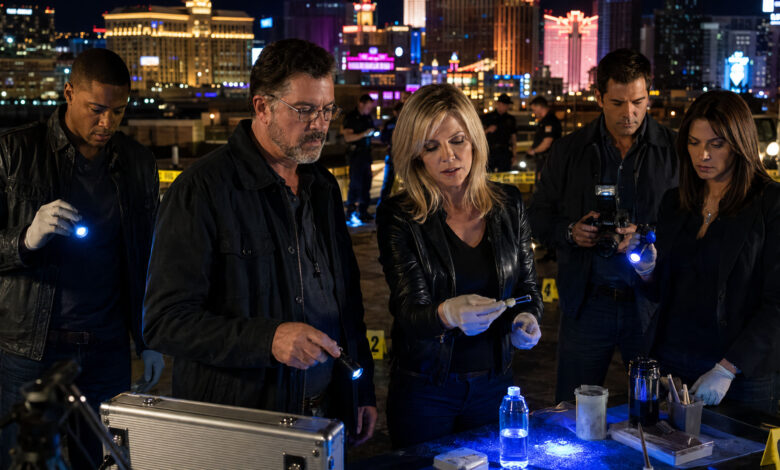
The central silhouette is equally strong: investigators crossing a dark crime scene with torches, metal cases and blue gloves while Las Vegas burns in neon behind them. Grissom’s stillness, Catherine’s confidence, Nick’s coffin, the Miniature Killer’s models and the opening cry of “Who Are You” are not merely remembered plot components; they are television iconography. The franchise spread to Miami, New York and cybercrime, crossed into other CBS dramas, produced games, novels and exhibitions, and eventually returned through CSI: Vegas. A procedural capable of making a cotton swab look dramatic has understood the assignment at a molecular level.
Its influence also escaped fiction. The phrase “CSI effect” entered legal and academic discussion as lawyers, researchers and forensic professionals debated whether television raised jurors’ expectations for scientific evidence. The effect is more complicated than the popular claim that juries simply demand DNA in every case, but the debate itself proves the programme’s reach. CSI did not invent forensic science, obviously — skulls had been making poor lifestyle choices for centuries — but it made the discipline culturally visible on an extraordinary scale. Few dramas can claim to have shaped television grammar, degree-course interest, courtroom conversation and the public image of an entire profession.
Deep Dive Highlights
- Creator Anthony E. Zuiker developed the original concept around the largely unseen work of crime-scene investigators; Jerry Bruckheimer’s production company helped turn it into a glossy network series.
- CBS premiered the programme on Friday, 6 October 2000. It later moved to Thursday nights, where it became one of American television’s dominant programmes.
- Paramount+ currently catalogues 337 episodes. The total treats the two-hour finale Immortality as two production instalments, which explains why some older counts appear lower.
- Channel 5 launched CSI in the UK with a feature-length presentation on 9 June 2001. Its success helped make imported US crime drama central to the channel’s identity.
- “Who Are You”, written by Pete Townshend and performed by The Who, became the theme. The spin-offs continued the family habit with other songs by the band.
- Roger Daltrey guest-starred in the 150th episode, Living Legend, which naturally found room for several Who-related references.
- The show’s signature internal visualisations — commonly called “CSI shots” — dramatised bullets, blades, chemicals and bodily processes in close-up, making scientific explanation a visual event rather than a lecture beside a whiteboard.
- Although set in Las Vegas, much of the series was filmed in California, with periodic Nevada location work maintaining the neon-and-desert identity.
- Quentin Tarantino, an admirer of the show, directed the two-part season-five finale Grave Danger and received story credit. It remains the episode most likely to make viewers inspect the ventilation arrangements before entering a box.
- William Friedkin, director of The French Connection and The Exorcist, directed the episodes Cockroaches and Mascara. The latter was the show’s 200th instalment.
- Frame by Frame, the 300th episode, brought Marg Helgenberger back as Catherine and used a cold case to revisit the team’s earlier years.
- The series received 39 Primetime Emmy nominations and won six, including recognition for cinematography, sound and visual effects — the technical departments receiving evidence that their work had been noticed.
- During its peak, CSI ranked among the most-watched programmes in the United States and repeatedly received international audience recognition at the Monte-Carlo Television Festival.
- Its success produced CSI: Miami in 2002, CSI: NY in 2004 and CSI: Cyber in 2015. The franchise later returned with CSI: Vegas in 2021.
- The “CSI effect” became shorthand for the possibility that forensic television influences juror expectations. Research suggests viewers may expect more scientific evidence, although the relationship between viewing habits and verdicts is not the simple acquittal machine of popular legend.
- The series influenced interest in forensic education as well as perceptions of the profession. A 2025 UK study reported that 71.5% of surveyed forensic science and related students said popular forensic television had influenced their choice of study.
- The laboratory speed is dramatic compression, not documentary practice. Real testing can take days, weeks or months, and crime-scene personnel do not normally collect evidence, run every specialist test, interview suspects and perform arrests before breakfast.
- The original series ended with Immortality, written by Zuiker and broadcast on 27 September 2015. William Petersen, Marg Helgenberger and Paul Guilfoyle returned alongside the then-current cast.
- CSI: Vegas continued the universe rather than rebooting it, bringing back Grissom, Sara and Catherine while introducing another generation of investigators.
Legacy & Impact
At its peak, CSI: Crime Scene Investigation was not merely successful television; it was a global habit. The show helped CBS dominate Thursday nights, travelled widely and made a procedural about technical specialists into mass entertainment. Its descendants were not confined to the official franchise. The wave of 2000s dramas built around specialist evidence, brilliant laboratories and visually explained science owes it a visible debt, whether the relevant clue was a bone, a blood cell, a digital trace or a very cross pathologist.
The visual legacy may be even stronger than the ratings. Crime scenes became pools of saturated colour. Evidence collection acquired ritual: gloves, swab, bag, label, meaningful look. Laboratory sequences became music videos for centrifuges. The camera no longer had to remain outside the body when a microscopic journey could explain precisely how a victim died. What once required dialogue could now be shown as a stylised chain of physical events. Later series refined, exaggerated or mocked that language, but CSI placed it in the mainstream.
Its cultural impact is complicated in useful ways. Forensic professionals gained visibility, but viewers also received unrealistic expectations about certainty, speed and the availability of sophisticated testing. Legal scholars and practitioners continue to debate the “CSI effect”, while educators encounter students whose interest in the subject began with fictional crime labs. That mixture of inspiration and distortion is the consequence of making specialist work dramatically legible to millions: the public learns that evidence matters, then wonders why the report is not ready by Thursday.
Most importantly, the series endured beyond its original personnel because its premise was sturdier than any single star. Grissom remains the defining figure and the first ensemble remains the emotional ideal, yet Fishburne and Danson carried genuinely different versions of the show. The finale closed the original story, and CSI: Vegas demonstrated that the world could be reopened without pretending the intervening years had not happened. The mothership’s legacy is therefore both industrial and emotional: a worldwide franchise built from trace evidence, and a collection of characters viewers still want to follow back into the dark whenever somebody switches on a torch.
Want to Go Deeper?
- Watch CSI: Crime Scene Investigation on Paramount+ UK (All those evidence bags will not catalogue themselves.)
- Check current UK streaming options on JustWatch (Useful when rights have quietly left through the service entrance.)
- Explore the show’s Emmy record (Six wins, 39 nominations and not one award for Most Dramatic Use of a Cotton Bud.)
- Read the US National Institute of Justice discussion of the “CSI effect” (The real evidence is more complicated than the pub-chat version. Grissom would approve.)
- Visit the CSI Wiki (A deep evidence locker for episodes, characters and every Las Vegas killer who should have considered a quieter hobby.)
- Continue the story with CSI: Vegas (Because no television crime lab is ever truly closed while a familiar theme song remains available.)
Recommended TV Products
Watch Reacher Season 4 on Prime Video
A chance encounter with a distraught stranger on the Philadelphia subway draws Jack Reacher into a deadly mystery.
Watch Now
Watch Lioness Season 3 on Prime Video
Inspired by a U.S. Military program, three agents embark on a dangerous undercover mission following the 9/11 terrorist attack.
Watch Now
The Terminal List Season 2: Coming Soon
Season Two finds James Reece searching for a new purpose after finishing his list. But when the CIA corners him, Reece must clear his name by stopping a resurgent terrorist group that has turned an ally to their cause. In this globe-trotting espionage thriller, Reece will uncover a conspiracy that reaches from Moscow to Langley, even to his own family's history.
Watch the TrailerAs an Amazon Associate I earn from qualifying purchases.