Byte-Sized Overview
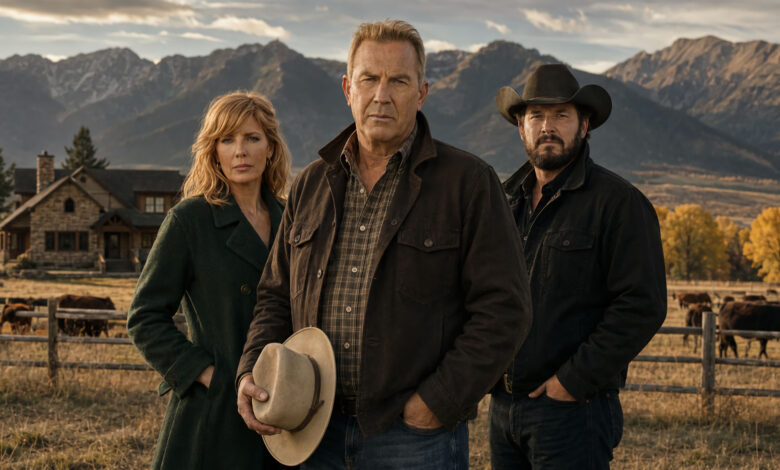
John Dutton owns the largest contiguous cattle ranch in the United States, which sounds impressive until everybody bordering it decides they would prefer the land without him attached.
Set in modern Montana, Yellowstone follows the Dutton family as it fights developers, politicians, the neighbouring Broken Rock Reservation and its own astonishing capacity for internal warfare. John considers the ranch a sacred inheritance that must pass intact to another generation. His children have inherited the obligation rather less evenly. Kayce wants distance, Beth wants her father’s approval, Jamie wants power and Lee has the misfortune to begin the series closest to the cattle.
Kevin Costner gives John the gravity of an old Western patriarch while Taylor Sheridan and John Linson surround him with a much less orderly world. Land disputes become gunfights, livestock officers behave like an auxiliary military unit and ranch hands carrying the Yellowstone brand discover that employment comes with accommodation, loyalty and a retirement scheme largely involving cliffs in Wyoming.
The programme mixes family saga, crime drama, political thriller and luxurious cowboy spectacle. It can be thoughtful about land, inheritance and the disappearance of rural life, then resolve the next disagreement with a rattlesnake in a cool box. Its moral universe is complicated, its body count is ambitious and its scenery could persuade a city dweller to buy boots before asking what happens at 4.30 in the morning.
Five seasons turned Yellowstone from a cable drama into a television empire. The ranch did not survive intact. The franchise certainly did.
Yellowstone Transmission Details
- Show: Yellowstone.
- Years Active: 2018-2024.
- Seasons: 5.
- Episodes: 53.
- Original Broadcaster: Paramount Network, beginning on 20 June 2018 and concluding on 15 December 2024.
- Where to Watch:
- US: All five seasons stream on Peacock. Episodes also appear in Paramount Network repeats and can be purchased through major digital stores. Despite the similar name, the original series does not stream on Paramount+ in the United States.
- UK: Paramount+.
- Creators: Taylor Sheridan and John Linson.
- Primary Writer: Taylor Sheridan, with additional scripts credited during the series to John Linson, Brett Conrad, John Coveny, Ian McCulloch and Eric Beck.
- Key Executive Producers: Taylor Sheridan, John Linson, Art Linson, Kevin Costner, David C. Glasser, Michael Friedman and Christina Alexandra Voros.
- Main Cast: Kevin Costner, Luke Grimes, Kelly Reilly, Wes Bentley, Cole Hauser, Kelsey Asbille and Gil Birmingham.
- Ranch and Family Ensemble: Jefferson White, Forrie J. Smith, Denim Richards, Ian Bohen, Ryan Bingham, Jennifer Landon, Finn Little, Brecken Merrill, Mo Brings Plenty, Wendy Moniz, Kathryn Kelly and Hassie Harrison.
- Major Recurring Cast: Danny Huston, Neal McDonough, Josh Holloway, Will Patton, Jacki Weaver, Piper Perabo, Dawn Olivieri, Q’orianka Kilcher, Josh Lucas, Kylie Rogers and Kyle Red Silverstein.
- Composers: Brian Tyler, with Breton Vivian becoming co-composer for seasons three to five.
- Production Companies: Linson Entertainment, Bosque Ranch Productions, Treehouse Films, 101 Studios and MTV Entertainment Studios during different stages of the run.
- Related Productions: Prequels 1883 and 1923; Kayce continuation Marshals; Beth and Rip continuation Dutton Ranch. Further projects have been discussed or developed, but these four are the released screen extensions directly connected to the Dutton story.
- Sub-Genre Tags: Neo-Western, family drama, crime drama, ranching, political drama, contemporary Western, Montana, land disputes, Native American drama, business drama and television sagas.
Yellowstone Signal Strength (aka: Is It Worth Your Binge?)
Yes, with one practical warning: Yellowstone is not a quiet drama about cattle farming. It is The Godfather wearing a cowboy hat, operating a livestock commission and stopping occasionally so a horse can demonstrate better emotional regulation than the human cast.
The early episodes establish a powerful central conflict. John Dutton regards Yellowstone Ranch as a promise made between generations. Thomas Rainwater, chairman of the Broken Rock Reservation, sees the same land as territory taken from his people. Developer Dan Jenkins sees opportunity. None of them is completely wrong about the land’s value, and none intends to lose politely. The show is most compelling when it lets those competing histories and ambitions remain unresolved.
Kevin Costner provides the original centre. John is commanding, emotionally withholding and capable of tenderness that usually arrives after somebody has endured several years without it. He can seem like the last responsible custodian of an irreplaceable landscape or a criminal patriarch using public office to protect private property. Usually he is both before lunch.
Kelly Reilly and Cole Hauser gradually become the programme’s most reliable emotional engine. Beth Dutton is brilliant, traumatised and verbally equipped to turn a breakfast meeting into a controlled demolition. Rip Wheeler is the ranch foreman John rescued as a boy and shaped into an instrument of absolute loyalty. Their love story succeeds because neither mistakes the other for a project requiring improvement. Considering the material available, this may be the healthiest relationship on the ranch.
Luke Grimes gives Kayce a quieter conflict. A former Navy SEAL married to Monica, a Native American woman from Broken Rock, Kayce stands between the Dutton inheritance and the family he has created. He is capable of the same violence as John and Rip but never accepts it as naturally. His repeated attempts to leave create one of the show’s most important questions: can a person inherit land without inheriting the damage used to preserve it?
Wes Bentley performs the least comfortable role. Jamie is educated, useful and desperate for John’s love. Every effort to gain independence becomes evidence of disloyalty, while every return confirms that he cannot escape. The writing eventually pushes him into choices so weak and destructive that sympathy becomes strenuous work, but Bentley keeps the frightened child visible inside the attorney general.
The bunkhouse adds humour, skill and community. Jimmy begins as a branded offender who can barely sit on a horse and develops into a genuine cowboy. Lloyd carries the ranch’s institutional memory, Teeter introduces a dialect requiring local subtitles and Walker discovers that accepting a job from Rip is easier than resigning from it. Their stories reveal that Yellowstone loyalty offers belonging to people who had very little, while quietly ensuring they become accessories to an impressive number of crimes.
The show improves after its uneven first season, reaches its most confident stretch across seasons two to four and becomes more fractured in season five. The long gap between its two halves and Kevin Costner’s departure forced John Dutton’s final chapter to occur without the actor present. The remaining cast delivers a committed ending, but viewers can feel the machinery adjusting around an absent centre.
Taylor Sheridan’s writing is muscular, quotable and often very funny. It is also fond of speeches in which one character explains the entire decline of the American West while everybody else temporarily forgets how conversation works. Later episodes devote increasing time to horse demonstrations, country music and Sheridan’s own character, Travis Wheatley. Whether this is immersive Western texture or the world’s most expensive showreel depends upon your tolerance for spinning horses and confident men explaining the price of them.
Fifty-three episodes make Yellowstone a substantial binge without approaching old network-procedural territory. Most episodes run close to an hour, with finales stretching considerably longer. The plot is serialised and extremely habit-forming. One episode about conservation easements will somehow end with you immediately beginning another because Beth has entered a room holding car keys and unresolved trauma.
Vibe Check
- Tone: Sweeping, violent and emotionally constipated, with occasional warmth beside a campfire.
- Visuals: Montana valleys, enormous ranch houses, cattle drives, mountain light and boardrooms where Beth is about to invalidate somebody’s career.
- Bingeability: Very high. Every temporary victory creates two enemies and a planning application.
- Western Level: Contemporary rather than nostalgic, although horses, hats and frontier justice remain fully operational.
- Family Harmony: The livestock display stronger herd instincts.
- Action Level: High. Shoot-outs, bombings, assassinations, stampedes and roadside executions accompany the agricultural calendar.
- Romance Level: Passionate, damaged and frequently conducted beside animals that would prefer breakfast.
- Political Detail: Persuasive in atmosphere, flexible in procedure and remarkably efficient whenever a Dutton needs an appointment.
- Humour Level: Dark and regular, especially in the bunkhouse and whenever Beth identifies a social boundary she can cross at speed.
- Employee Retention: Excellent, provided the employee accepts permanent branding and does not enquire about the train station.
Spoiler Mode: Plot Brief for Pub Chat
Major spoilers for all five seasons begin here. Anyone proceeding further has voluntarily entered the train station.
John Dutton III controls Yellowstone Ranch, an enormous Montana property bordered by Yellowstone National Park, the Broken Rock Indian Reservation and land increasingly attractive to developers. He promised his father never to surrender an acre. That vow defines his children before they are old enough to decide whether they want it.
Lee, the eldest, works beside John and appears to be the natural successor. Jamie is the family lawyer and political operator. Beth works in corporate finance and returns when John needs somebody capable of destroying an opponent without leaving the boardroom. Kayce lives on Broken Rock with his wife Monica, their son Tate and Monica’s family, remaining estranged from John after years of conflict.
The opening cattle dispute establishes the cost. Dutton livestock wander onto reservation land, and an armed confrontation develops when John’s livestock agents attempt to recover them. Lee is shot by Monica’s brother Robert Long. Kayce kills Robert, then fatally shoots Lee to end his suffering. The Dutton family loses its presumed heir while Broken Rock loses one of its own, making the ranch conflict immediately personal on both sides.
Thomas Rainwater, the chairman of Broken Rock, intends to reclaim land taken from Native people. He recognises that defeating John directly may be impossible, so he uses law, politics and economic development. Dan Jenkins, a property developer planning a luxury community and resort, wants access and water. John responds through Jamie’s legal work, Beth’s financial attacks and Rip Wheeler’s less documented methods.
Rip is Yellowstone’s foreman and John’s most loyal agent. As a teenager, he killed his abusive father after finding his mother and brother murdered. John concealed Rip’s existence from ordinary systems, gave him work and eventually branded him. Rip gained a home but no legal identity, property or future independent of the ranch. He performs the violence John requires and receives belonging in return.
Beth and Rip share a relationship stretching back to adolescence. Their early love was shattered by trauma. Beth became pregnant and asked Jamie for help obtaining an abortion. Jamie took her to a clinic on the reservation where sterilisation was mandatory, consented to the procedure without telling her and left Beth unable to have children. The revelation explains Beth’s hatred of Jamie and her fear that love with Rip cannot include the family she believes he deserves.
Beth also carries guilt for the death of her mother Evelyn. During a childhood ride, Beth’s fear unsettled her horse and caused the accident that fatally injured Evelyn. Her mother blamed Beth as she died, leaving a wound that John never successfully addresses. Adult Beth converts shame into aggression, attacking first so nobody can reach the original injury.
Kayce’s relationship with John is equally damaged. John once branded him for refusing to pressure Monica into ending her pregnancy. Kayce nevertheless shares his father’s instincts and joins the livestock commission, repeatedly using lethal force while insisting he wants a different life. Monica is injured while breaking up a school fight, and the family moves temporarily to Yellowstone during her recovery. The ranch offers safety and intensifies every existing conflict.
John’s health creates additional urgency. He initially believes he has colon cancer and undergoes surgery, although a later crisis is caused by a ruptured ulcer. Mortality makes the succession question immediate. Lee is dead, Kayce is reluctant, Beth does not want the ranch and Jamie wants recognition John does not trust him to use properly.
Jamie launches a campaign for Montana attorney general with John’s support, then continues after John withdraws it. Feeling abandoned, he gives damaging information about John to reporter Sarah Nguyen. He regrets the interview when he understands the consequences, but Sarah refuses to bury the story. Jamie kills her in panic, and Rip helps stage the death as a kayaking accident. The family lawyer has crossed from protecting crimes into committing one.
Rainwater and Jenkins form an uneasy partnership around a casino and development that could weaken the Dutton ranch. Their plans attract the Beck brothers, Malcolm and Teal, wealthy businessmen who use intimidation and white-supremacist connections to protect their interests. The Becks attack everybody involved. Their men assault Beth in her office, killing her assistant and beating her before Rip arrives. Beth refuses to submit even while expecting death, and Rip tells her he loves her as he carries her from the wreckage.
The Beck brothers later kidnap Tate. The Duttons, Rainwater’s men and law enforcement combine to find him at a compound used by a violent militia. Kayce kills Teal while he sits on a lavatory, extracting the information needed to locate the boy. John shoots Malcolm and leaves him bleeding after the rescue. Tate returns traumatised, his head shaved by his captors, while Dan Jenkins is murdered during the same conflict.
Season three introduces Market Equities, a corporation planning an airport and resort development across Paradise Valley. Executive Roarke Morris and later chief executive Willa Hayes offer the Duttons hundreds of millions for land. John refuses because the promise matters more to him than money capable of securing every descendant’s future.
Rainwater opposes Market Equities for his own reasons and works with Angela Blue Thunder, an uncompromising attorney who argues that Broken Rock should exploit the dispute. Beth fights the company through financial manoeuvres, while Jamie uses his position as attorney general and power of attorney to make choices he considers necessary to preserve some family wealth.
Jamie discovers that he was adopted. His biological father, Garrett Randall, killed Jamie’s mother and served a prison sentence. John explains that he rescued Jamie from that life, but the information deepens Jamie’s belief that his place in the family was conditional. Garrett offers the approval John withheld and quietly encourages his son’s resentment.
The conflict over the ranch expands through old enemies and branded loyalties. Wade Morrow, once connected to Yellowstone, trespasses and attacks ranch operations. John orders the branded men to retrieve what Wade stole. They hang him after cutting the Yellowstone brand from his chest, and Walker is forced to help dispose of the body. The ranch’s traditions are no longer metaphorical.
Season three ends with coordinated attacks upon the Duttons. A bomb explodes in Beth’s office. Gunmen assault Kayce at work. John stops to help a woman with a flat tyre and is shot repeatedly beside the road. Monica and Tate also face an attacker at the ranch. The family survives, but the scale proves that somebody has purchased an organised attempt to eliminate them.
Season four begins with John recovering after months in hospital, Beth scarred by the explosion and Kayce having defended his office. Rip kills Roarke with a rattlesnake, ending one Market Equities threat while the corporation sends Caroline Warner to continue the development fight. Beth accepts a senior role with Market Equities, intending to destroy it from inside.
The investigation leads Jamie to a prison inmate connected to the attack, then to Garrett. Garrett arranged the killings to free Jamie from the Duttons, although Jamie cannot bring himself to expose or kill the father who finally appears to love him. This decision ends any remaining possibility that Beth will see him as merely weak.
Beth discovers the truth and gives Jamie a choice between prison, public destruction and killing Garrett. Jamie shoots his biological father, drives the body to the unmarked Wyoming ravine known as the train station and finds Beth waiting with a camera. Her photograph gives her permanent leverage. Jamie has now killed both a reporter threatening the family and a father threatening it, without ever becoming part of the family he intended to protect.
Beth’s campaign inside Market Equities intersects with environmental activist Summer Higgins. Beth encourages Summer to target a project connected to the company, then uses the resulting protest for corporate sabotage. Summer receives a severe prison sentence. John, who has formed a relationship with her, uses his political influence to reduce the damage. Beth is dismissed, but her attack helps stall development.
Jimmy’s story provides the season’s gentler transformation. After breaking his promise to stop rodeoing and suffering another serious injury, John sends him to the Four Sixes Ranch in Texas. Jimmy learns horsemanship, work and self-respect without the Yellowstone’s constant criminal pressure. He returns with Emily, a veterinary technician and his fiancée, ends his relationship with Mia and earns John’s acknowledgement as a cowboy.
Beth and Rip marry in an improvised ceremony after Beth abducts a priest. John walks his daughter towards Rip, Lloyd serves as best man and the wedding achieves genuine tenderness despite several procedural irregularities. Carter, an orphan Beth has taken in, begins to occupy the family space she believed impossible, although Rip insists affection must arrive through discipline rather than easy promises.
Kayce undertakes a Native vision quest and tells Monica he saw “the end of us”. The meaning remains uncertain, but his struggle is clear. The ranch and his family cannot continue to claim him equally. Monica becomes pregnant again, creating hope after years of violence.
Season five begins with John elected governor of Montana. He does not want the job as a political career; he wants the authority to cancel Market Equities’ airport and resort. On his first day he halts state support for the project, removes officials who might obstruct him and begins using public power to preserve private land. Supporters see defence of Montana. Opponents see an impeachable collection of conflicts.
John appoints Beth as chief of staff and leaves Jamie as attorney general, giving his adopted son legal responsibility without trust. Market Equities sends Sarah Atwood, a corporate strategist who seduces Jamie and directs his resentment towards impeachment. Jamie begins preparing to remove John and position himself as the next governor.
Kayce and Monica suffer devastating loss. While driving herself to hospital during premature labour, Monica swerves to avoid an oncoming vehicle and collides with a buffalo. Their baby, named John, dies. The grief changes Kayce’s priorities and reinforces the choice he saw during his vision quest.
At the ranch, cattle may have been exposed to brucellosis from wild bison. To save the herd, Rip and several cowboys take the animals to leased grazing land in Texas. This separation allows the programme to contrast Montana’s threatened ranching culture with the Four Sixes operation while also positioning characters for potential continuation.
John places Yellowstone land into a conservation easement, making Market Equities’ development substantially harder and reducing its commercial value. Jamie regards the move as financially ruinous. Sarah persuades him that removing John is the only path forward. Beth and Jamie independently begin discussing whether the family would be safer if the other were dead.
Beth learns about the train station and initially believes the site can be used against Jamie, only to discover that it contains generations of bodies connected to Yellowstone. Exposing him would expose John, Rip and the ranch. The family has built its defence upon crimes too interconnected for selective justice.
Production delays and Kevin Costner’s departure create a long break before the final six episodes. When the story returns, John is found dead in the governor’s mansion. The death is staged as suicide. Viewers do not see Costner perform John’s final moments, and the absence gives the event an intentionally cold quality even if the production history remains visible behind it.
Sarah has arranged the contract killing after Jamie discussed removing John. Jamie did not issue a clean direct order, but he understood the possibility and failed to stop it. When he realises the murder has occurred, horror competes with the opportunity it creates. He publicly supports the suicide account while using his office to reverse John’s policies.
Kayce studies the forensic details and proves the death was murder. He traces the operation to professional fixer Grant Horton and terrorises Grant’s family to demonstrate that retaliation will reach the people he loves. Kayce wants the threat ended without beginning another permanent war, revealing a restraint that John and Beth rarely possessed.
The organisation behind the hit kills Sarah to remove a link. Jamie is left politically exposed and emotionally unstable. Beth has no doubt about his responsibility. Whatever distinction exists between requesting a murder and welcoming the person who arranges it has lost practical importance to her.
The ranch cannot survive John’s death in its existing form. Estate taxes, operating costs and development pressure make the inheritance financially impossible. The family auctions livestock, horses and equipment. Travis Wheatley helps sell valuable horses while finding generous amounts of screen time in which to demonstrate that Travis Wheatley is extremely good at selling valuable horses.
John is buried beside generations of Duttons. Beth promises at the coffin that she will avenge him, then goes directly to Jamie’s house. Their final fight is brutal rather than elegant. Jamie nearly kills Beth before Rip arrives. Beth stabs Jamie, and Rip helps take the body to the train station. She constructs a public account in which Jamie fled after involvement in John’s murder, allowing his disappearance to complete both revenge and political blame.
Kayce solves the land problem through surrender. He sells almost the entire Yellowstone to Thomas Rainwater and Broken Rock for $1.25 an acre, approximately the historical price paid when the Dutton ancestors arrived. Rainwater promises the land will never be developed or sold. Kayce retains East Camp for Monica and Tate, choosing a manageable home over an empire.
The transfer fulfils the prophecy delivered in 1883, when Spotted Eagle warned James Dutton that his people would rise up and reclaim the land in seven generations. Broken Rock members dismantle the ranch house and remove symbols of Dutton ownership while preserving the graves. The land remains whole, but the family no longer controls it.
The bunkhouse disperses. Teeter goes to Texas, Ryan seeks a new beginning with singer Abby, Lloyd continues ranch work and the cowboys carry their shared history elsewhere. Beth, Rip and Carter purchase a smaller ranch near Dillon, Montana. Kayce, Monica and Tate remain at East Camp. The family survives by releasing the inheritance that had defined and damaged it.
The original series ends there, but the characters continue. Kayce later joins an elite US Marshals unit in Marshals. Beth, Rip and Carter eventually move into a new South Texas struggle in Dutton Ranch. John spent five seasons believing the land could preserve his family. In the end, the family can move forward only after the land is returned.
Yellowstone Character Shout-Outs
- John Dutton III: Ranch patriarch, livestock commissioner and governor who considers surrendering land a greater moral failure than the crimes committed to retain it.
- Beth Dutton: Financial strategist, devoted daughter and verbal incendiary device whose loyalty to John is matched only by her capacity to identify Jamie’s weakest point.
- Kayce Dutton: Former Navy SEAL, cowboy and reluctant heir, caught between the violence he inherited and the family life he wants to protect.
- Jamie Dutton: Adopted son, attorney and politician whose hunger for John’s approval repeatedly makes him vulnerable to anybody offering an alternative.
- Rip Wheeler: Ranch foreman, branded enforcer and Beth’s husband, capable of extraordinary tenderness and equally extraordinary assistance with body disposal.
- Monica Dutton: Teacher, mother and connection between the Duttons and Broken Rock, unwilling to pretend that loving Kayce erases what the ranch has done.
- Thomas Rainwater: Chairman of the Broken Rock Reservation, strategic opponent and eventual recipient of the land his people lost.
- Mo: Rainwater’s driver, adviser and field operator, whose quiet competence makes almost everybody else seem unnecessarily theatrical.
- Tate Dutton: Kayce and Monica’s son, survivor of kidnapping and inheritor of a future deliberately separated from the Yellowstone empire.
- Jimmy Hurdstram: Branded ranch hand who develops from terrified novice into a capable cowboy through bruises, discipline and several medical invoices.
- Lloyd Pierce: Senior ranch hand, Rip’s mentor and keeper of traditions that become less charming when explained to law enforcement.
- Teeter: Texas-born ranch hand with ferocious loyalty, impressive resilience and an accent that defeats colleagues before opponents.
- Walker: Singer, cowboy and reluctant participant in Yellowstone justice, correctly suspicious that leaving the ranch should not require this much negotiation.
- Carter: Orphan taken in by Beth and Rip, gradually becoming the child and future neither expected to receive.
- Governor Lynelle Perry: Political ally, former lover of John and one of the few officials capable of explaining consequences without being removed from the room.
Yellowstone Memorable Moments
- John euthanising an injured horse beside the road before the wider story has properly begun.
- Lee Dutton and Robert Long dying during the cattle confrontation that starts the family war.
- Rip recruiting Jimmy, applying the Yellowstone brand and introducing employment terms unavailable through ordinary human resources departments.
- John ordering a river diverted with explosives to obstruct Dan Jenkins’ development.
- The first journey to the train station revealing how Yellowstone handles employees who know too much.
- Beth confronting the trauma of her mother’s death and turning vulnerability into another weapon.
- Jamie killing Sarah Nguyen and Rip helping disguise the murder as an accident.
- Beth surviving the Beck brothers’ office assault and Rip arriving to save her.
- Kayce questioning Teal Beck while the man remains seated on a toilet.
- The rescue of Tate from the militia compound.
- Rip telling Beth that he loves her after carrying her from the destroyed office.
- Jamie discovering that Garrett Randall is his biological father.
- Wade Morrow losing both the Yellowstone brand and his life.
- The season-three finale delivering a bomb to Beth, gunmen to Kayce and roadside assassins to John.
- John waking in the road and using his own blood to record a clue upon the ground.
- Rip killing Roarke with a concealed rattlesnake.
- Beth forcing Jamie to kill Garrett and photographing him at the train station.
- Jimmy arriving at the Four Sixes and slowly becoming the cowboy he claimed to be.
- Beth kidnapping a priest and marrying Rip on the ranch.
- Kayce completing his vision quest and returning with a choice he cannot yet explain.
- John taking the oath as governor while openly admitting he does not want the office.
- Monica’s crash and the death of her newborn son.
- Rip taking the Yellowstone herd to Texas after the brucellosis threat.
- Beth learning that Jamie knows where the train station is and has finally located leverage of his own.
- The discovery of John’s body and Kayce’s realisation that the apparent suicide is a murder scene.
- Kayce confronting Grant Horton through the one language the professional killer cannot dismiss.
- Sarah Atwood being eliminated by the organisation she hired.
- The ranch auction turning generations of property into one final gathering.
- Beth promising vengeance beside John’s coffin.
- Beth and Jamie’s final fight, ending with Rip’s intervention and Beth’s knife.
- Kayce selling Yellowstone to Rainwater for $1.25 an acre.
- Broken Rock reclaiming the land and leaving the Dutton graves undisturbed.
- Elsa Dutton’s narration connecting the return of the ranch to the promise made in 1883.
Performance Highlights
- Kevin Costner: Gives John Dutton scale without losing the physical wear of a working rancher. His stillness can suggest authority, fatigue or concealed threat, and the programme depends upon viewers understanding why people follow a man whose love frequently resembles an order.
- Kelly Reilly: Delivers one of television’s most combustible performances. Beth’s dialogue could become pure provocation, but Reilly keeps grief, terror and the need for John’s approval visible beneath every attack.
- Cole Hauser: Turns Rip from a frightening enforcer into the show’s most dependable romantic lead without softening the violence that made him useful. His chemistry with Reilly gives the series its strongest emotional continuity.
- Luke Grimes: Plays Kayce inwardly, providing necessary contrast to the family’s louder personalities. Grimes makes violence feel like a skill Kayce hates possessing rather than a performance he enjoys.
- Wes Bentley: Accepts a punishing character arc and continually finds Jamie’s need beneath his betrayal. Even when the writing asks viewers to abandon him, Bentley shows the fear and humiliation powering the next terrible decision.
- Kelsey Asbille: Gives Monica moral independence inside a narrative frequently determined by Dutton priorities. Her grief after the loss of baby John is among the fifth season’s most grounded work.
- Gil Birmingham: Makes Rainwater controlled, intelligent and patient enough to imagine victory beyond a single generation. The finale succeeds partly because Birmingham has sustained the claim from the opening season.
- Jefferson White: Provides the most visible transformation. Jimmy’s awkwardness, pain and growing competence create a humane coming-of-age story inside the larger family tragedy.
- Forrie J. Smith: Brings genuine cowboy experience to Lloyd and makes the bunkhouse feel inhabited rather than decorated. His face can communicate an entire ranch history while somebody younger is still finding a hat.
- Mo Brings Plenty: Gives Mo authority through economy. He rarely needs the volume other characters require and becomes one of the franchise’s most trusted presences.
- Wendy Moniz: Makes Lynelle both politically credible and emotionally perceptive, sustaining a relationship with John that contains affection without illusion.
- Jennifer Landon: Plays Teeter with enormous comic confidence and later reveals loyalty and grief beneath the accent.
- Will Patton: Makes Garrett Randall warm enough for Jamie’s attachment to feel plausible and cold enough for the Dutton attack to remain credible.
- Dawn Olivieri: Gives Sarah Atwood predatory assurance, turning Jamie’s need for approval into another corporate acquisition.
- Josh Lucas, Kylie Rogers and Kyle Red Silverstein: Make the younger Dutton flashbacks feel like parts of the same damaged people rather than explanatory sketches wearing period hats.
Skull Face’s Take
Yellowstone became enormous because it offers several programmes at once. It is a crime family drama, a Western, a political soap, a workplace series and an extended advertisement for Montana views unavailable within ordinary commuting distance. Viewers can arrive for Kevin Costner, stay for Beth and Rip and discover that they now possess opinions about cutting horses.
The ranch is the perfect dramatic object because every character can assign it a different meaning. To John, it is promise and identity. To Beth, it is the father she wants to protect. To Kayce, it is an inheritance capable of consuming his family. To Jamie, it is the institution that decides whether he belongs. To Rainwater, it is stolen land. To Market Equities, it is acreage beside an airport proposal. Nobody is fighting over the same thing even when they stand on the same soil.
The moral contradiction is essential. John speaks convincingly about preservation while operating a private system of murder and coercion. The Duttons protect land from commercial development but do not possess a democratic mandate to decide its future. They respect labour while branding vulnerable men into permanent service. The show sometimes admires them more uncritically than it should, but it rarely allows victory to make them happy.
Beth and Rip are the exceptional success. Beth could have become exhausting if the writing offered only insults and immunity. Reilly finds the frightened person beneath the armour, while Hauser gives Rip a form of acceptance Beth has never received elsewhere. He does not ask her to become gentler before he loves her. She does not ask him to pretend his loyalty has been harmless. Romance has been built from less promising materials, though usually with fewer corpses.
Jamie receives the opposite journey. His original conflict with John is understandable. He has devoted his life to legal and political work the ranch needs, only to be distrusted for wanting an identity beyond it. The revelation that he is adopted sharpens that wound. Unfortunately, the series increasingly makes him responsible for choices that narrow sympathy until his death feels structurally inevitable. Bentley keeps the character human long after the plot has filed the necessary paperwork.
The representation of Broken Rock is significant and imperfect. Rainwater, Mo, Monica and other Native characters receive intelligence, agency and conflicting views. The ending returns the land rather than simply declaring Dutton stewardship noble forever. Yet the story still spends far more time inside the settler family’s anguish, and Native critics have challenged its history, women and perspective. The reclamation is powerful, but it does not retroactively redistribute five seasons of narrative attention.
The later indulgences are real. Sheridan’s Travis becomes increasingly central, and extended scenes of horsemanship can delay a plot that already has cattle in Texas and a governor in the ground. Some monologues arrive less as dialogue than engraved tablets. Political processes bend around the ranch, law enforcement displays selective curiosity and the train station remains an ambitious solution to jurisdictional clutter.
Then the series produces a cattle drive at dawn, a quiet conversation between John and Kayce or Beth sitting beside Rip without needing to attack anybody, and the whole machine works again. Its sincerity about vanishing skills and communities gives weight to the spectacle. The cowboys are romanticised, but they are not treated as effortless decoration.
The finale finds the right answer even if the route is uneven. John cannot keep the promise literally because the promise has become fatal. Kayce preserves the land by ending Dutton ownership. Rainwater receives what he sought without destroying the landscape to achieve it. Beth and Rip gain a future once separated from John’s demand. The ranch survives by ceasing to be the Yellowstone Dutton Ranch.
Skull Face recommends the journey. Bring provisions, distrust the attorney general and decline any lift towards the Wyoming border.
Why Yellowstone Has Drama/Action Icon Potential
Few modern dramas established a visual identity as quickly as Yellowstone. The hooked-Y brand, John Dutton’s hat, Rip’s black clothing, Beth’s fur coats, the ranch house and Montana’s valleys form a complete world before a character speaks. Even people who have never watched an episode may recognise the silhouette of the programme.
The landscape is not background. Wide shots make human ownership look temporary, which quietly undermines John’s certainty that a deed can settle the future. Seasons change, cattle move and mountains continue beyond every political boundary. The final transfer to Broken Rock feels plausible because the land has always appeared older than the family arguing over it.
The action combines traditional Western iconography with contemporary systems. Cowboys ride into conflict beside helicopters, livestock agents carry badges and corporate opponents send lawyers before assassins. The Duttons can fight a range war, manipulate a stock price and call the governor within the same episode. This mixture gave the series a scale that neither a period Western nor a conventional boardroom drama could achieve alone.
Beth and Rip became icons independently of John. Her language, wardrobe and refusal to retreat created an instantly quotable character. His black hat, beard and quiet threat modernised the devoted Western gunman into a ranch foreman with a payroll. Their continuation in Dutton Ranch demonstrates that the relationship can carry a series after the original property has gone.
Kayce represents a different extension. His Navy SEAL history, livestock experience and moral discomfort naturally support the law-enforcement format of Marshals. The character can leave Yellowstone without becoming unrecognisable because his central conflict was always how to use violent skill without letting it define his home.
The brand itself supplies the strongest piece of iconography. On cattle it denotes ownership. On ranch hands it denotes loyalty, protection and permanent obligation. The same mark can represent belonging or exploitation depending upon who applies it. That ambiguity summarises the show more effectively than any speech.
The franchise proved that the world could expand backwards and forwards. 1883 turned the ranch’s founding into tragedy. 1923 showed another generation preserving it through drought, violence and economic power. Marshals and Dutton Ranch follow the children after the original land has been surrendered. The Dutton story no longer requires every road to return to the same house.
That is Yellowstone‘s most durable legacy. It created a television setting large enough to outlive its central character and, eventually, the ranch carrying its name.
Deep Dive Highlights
- Taylor Sheridan and John Linson created Yellowstone.
- Sheridan originally conceived the story as a film and described its essential idea as a crime-family saga in Montana.
- HBO declined an early version before Paramount Network ordered the series.
- Yellowstone became Paramount Network’s first major original scripted drama after the channel’s rebranding.
- The series premiered on 20 June 2018.
- It concluded on 15 December 2024 with “Life Is a Promise”.
- Five seasons produced 53 episodes.
- The fifth season was divided into two parts, with a gap of almost two years between them.
- Kevin Costner did not return for the final six episodes.
- John Dutton’s death was therefore depicted without Costner appearing in the event itself.
- Costner won the Golden Globe for best actor in a television drama for his performance.
- Kelly Reilly and the ensemble also received major awards nominations as the programme’s profile grew.
- Brian Tyler composed the main theme and original score.
- Breton Vivian joined Tyler as co-composer across the later seasons.
- Ben Richardson’s cinematography helped establish the programme’s large-scale visual language.
- The Chief Joseph Ranch near Darby, Montana, represents the Dutton family home.
- Early production also used locations and studio facilities in Utah.
- Filming moved more fully to Montana from the fourth season.
- Taylor Sheridan wrote the overwhelming majority of episodes and directed several key instalments.
- Sheridan appears as horse trainer and trader Travis Wheatley.
- Several cast members have substantial real-world ranching or cowboy experience, including Forrie J. Smith.
- Ryan Bingham, who plays Walker, is a Grammy and Academy Award-winning singer-songwriter.
- Music by Bingham and numerous country and Americana artists became an important part of the programme’s identity.
- The Yellowstone “Y” brand was created for the fictional ranch and became a widely recognised merchandising symbol.
- Within the story, branded ranch hands receive protection and belonging in exchange for permanent loyalty.
- The “train station” is a fictional dumping ground just across the Wyoming border in an area the characters claim lacks useful jurisdiction and population.
- The legal explanation is dramatically convenient and should not be tested with an actual body.
- Peacock obtained US streaming rights before Paramount+ launched, creating lasting confusion because the programme airs on Paramount Network.
- In the United States, Yellowstone still streams on Peacock rather than Paramount+.
- The spin-offs were developed for Paramount+ under different rights arrangements.
- The first prequel, 1883, explains how James and Margaret Dutton reach Montana and establish the ranch near Elsa’s grave.
- Its finale includes Spotted Eagle’s warning that his people will reclaim the land in seven generations.
- The second prequel, 1923, follows Jacob, Cara, Spencer and Alexandra Dutton through the early twentieth century.
- 1923 ultimately establishes Spencer and Alexandra’s son as John Dutton II, father of the modern John Dutton III.
- The finale of Yellowstone fulfils the reclamation prophecy when Kayce transfers the ranch to Broken Rock.
- Kayce retains East Camp for Monica and Tate rather than preserving the entire family empire.
- Marshals continues Kayce’s story after he joins an elite US Marshals unit in Montana.
- Luke Grimes, Gil Birmingham, Mo Brings Plenty and Brecken Merrill reprise their roles in that series.
- Dutton Ranch continues Beth, Rip and Carter’s story in South Texas.
- Kelly Reilly, Cole Hauser and Finn Little reprise their characters.
- The first season of Dutton Ranch premiered in May 2026 and was renewed for a second season.
- The original series helped produce a major increase in tourism, Western clothing sales and interest in ranch-centred television drama.
- It also generated criticism concerning Native American representation, gender, politics and its romantic treatment of private violence.
- Sheridan has rejected simple descriptions of the show as either conservative or progressive, arguing that it targets multiple institutions and assumptions.
- Whatever its political classification, the programme became one of the largest cable dramas of its era.
Legacy & Impact
Yellowstone began as an ambitious Paramount Network drama and ended as the foundation of a multi-series franchise. Its growth was unusual. The first season attracted mixed reviews and a respectable audience, but later seasons became cultural events. By the fourth and fifth premieres, viewing figures belonged to a scale rarely associated with contemporary cable drama.
The programme helped restore the television Western without returning to a purely historical frontier. Its characters use mobile phones, financial derivatives, helicopters, surveillance and public office while fighting over cattle, water and land. That combination made ranching feel connected to modern power rather than preserved behind museum glass.
It also changed the screen image of Montana. The series presents an extraordinarily beautiful landscape under pressure from development, tourism and outside capital. The attention benefited tourism and local production while contributing to the same property pressure the drama criticises. A show about outsiders changing Montana inevitably encouraged more outsiders to visit Montana, which is the sort of irony Beth would monetise.
Costume and lifestyle influence followed. Cowboy hats, boots, ranch jackets and the hooked-Y logo moved far beyond viewers likely to work cattle. Beth and Rip became especially marketable figures, their relationship generating quotations, merchandise and a romantic ideal best enjoyed without copying their conflict-resolution methods.
The series created prominent roles for Native actors and placed land restitution at the centre of its ending. Gil Birmingham and Mo Brings Plenty became essential faces of the franchise, and Broken Rock is never simply an obstacle placed beside John’s ranch. At the same time, Native scholars and performers have criticised the narrative for filtering history through the Duttons and for specific portrayals of Native people, particularly women. Both facts belong in any serious assessment of its legacy.
Its politics resist a single label because the programme values ranching tradition while distrusting corporations, developers, environmental simplification and government institutions. John uses state power to protect private land. Beth attacks global capital but is herself a corporate predator. Rainwater seeks restitution through casinos and investment. Summer’s activism is sincere and sometimes mocked. Viewers can find affirmation or provocation depending upon which speech has just ended.
The off-screen ending affected the finished work. Kevin Costner’s departure after the first half of season five removed the actor from John Dutton’s death and compressed the final succession story. The series finds a coherent conclusion, but its route bears visible evidence of contract, schedule and production conflict. A patriarch who controlled every room disappears between episodes, forcing the children to inherit both the story and the explanation.
The franchise nevertheless transformed that ending into expansion. 1883 and 1923 gave the land a history larger than John. Marshals allows Kayce to use his abilities beyond ranch preservation. Dutton Ranch gives Beth and Rip a future after the original Yellowstone has been returned. Each continuation tests whether the characters remain compelling without the central property.
The final sale to Broken Rock is the defining image. John succeeds in keeping the land whole but fails to keep it Dutton-owned. Rainwater succeeds without building the casino strategy imagined in the first season. Kayce breaks the inheritance so Tate will not be broken by it. The solution honours the promise to preserve the land by rejecting the assumption that preservation requires possession.
That ending gives Yellowstone more than popularity. It turns five seasons of defence into a story about relinquishment. The Duttons spend generations believing survival means holding on. Their descendants survive because one of them finally lets go.
Want to Go Deeper?
- Watch all five seasons of Yellowstone on Peacock (The US streaming home, despite every instinct produced by the word Paramount.)
- Explore the official Dutton viewing-order guide (Release order, chronological order and a family tree requiring increasingly wide paper.)
- Follow the complete Dutton family timeline (From the journey in 1883 to Kayce and Beth after the original ranch.)
- Continue Kayce’s story with Marshals (A new team, a federal badge and significantly less responsibility for inheritance tax.)
- Continue Beth and Rip’s story with Dutton Ranch (South Texas, Carter and proof that leaving Yellowstone does not guarantee peace.)
- Discover where to watch every Dutton series (A useful guide to the franchise’s unusually adventurous distribution arrangements.)
Recommended TV Products

Watch Law & Order: Special Victims Unit on Prime Video
From the creator of "Law & Order", comes a powerful series chronicling the life and crimes of the Special Victims Unit of the NYPD.
Watch Now
The Terminal List Season 2: Coming Soon
Season Two finds James Reece searching for a new purpose after finishing his list. But when the CIA corners him, Reece must clear his name by stopping a resurgent terrorist group that has turned an ally to their cause. In this globe-trotting espionage thriller, Reece will uncover a conspiracy that reaches from Moscow to Langley, even to his own family's history.
Watch the Trailer
Watch Reacher Season 4 on Prime Video
A chance encounter with a distraught stranger on the Philadelphia subway draws Jack Reacher into a deadly mystery.
Watch NowAs an Amazon Associate I earn from qualifying purchases.