Byte-Sized Overview
Before superheroes claimed the name, The Avengers belonged to a British secret agent in a bowler hat and a succession of partners who could dismantle a criminal conspiracy without allowing it to interfere with afternoon champagne.
The series begins in 1961 as a relatively hard-edged crime thriller. Dr David Keel investigates the murder of his fiancée and encounters the mysterious John Steed, an intelligence operative whose methods and employer remain deliberately vague. Keel leaves after the first series. Steed stays, becoming more elegant, more eccentric and progressively less likely to visit any Britain that appears on an actual map.
Honor Blackman’s anthropologist and judo expert Cathy Gale establishes the programme’s defining partnership of sophisticated equals. Diana Rigg’s Emma Peel takes it into international cult territory, combining intelligence, wit and physical confidence with stories about killer robots, shrinking machines, underground cities and villages where every resident is behaving suspiciously before the first advertisement. Linda Thorson’s Tara King completes the original run as a younger, trained agent working alongside Steed and an increasingly visible headquarters.
Across 161 episodes, The Avengers evolves from videotaped noir into filmed spy fantasy and full-colour pop art. Patrick Macnee is the constant, creating a version of Britishness made from impeccable manners, quiet mischief, vintage cars and an umbrella that discourages the asking of practical questions.
It is stylish, witty, inventive and occasionally so committed to nonsense that the nonsense acquires formal elegance. Other spies save the world and return to headquarters. Steed and Mrs Peel save it, exchange a look and locate a bottle worth opening.
The Avengers Transmission Details
- Show: The Avengers, the original British television series, not the later superhero films or the unrelated 1998 feature adaptation.
- Years Active: 1961-1969.
- Series: 6 in the standard UK classification. Some production histories divide the later colour episodes differently and count 7.
- Episodes: 161 transmitted episodes of approximately 50 minutes.
- Archive Status: 22 episodes from the first series remain missing and the opening episode, “Hot Snow”, survives only in part. Three complete first-series episodes survive: “Girl on the Trapeze”, “The Frighteners” and “Tunnel of Fear”. All episodes from series two onwards survive.
- Original Broadcaster: ITV, produced initially for the network by ABC Weekend Television. Regional scheduling varied, with the series beginning on 7 January 1961 and final UK transmissions continuing into May 1969.
- Where to Watch:
- UK: Available through the STUDIOCANAL PRESENTS channels on Apple TV and Amazon, with digital purchases offered by Apple TV Store and Amazon Video. Restored DVD and Blu-ray editions cover the surviving material.
- US: Peacock carries five surviving seasons. Availability also includes Amazon Prime Video and its associated channels, with ad-supported options and digital purchases varying by service.
- Creator: Sydney Newman, then head of drama at ABC, although he did not take an on-screen creator credit.
- Key Writers: Brian Clemens, Philip Levene, Roger Marshall, Dennis Spooner, Malcolm Hulke, Terrance Dicks, Eric Paice, Richard Harris, Tony Williamson, Jeremy Burnham and Terry Nation.
- Key Producers and Executive Producers: Leonard White, John Bryce, Julian Wintle, Albert Fennell and Brian Clemens, with Gordon L. T. Scott serving as executive in charge of production during the final era.
- Main Cast: Patrick Macnee, Ian Hendry, Honor Blackman, Julie Stevens, Jon Rollason, Diana Rigg and Linda Thorson.
- Recurring Cast: Ingrid Hafner, Douglas Muir, Patrick Newell and Rhonda Parker.
- Principal Characters by Era: Ian Hendry as Dr David Keel; Patrick Macnee as John Steed; Honor Blackman as Cathy Gale; Julie Stevens as Venus Smith; Jon Rollason as Dr Martin King; Diana Rigg as Emma Peel; Linda Thorson as Tara King; Patrick Newell as Mother.
- Theme and Principal Music: John Dankworth supplied the jazz-influenced early theme. Laurie Johnson created the celebrated theme and much of the score from the Emma Peel era onwards, with Howard Blake contributing music during the final series.
- Production Companies: ABC Television for series one to three; Associated British Productions for the fourth series; ABC Television Films for the fifth; and ABC Television Films for Thames Television during the sixth.
- Related Productions: The New Avengers reunited Steed with Purdey and Mike Gambit in 1976-1977. A stage play followed in 1971, Big Finish later reconstructed missing first-series stories as audio dramas, and the 1998 film used the characters without recreating the programme’s particular chemistry.
- Sub-Genre Tags: Espionage, spy-fi, action comedy, crime drama, mystery, adventure, surreal television, British cult television, Swinging London, science fiction, pop-art television and martial arts.
The Avengers Signal Strength (aka: Is It Worth Your Binge?)
Yes, although “binge” requires qualification when the complete surviving run could occupy a respectable portion of a season and the programme changes identity several times while you are watching.
The easiest entry point is series four, the first Emma Peel series. It has Patrick Macnee and Diana Rigg, the famous Laurie Johnson theme, the filmed production style and most of the ingredients people imagine when they hear The Avengers. It remains in black and white, which suits stories filled with empty airfields, sinister country houses and laboratories apparently designed by architects specialising in dramatic shadows.
Series five adds colour and becomes still more confident in its unreality. Red telephone boxes stand in unnaturally green villages, villains decorate lairs according to one obsessive idea and entire organisations dress as though coordinated evil requires a visual identity package. The best episodes understand that style is not a substitute for story. It is the environment in which the story becomes possible.
Viewers interested in the programme’s development should begin earlier. The surviving David Keel material reveals a recognisably different production. Keel is the moral centre, while Steed is a dangerous and not entirely trustworthy contact. The crime stories are urban, live or near-live in atmosphere and closer to theatrical television. Unfortunately, most of this first series was wiped, making a complete chronological watch impossible unless the missing episodes develop the useful habit of returning from overseas archives.
The Cathy Gale years are the bridge and deserve more attention than a hurried route to Emma Peel. Honor Blackman plays an anthropologist who has travelled, written, fought and formed opinions before Steed enters the room. Cathy is not his employee and frequently distrusts the way he uses her. Their friction creates a sharper relationship than the later, more playful partnership. The videotaped studio style can feel confined, but it also gives conversations an immediate, adult tension.
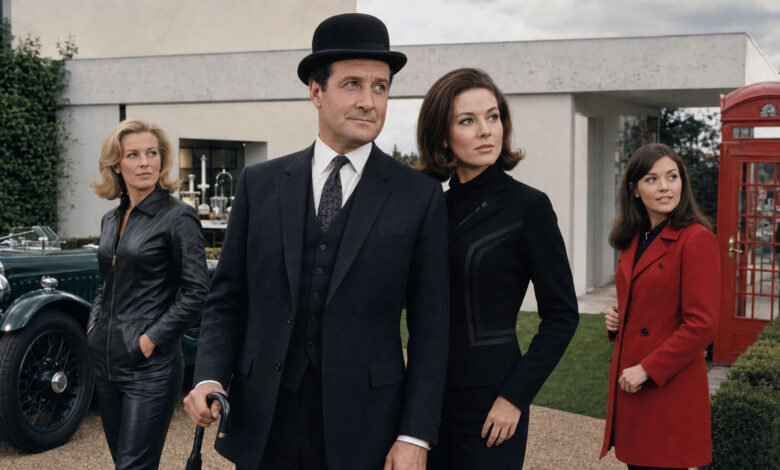
Patrick Macnee performs one of television’s most successful gradual transformations. Early Steed wears practical coats, uses firearms and operates from the shadows. Over time, Macnee and the production team turn him into the complete English gentleman agent. The bowler, umbrella, suit, Bentley, carnation and champagne become recognisable parts of a silhouette without reducing him to costume. Steed remains clever because he allows enemies to mistake courtesy for harmlessness.
Diana Rigg is the ideal partner for that version of Steed. Emma Peel is a scientist, businesswoman, martial artist, driver and talented amateur whose absent test-pilot husband makes the title “Mrs” a small mystery rather than a domestic restriction. Rigg’s dry delivery creates flirtation without requiring the programme to resolve it. Steed and Emma behave like adults who understand one another completely and consider explanation a vulgar use of time.
Linda Thorson inherits an impossible position. Tara King is younger and explicitly training as an agent, so the partnership is less equal by design. The final series also gives her a romantic attachment to Steed that the earlier relationships mostly left as subtext. Some scripts make Tara capable and resourceful; others place her in danger to motivate Steed. Thorson brings warmth and comic commitment even when the programme has not decided whether her inexperience is a character journey or a weekly reset button.
The greatest pleasure is tonal control. An episode can involve murder, brainwashing or national catastrophe while remaining light enough for Steed to duel using champagne corks. The violence is stylised, death often occurs off screen and ordinary police are scarce. This creates “Avengerland”, an exaggerated Britain populated by eccentric experts, deserted villages, private clubs and ministries containing one civil servant too few.
Not everything has aged equally well. The series is progressive in giving Cathy and Emma physical and intellectual equality, but the camera also treats their clothes and bodies as attractions. Some international characters rely upon stereotypes, and the fantasy Britain is conspicuously white. Tara receives less consistent agency than her predecessors. The programme can be celebrated for changing female action roles without pretending it completed the work.
Episode quality also varies. At its best, The Avengers produces elegant little nightmares such as “The House That Jack Built”, “The Hour That Never Was” and “The Town of No Return”. At its weakest, the whimsy becomes self-conscious and the villains appear to have created an elaborate visual metaphor because an ordinary bank robbery lacked sufficient hats.
The run is too large for compulsory completion. Sample each era, then follow the partnership that suits you. Cathy offers tension and realism; Emma offers the purest balance of wit and fantasy; Tara offers colour, headquarters comedy and late-series excess. Keel provides the fascinating beginning that history has only partially allowed us to see.
Vibe Check
- Tone: Urbane, playful and increasingly surreal, with murder treated as a regrettable interruption to good tailoring.
- Visuals: Bare early television studios evolving into pop-art colour, modernist homes, foggy villages, country estates and villain headquarters decorated around a single unhealthy enthusiasm.
- Bingeability: High in selected runs, formidable across every surviving episode.
- Espionage Level: Flexible. National secrets matter, but so do killer toys, invisible enemies and milk-delivery conspiracies.
- Science-Fiction Level: Begins cautiously and ends with robots, miniaturisation, mind transfer and a rocket leaving without permission.
- Action Level: Regular but stylised. Judo, fencing, improvised weapons and furniture suffer more than the principal cast.
- Romance Level: Mostly contained within glances, double meanings and the precise distance between two champagne glasses.
- Fashion Level: Operationally essential. Villains may not recognise Emma Peel after a costume change, which is fortunate because there are several per episode.
- Police Presence: Mysteriously low for a country experiencing this number of elaborate murders.
- Umbrella Forecast: Useful in all weather, especially organised crime.
Spoiler Mode: Plot Brief for Pub Chat
Major spoilers for all six series begin here. The programme is primarily episodic, but this section reveals partner departures, recurring enemies and the final scene. Bowler hats cannot protect against prior knowledge.
The Avengers begins with revenge in the literal sense. In “Hot Snow”, Dr David Keel prepares to marry his surgery receptionist, Peggy. She accidentally receives a package of heroin intended for a criminal organisation and is murdered. Keel pursues the people responsible and encounters John Steed, an intelligence agent investigating the same drug network.
Keel is the original protagonist. He is an ordinary professional pushed into danger by grief, while Steed arrives as an ambiguous figure who already understands the hidden world. Their alliance continues beyond Peggy’s killers because Steed needs a capable civilian able to enter spaces closed to official agents. Keel needs somewhere to direct the anger that has replaced his planned future.
Only part of “Hot Snow” survives, ending before Steed’s entrance. Most of the Keel era is missing because the original videotapes were wiped, a common practice when broadcasters regarded recorded television as reusable material rather than cultural history. The complete surviving episodes offer fragments of the original design.
“Girl on the Trapeze” follows Keel into a circus mystery and does not feature Steed. “The Frighteners” brings both men into a protection racket involving hired thugs who intimidate socially inconvenient people. “Tunnel of Fear”, rediscovered decades later, sends Steed undercover at a Southend funfair while Keel investigates coded information leaving the country. The episodes show a harder, less ornamental programme than the one remembered through colour photographs.
An actors’ strike interrupts production after the first series. Ian Hendry leaves to pursue film work, and the programme returns with Patrick Macnee promoted to lead. Series two initially rotates partners while unused Keel-style scripts are adapted. Dr Martin King appears in three stories as an obvious transitional doctor. Venus Smith, a nightclub singer, becomes involved in six cases despite possessing neither official training nor a persuasive reason to continue accepting Steed’s invitations.
The decisive arrival is Cathy Gale. She is a widowed anthropologist who has worked in Kenya, knows firearms and judo, and refuses to behave as though Steed’s security clearance grants him ownership of her time. Their investigations concern smuggling, political plots, scientific crime and blackmail, still grounded more firmly than the later fantasy stories.
Steed often withholds information, manipulates Cathy’s access and places her inside danger without explaining the complete plan. Cathy notices. Their arguments are central to the pleasure of the second and third series. She may agree that the case matters while objecting to being treated as equipment borrowed from another department.
The partnership gradually warms. Macnee refines the clothes and mannerisms that will define Steed, while Honor Blackman’s physical confidence changes the type of action available to British television heroines. Cathy does not wait for rescue if she can throw the man guarding the door.
Notable cases include “Mr Teddy Bear”, in which an apparently untouchable assassin communicates through children’s toys; “Death of a Great Dane”, involving diamonds concealed inside a dead man’s stomach; and “The Mauritius Penny”, where a rare stamp opens an espionage trail. “Don’t Look Behind You” isolates Cathy in a country house where somebody manipulates her fear, a psychological design later reworked for Emma Peel.
Series three strengthens the Steed-Gale unit. “Brief for Murder” has them perform hostility to trap corrupt lawyers. “The Gilded Cage” places Cathy inside an apparent gold robbery. “Build a Better Mousetrap” surrounds two elderly women with technology, bikers and a device everybody wants. The plots are beginning to test the limits of realism, though the world has not yet committed to robotic assassins.
Honor Blackman leaves after the third series and moves into international film, most famously playing Pussy Galore in Goldfinger. Cathy does not receive a filmed farewell because the programme’s next transformation follows a production break. Steed later remarks that she is in Fort Knox, a playful reference to Blackman’s new role rather than an elaborate attempt at shared continuity.
The fourth series is rebuilt for international sale. An American network deal brings a larger budget and requires production on 35mm film rather than incompatible British videotape. Exterior filming expands, compositions become more cinematic and the series can travel without leaving every street trapped inside Teddington Studios.
Elizabeth Shepherd is initially cast as Emma Peel and begins filming, but the production decides the partnership does not work. Diana Rigg takes the role and quickly establishes the chemistry around which the reinvented series will operate.
Emma is the widow of test pilot Peter Peel, whose aircraft vanished and who is presumed dead. She is wealthy, scientifically accomplished and independent. The name is famously associated with a search for “man appeal”, shortened during development to “M. appeal”, although Rigg gives Emma far more substance than the phrase suggests.
“The Town of No Return” sends Steed and Emma to Little Bazeley, a coastal village where familiar residents have been replaced by impostors operating from beneath the ground. It is an ideal statement of the new format: rural England, hidden invasion, unsettling normality and two agents who respond to danger as though they had planned an entertaining weekend.
“The Cybernauts” introduces nearly indestructible robotic killers controlled by scientist Dr Armstrong. Their blank faces, mechanical movement and violent strength create one of the programme’s enduring threats. Steed and Emma defeat the scheme, but the Cybernaut idea proves too useful to remain permanently dismantled.
“The Hour That Never Was” takes the pair to an airbase for a reunion that nobody else attends. Clocks have stopped, milk remains fresh and the empty installation feels wrong long before the explanation arrives. The episode turns absence into menace, using silence and familiar spaces more effectively than an army of visible enemies.
“Too Many Christmas Trees” attacks Steed through nightmares before placing him among telepaths trying to steal secrets from his mind. Christmas imagery, psychic threat and the partnership’s protective intimacy combine into one of the strongest black-and-white stories.
“The House That Jack Built” removes Steed for much of the action and traps Emma inside a house constructed as a psychological weapon. Rooms repeat, doors lead backwards and recordings expose the revenge of a man who blames her for his professional destruction. Emma escapes through intelligence and control, demonstrating that the series can centre her without turning the episode into an extended wait for Steed.
“A Touch of Brimstone” infiltrates a revived Hellfire Club whose members plan political chaos while indulging fantasies of eighteenth-century decadence. Emma adopts the persona of the Queen of Sin in a costume and performance that become iconic. American network concerns prevent the episode’s original transmission there, giving censorship an excellent opportunity to advertise it indefinitely.
The series ends with “The Girl from Auntie”, in which Emma is abducted and replaced while Steed follows a sequence of clues involving the guest character Georgie Price-Jones. It is not a departure story, merely another example of the programme using identity and substitution as toys.
Series five enters colour with “From Venus with Love”. Astronomers are found burned beside apparently impossible evidence, and the investigation reveals a scheme using concentrated light. The colours are no longer incidental. Sets, clothes, props and title sequences are designed for viewers who may not yet own a colour television but can be trusted to feel that they ought to.
“Escape in Time” sends criminals through a supposed time corridor to safety in the future. “The Winged Avenger” features murders resembling the work of a comic-book creature and uses comic panels, sound effects and production design as part of the mystery. “The Living Dead” constructs a ghost village above an underground operation. “The Hidden Tiger” investigates apparently lethal domestic cats before uncovering people with a very organised interest in animals.
“The Correct Way to Kill” allows foreign agents to complain that British espionage has become far too eccentric, which is difficult to dispute while Steed and Emma investigate killers dressed like Edwardian undertakers. “Epic” traps Emma inside a film production where ageing performers intend to make her death their final masterpiece. “The Superlative Seven” places Steed on an island with specialists being tested by an unseen opponent, leaving Emma to work from outside the principal game.
The Cybernauts return in “Return of the Cybernauts”, now employed by Paul Beresford, a relative of Dr Armstrong seeking revenge. Emma is manipulated into wearing a device that can be turned against Steed. The episode gives the mechanical villains a worthy second outing and a guest performance from Peter Cushing, whose ability to make courtesy threatening is exceptionally useful in Avengerland.
The later colour episodes grow more self-aware. “Murdersville” sends Emma to a village where the entire community supports a murder business. She cannot trust the pub, police or telephone exchange, making the cheerful rural setting a complete criminal system. Steed arrives after receiving a desperate clue and discovers that local hospitality has acquired terms.
Diana Rigg decides to leave. In “The Forget-Me-Knot”, Emma suffers amnesia during an internal-security conspiracy involving an organisation called REMAK. Tara King, a trainee agent, mistakes Steed for a training opponent and attacks him before becoming involved in the case.
Emma’s missing husband Peter is discovered alive in the Amazon. She leaves to reunite with him, telling Tara how to stir Steed’s tea and warning that he dislikes anti-clockwise motion. As Emma departs, Steed notices Peter resembles him from behind. The farewell is affectionate, witty and unwilling to turn years of unspoken intimacy into a speech after the car has arrived.
Tara becomes Steed’s new partner. Unlike Cathy and Emma, she is formally part of the service and addresses Steed as a senior figure. The relationship includes open affection and occasional jealousy. Tara is brave and well trained but less experienced, giving writers a reason to place her in peril that they use with varying restraint.
Headquarters becomes visible through Mother, a senior controller who moves between elaborate temporary offices and directs operations from a wheelchair. His silent assistant Rhonda handles the practical requirements. The secrecy is now ceremonial rather than mysterious. Nobody can find headquarters because Mother has apparently placed it on a bus, rooftop or wherever the set department had the better idea.
The final series experiences turmoil behind the camera. John Bryce begins production with instructions to reduce fantasy and return to realism. After early material fails to satisfy the American backers and production difficulties mount, Brian Clemens and Albert Fennell return. Episodes are revised, abandoned footage is repurposed and the series embraces eccentricity with the enthusiasm of people who suspect restraint has already missed its appointment.
“Game” forces Steed to face deadly versions of childhood diversions. “Noon Doomsday” places him in a hospital under threat from an old enemy while Tara must break through the surrounding control. “They Keep Killing Steed” uses duplicate Steeds as targets in an assassination-training scheme, allowing Macnee to become both hero and production resource.
“The Morning After” traps Steed and Tara in an evacuated town where a bomb is believed to be waiting. “Love All” turns romantic obsession into a weapon. “Take-Over” makes a country-house gathering the site of a carefully managed siege. “Look (Stop Me If You’ve Heard This One) But There Were These Two Fellers” assembles murderous clowns and music-hall performers beneath a title requiring its own interval.
The finale, “Bizarre”, involves people discovered dead in circumstances connected to a private organisation promising transport into space. Steed and Tara expose the operation but accidentally launch themselves aboard a rocket. They calmly drink champagne as Earth recedes. Mother tells the audience they will return, then realises they are unchaperoned together.
They do return, although not within the original series. The New Avengers finds Steed older and partnered with Purdey and Mike Gambit. The 1960s run ends exactly where its final form belongs: elegant, impossible and travelling into orbit without having filed the correct paperwork.
The Avengers Character Shout-Outs
- John Steed: Intelligence agent, gentleman, manipulator and owner of the only umbrella likely to require an export licence. Steed changes more than any other character while remaining unmistakably Macnee’s creation.
- Dr David Keel: The original Avenger. Keel brings personal grief and moral urgency to the first series, grounding a world before it discovers killer robots and decorative champagne storage.
- Cathy Gale: Anthropologist, traveller and judo expert. Cathy is an adult equal who challenges Steed’s secrecy and establishes that a female action lead need not apologise before throwing somebody across a room.
- Venus Smith: A nightclub singer repeatedly recruited into danger despite being an ordinary civilian. Venus represents the transitional series still searching for the right chemistry after Keel.
- Dr Martin King: A brief medical bridge created from scripts intended for David Keel. King is less a new era than evidence that television production also keeps leftovers.
- Emma Peel: Scientist, entrepreneur, martial artist and talented amateur. Emma combines intellectual authority with playful cool, making extraordinary competence appear like something she arranged before breakfast.
- Tara King: A young professional agent learning beside Steed. Tara is affectionate, energetic and underestimated both by villains and sections of the audience still mourning Mrs Peel.
- Mother: The service controller whose mobile offices turn administration into visual comedy. Mother proves that bureaucracy can become surreal if given enough props.
- Rhonda: Mother’s silent assistant, delivering files, transport and competence while headquarters relocates around her.
- One-Ten: Steed’s early superior, a reminder that the service once resembled an organisation rather than an eccentric lifestyle maintained by public funds.
- The Cybernauts: Silent robotic assassins whose blank faces and heavy movement became the programme’s closest thing to recurring monsters.
The Avengers Memorable Moments
- David Keel discovering Peggy’s murder and beginning the revenge behind the title.
- The surviving first act of “Hot Snow” ending before Steed can make his historic entrance.
- Steed working undercover inside the funfair in “Tunnel of Fear”.
- Cathy Gale turning an opponent’s strength against him with judo rather than waiting for male assistance.
- The toy-based assassin of “Mr Teddy Bear”.
- Cathy isolated and psychologically tormented in “Don’t Look Behind You”.
- Steed and Cathy pretending to become enemies in “Brief for Murder”.
- The programme exchanging videotape studios for crisp 35mm film.
- Steed and Emma arriving in Little Bazeley and finding a village full of replacements.
- The first Cybernaut walking silently towards another victim.
- The deserted airbase and stopped clock in “The Hour That Never Was”.
- Steed’s threatening Christmas dreams in “Too Many Christmas Trees”.
- Emma trapped inside the repeating rooms of “The House That Jack Built”.
- Mrs Peel becoming the Queen of Sin in “A Touch of Brimstone”.
- Steed unwrapping champagne while Emma shoots the cork in the colour titles.
- The comic-book murders of “The Winged Avenger”.
- Emma discovering that every respectable citizen in “Murdersville” belongs to the same murderous business.
- Peter Cushing applying impeccable manners to revenge in “Return of the Cybernauts”.
- Steed and foreign agents comparing the proper national method of murder in “The Correct Way to Kill”.
- Emma fighting for her life while a deranged film crew directs “Epic”.
- Tara attacking Steed after mistaking him for a training partner.
- Emma giving Tara instructions for stirring Steed’s tea.
- Steed watching Peter Peel drive away and noticing the resemblance from behind.
- Mother conducting business from another needlessly mobile headquarters.
- Multiple substitute Steeds becoming targets in “They Keep Killing Steed”.
- A deserted town waking into danger in “The Morning After”.
- Tara and Steed surrounded by homicidal entertainment in the exceptionally titled clown episode.
- The pair entering the rocket at the end of “Bizarre”.
- Mother promising their return before becoming concerned about the absence of a chaperone.
Performance Highlights
Patrick Macnee holds eight years of tonal change together. He begins as support to Ian Hendry and ends as one of television’s most recognisable leads. The achievement is not simply the costume. Macnee makes Steed’s politeness active. A courteous question can be an interrogation; apparent distraction can hide complete attention; a raised eyebrow can inform Emma that the room contains three assassins and an inadequate claret.
Macnee also resists conventional toughness. Steed can fight, shoot when required and walk into danger, but he prefers wit, improvisation and partnership. The character’s masculinity leaves room for flamboyance, vulnerability and being rescued by women who are better positioned to handle the current attacker.
Ian Hendry’s surviving work shows why the series was originally built around him. Keel is direct, emotionally accessible and convincing as a doctor whose civilian life becomes a route into crime. The loss of most episodes prevents a full assessment, which is one of British television preservation’s more frustrating footnotes.
Honor Blackman gives Cathy intellectual and physical weight. The friction with Steed never feels like coy hostility waiting to become romance. Cathy genuinely objects to his manipulation. Blackman had judo training for the role and performs the action with a solidity that changes how the scripts imagine female participation.
Diana Rigg combines precision with freedom. Emma can deliver technical exposition, absurd comedy and a fight sequence without appearing to move between separate versions of the character. Her timing with Macnee creates a partnership that feels intimate without requiring domestic scenes. The actors understand that flirtation becomes stronger when neither character needs reassurance.
Rigg also protects Emma from perfection. She can be curious when caution would help, amused by danger and briefly frightened without losing authority. “The House That Jack Built” is the clearest display of range, asking her to carry isolation, memory, physical threat and surreal design largely alone.
Linda Thorson faces comparison built into every entrance. Tara is not Emma with a different wardrobe, and Thorson’s best work accepts the distinction. She brings openness and visible affection to the partnership. Her comic reactions fit the late series, while action scenes show Tara gaining confidence even when scripts sometimes forget the progress by the following week.
Patrick Newell turns exposition into a recurring joke. Mother could have been a conventional superior explaining missions. Newell gives him appetite, impatience and an assumption that moving headquarters is a normal managerial choice. Rhonda Parker’s controlled silence makes the surrounding absurdity sharper.
The guest casting is a substantial pleasure. Peter Cushing, Christopher Lee, Peter Wyngarde, Donald Sutherland, Charlotte Rampling, Brian Blessed, Julian Glover, Roy Kinnear, Bernard Cribbins, Ronnie Barker, Warren Mitchell and many more move through the series. Some become villains; others become suspicious eccentrics; several sensibly cover both categories before the closing credits.
Skull Face’s Take
The Avengers may be the most British programme ever to insist Britain is populated by two secret agents, twelve eccentrics and absolutely nobody doing an ordinary job.
Its reputation rests on Steed and Emma, and that is fair. Macnee and Rigg make partnership look effortless without allowing it to become bland. He does not need to protect her pride, and she does not need to pretend his umbrella is normal. Their confidence gives the fantasy permission to become stranger.
But do not skip Cathy Gale. The videotaped picture, studio confinement and slower pacing can initially feel older than the filmed episodes. Stay with it. Cathy and Steed have friction that the Emma partnership deliberately smooths away. She asks why he has manipulated her, and the answer is often that he knew she would object before doing it anyway.
Tara’s era is uneven, not worthless. The production confusion shows, and the attempt to introduce romance changes the balance. Yet several episodes are inventive, Thorson is engaging and Mother turns headquarters into something designed by a civil servant after an unusually vivid lunch.
The series works because it does not wink nervously at its own absurdity. Everybody understands the joke, but the case remains real while it is happening. A villain can construct killer robots instead of hiring a gunman, and Steed investigates the engineering rather than asking why the robot has no commercial application.
There are failures. Some stories are padded, some stereotypes have aged badly and the programme’s admiration for female capability coexists with a camera frequently aware of leather. Later whimsy sometimes arrives before logic has put on its shoes. Even so, very few television series developed such a complete visual and behavioural language.
Skull Face verdict: essential signal. Begin with Emma, go backwards for Cathy, continue to Tara and then become the person explaining missing telerecordings at social gatherings. Every hobby has a cost.
Why The Avengers Has Drama/Action Icon Potential
It already is an icon. The question is why the image remains legible decades after the culture that produced it changed.
Steed’s outline can be recognised without a face: bowler, umbrella, immaculate suit. Emma Peel is equally distinctive because costume supports character rather than replacing it. The catsuits, geometric patterns and boots announce physical freedom, modernity and the show’s Pop Art confidence. Cathy Gale’s leather clothing had already broken expectations, while Tara brings late-1960s colour and youth.
The partnerships alter action television. Cathy and Emma are not secretaries promoted for one emergency. They possess expertise Steed lacks and rescue him regularly. The series does not require them to reject femininity before becoming credible fighters. Fashion, intelligence, humour and violence operate together.
Its fight choreography helps. Ray Austin and the performers incorporate judo, kung fu and stylised movement suited to television framing. The action is exciting without chasing realism that the production cannot support. Furniture, umbrellas, doors and decorative objects become tools, allowing fights to share the wit of the dialogue.
The villains understand iconography. Cybernauts have blank faces and mechanical bodies. Hellfire Club aristocrats dress for decadence. Comic-book killers imitate panels. Undertaker assassins arrive with professional branding. The weekly antagonist is often a complete design concept, which makes individual episodes memorable even when the scheme could be defeated by a more reliable fuse.
The music completes the identity. Laurie Johnson’s theme combines percussion, brass and strings with stylish urgency. It does not merely introduce a spy show. It introduces this spy show, promising danger conducted with better posture.
Most importantly, The Avengers creates a world rather than copying one. It borrows from Bond, detective fiction, science fiction, horror and British comedy but reorganises them around two people whose mutual confidence remains the most stable fact on screen. Many programmes have umbrellas. Only one makes the umbrella feel like a security clearance.
Deep Dive Highlights
The title changes meaning with the format. It begins as Keel’s direct response to Peggy’s murder. After that revenge is complete and Keel leaves, “Avengers” becomes a description of agents dealing with crimes that ordinary institutions cannot reach. By the Emma era, the title is nearly ceremonial. The pair prevent events before there is anything left to avenge.
Sydney Newman’s role connects The Avengers to a broader transformation in British television. He encouraged contemporary drama, strong concepts and female characters who could move beyond domestic support. He later played a central role in creating Doctor Who. Both programmes discover that limited budgets become less limiting when audiences are invited into a coherent imaginative world.
The wiped first series is not a minor inconvenience. Twenty-two missing episodes mean the original starring performance, the Keel-Steed relationship and the programme’s first identity can be understood only through scripts, stills, production records, audio where available and later reconstructions. “Tunnel of Fear” returning in 2016 demonstrates that “missing” does not always mean destroyed, but optimism needs a very patient filing system.
The transition from video to film changes content as well as appearance. Studio video encourages long scenes and theatrical blocking. Film permits location work, tighter editing and visual effects that support fantasy. The American sale funds the transformation while also requiring a version of Britain attractive to international audiences.
That Britain is deliberately artificial. The creators remove much ordinary working life, visible police activity and social disorder. Avengerland contains country houses, private research establishments, clubs, ministries and villages whose residents pursue highly specialised hobbies. It is England redesigned as a playground for espionage.
The absence of conventional guns from Steed’s famous image is significant. Patrick Macnee disliked firearms and helped shape a hero who rarely depended upon them. The umbrella offers defence, disguise and occasional gadgetry while keeping Steed visually separate from Bond imitators. His weapon is often the opponent’s assumption that civility means weakness.
Cathy Gale’s influence reaches beyond the series. She is educated, widowed, sexually adult and physically formidable at a time when British television offered few comparable women. Honor Blackman’s move to Goldfinger illustrates the relationship between television spy fiction and the Bond boom, but Cathy is not merely a rehearsal for Pussy Galore. She has a longer and often more complex partnership.
Emma Peel perfects the “talented amateur” idea. She works with Steed by choice rather than salary and possesses almost implausibly broad expertise. The freedom is part of the fantasy. Emma can enter science laboratories, art circles, industrial boards and combat because no weekly domestic obligation restricts the plot.
The missing Peter Peel solves and complicates that freedom. His presumed death leaves Emma married but independent, allowing the programme to avoid both widowhood and an active husband. His return provides a departure that does not diminish her. She leaves for a life she believed lost, not because Steed replaces her with a newer model.
Tara King marks a shift towards professionalisation. She is trained by the service and reports through a visible command structure. This could have made her more authoritative, but youth and hierarchy often make her less equal to Steed. The contrast reveals how much Cathy and Emma gained from remaining outside his organisation.
Mother embodies the show’s late desire to parody itself. Secret headquarters no longer need plausible offices. They need a memorable location and a joke about access. The series exposes the machinery of espionage only after deciding the machinery should be mounted on something movable.
The Cybernauts show how The Avengers absorbs science fiction without becoming a conventional science-fiction series. They are not explored as artificial intelligence or future society. They are assassins whose mechanical nature produces a specific visual threat. Technology in Avengerland is usually a personality disorder made functional.
Colour accelerates the pop-art design. Britain did not yet offer full ITV colour transmission when the episodes were made, but international sales justified production. Sets and costumes therefore anticipate a domestic future many original viewers initially saw in monochrome. The programme was literally more colourful than the televisions receiving it.
The show also balances censorship and innuendo. Steed’s relationships with his partners remain unstated, allowing dialogue and visual jokes to carry adult meaning. “A Touch of Brimstone” demonstrates the boundary: British fantasy, sexual suggestion and the Queen of Sin costume moved beyond what the American network would show, ensuring the episode became more famous than routine transmission might have achieved.
The final rocket is an appropriate endpoint because the programme has gradually removed every limit. It begins in a doctor’s surgery after a drug-related murder and ends in space with champagne. The journey is not a loss of seriousness so much as a discovery that style can hold increasingly impossible stories together.
Legacy & Impact
The Avengers became one of Britain’s most successful television exports and an international shorthand for 1960s cool. By the end of its original run, it had reached audiences in more than ninety countries and demonstrated that British television could sell a distinctive style rather than imitate American production.
The American deal changed the industrial model. Shooting on film improved export compatibility and preservation, while the larger budget expanded locations, action and design. The fact that every episode from the filmed period survives, while most of the first series does not, gives the production decision an unintended archival importance.
John Steed remains one of television’s great spies. He is patriotic without speeches, dangerous without a permanent gun and masculine without treating elegance as a threat. Later gentleman agents, comic spies and fantasy detectives inherit parts of Macnee’s performance even when no bowler appears.
Cathy Gale and Emma Peel influence generations of action heroines. They fight beside the male lead, possess independent expertise and are not framed as temporary exceptions within the story. Emma becomes the more famous image, but Cathy’s earlier refusal to accept Steed’s authority creates the foundation.
The legacy is not uncomplicated. “Strong female character” can become a flattering phrase used to avoid examining costume, pay, creative control and narrative agency. Diana Rigg challenged unequal treatment behind the scenes, while the finished programme continued to sell her image as part of its international appeal. Progress and exploitation can occupy the same exceptionally well-lit set.
The series helped establish spy-fi as a television mode. Its mixture of intelligence work, speculative technology, horror imagery and comedy influenced programmes including The Prisoner, later Doctor Who, The Champions and many stylish descendants. It proved that espionage could become surreal without abandoning suspense.
Its production talent travelled widely. Brian Clemens and Albert Fennell continued with The New Avengers and The Professionals. Laurie Johnson carried a related musical energy into both. Directors including Robert Fuest, Roy Ward Baker and Charles Crichton brought strong visual identities to television and film.
The New Avengers revived Steed in a more muscular 1970s action format with Joanna Lumley’s Purdey and Gareth Hunt’s Mike Gambit. It retained humour and returning ideas, including the Cybernauts, but belonged to a harder decade. The original’s champagne-light unreality could be revisited but not simply resumed.
The 1998 film demonstrated the difficulty of copying surface details. It had Steed, Emma, weather control, eccentric villains and immaculate clothes, yet the chemistry and tonal ease did not arrive automatically with the bowler. Avengerland requires confidence, not merely props.
Archive recovery and restoration have become part of the continuing story. Surviving video-era episodes exist as telerecordings, while the filmed series have received extensive restoration and Blu-ray releases. Big Finish audio adaptations give the missing Keel stories a performable life without pretending the original recordings have been found.
The show’s greatest legacy is pleasure without apology. It can be intelligent without solemnity, camp without contempt and fashionable without treating style as empty. Steed and his partners enter absurd situations with complete professional commitment. The audience is invited to laugh with the world, never at people foolish enough to believe in it.
More than sixty years later, the image still works: bowler, boots, umbrella, champagne and two people entirely certain that whatever waits behind the next eccentric door has underestimated them.
Want to Go Deeper?
- Explore the BFI Screenonline history of The Avengers (Production background, cultural context and core credits for the complete run.)
- Browse STUDIOCANAL’s The Avengers collection (Official rights-holder information beginning with the first series.)
- Check the current UK streaming options (STUDIOCANAL PRESENTS subscriptions and digital purchases.)
- Watch the surviving series on Peacock in the US (Current American subscription availability.)
- Follow the detailed production timeline at The Avengers Forever (A specialist guide to cast changes, filming blocks and transmissions.)
- Continue with The New Avengers (Steed returns in the 1970s with Purdey and Mike Gambit.)
Recommended TV Products
Watch Lioness Season 3 on Prime Video
Inspired by a U.S. Military program, three agents embark on a dangerous undercover mission following the 9/11 terrorist attack.
Watch Now
Watch Reacher Season 4 on Prime Video
A chance encounter with a distraught stranger on the Philadelphia subway draws Jack Reacher into a deadly mystery.
Watch Now
The Terminal List Season 2: Coming Soon
Season Two finds James Reece searching for a new purpose after finishing his list. But when the CIA corners him, Reece must clear his name by stopping a resurgent terrorist group that has turned an ally to their cause. In this globe-trotting espionage thriller, Reece will uncover a conspiracy that reaches from Moscow to Langley, even to his own family's history.
Watch the TrailerAs an Amazon Associate I earn from qualifying purchases.