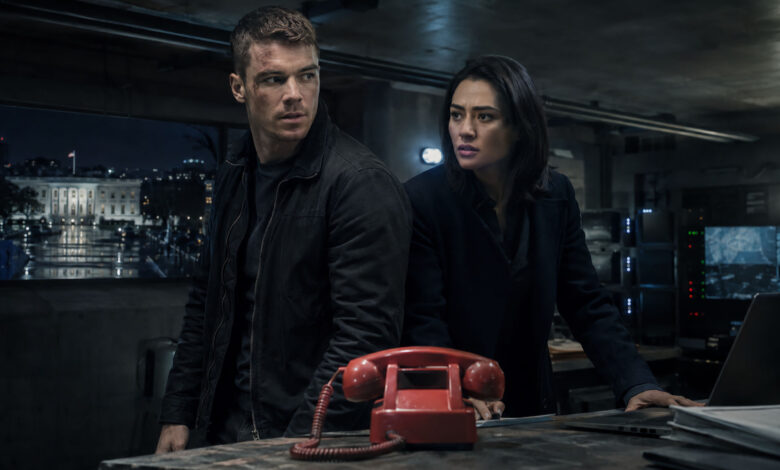
Byte-Sized Overview
A low-level FBI agent answers a telephone that is not supposed to ring and discovers that the quietest room in the White House may contain the loudest conspiracy in Washington.
The Night Agent follows Peter Sutherland, an earnest, physically capable agent whose career has been overshadowed by accusations that his father betrayed the United States. Assigned to monitor the emergency line used by undercover operatives, Peter expects long nights, stale coffee and perhaps several productive hours of staring at a telephone. Then Rose Larkin calls. Her aunt and uncle have been murdered, assassins are hunting her, and the people responsible appear to have access to the highest levels of government.
The first season is a breathless protection thriller built around Peter and Rose learning to trust one another while almost everybody with an impressive job title becomes suspicious. Later seasons move Peter into Night Action itself, widening the story from a White House conspiracy to international intelligence operations, chemical weapons, financial crime and political corruption. The locations change and the supporting cast rotates, but the central question remains: can Peter serve an institution without becoming obedient to the people who misuse it?
Gabriel Basso gives the programme its moral centre. Peter is not a polished superspy, a quip dispenser or a man who owns twelve passports and an invisible car. He is stubborn, sincere and extremely good at continuing to run after most people would have requested an ambulance. That combination makes The Night Agent one of Netflix’s most straightforwardly enjoyable action thrillers: fast, tense and always prepared to reveal that the trustworthy official in the previous episode has a second phone and a deeply alarming calendar.
The Night Agent Transmission Details
- Show: The Night Agent.
- Years Active: 2023–present.
- Seasons: 3 released; a fourth and final season is in production.
- Episodes: 30 released, with ten episodes in each of the first three seasons.
- Original Broadcaster: Netflix, with the first season released worldwide on 23 March 2023.
- Where to Watch:
- US: Netflix.
- UK: Netflix.
- Creator and Showrunner: Shawn Ryan.
- Based On: Matthew Quirk’s 2019 novel The Night Agent. The first season uses the novel as its foundation, while later seasons take Peter into original television storylines.
- Key Executive Producers: Shawn Ryan, Marney Hochman, Seth Gordon, Julia Gunn, James Vanderbilt, William Sherak, Paul Neinstein and Nicole Tossou, with additional executive producers joining across later seasons.
- Original Main Cast: Gabriel Basso, Luciane Buchanan, Hong Chau, Fola Evans-Akingbola, Sarah Desjardins, Eve Harlow, Phoenix Raei, Enrique Murciano and D. B. Woodside.
- Later Main Cast: Amanda Warren, Arienne Mandi, Louis Herthum, Berto Colon, Keon Alexander, Michael Malarkey, Ward Horton, Albert Jones, David Lyons, Jennifer Morrison, Genesis Rodriguez and Stephen Moyer.
- Composer: Robert Duncan.
- Production Companies: Sony Pictures Television, MiddKid Productions, Exhibit A and Project X Entertainment.
- Sub-Genre Tags: Political thriller, conspiracy thriller, espionage drama, action thriller, government conspiracy, fugitive drama, intelligence agencies and techno-thriller.
The Night Agent Signal Strength (aka: Is It Worth Your Binge?)
Yes. The Night Agent is designed for the moment when you intend to watch one episode and discover several hours later that you have become personally invested in federal continuity-of-government procedures.
The programme’s greatest strength is momentum. The first episode establishes Peter’s troubled family history, introduces the Night Action telephone and puts Rose in danger without spending half the evening arranging everybody around a conference table. Once the call arrives, the story rarely stops moving. Every safe location proves temporary, each answer exposes a larger question and any character who announces that they have finally found somebody trustworthy should immediately check the windows.
Season one is the cleanest and most satisfying run. Peter and Rose form a strong central partnership because both contribute something essential. Peter brings training, courage and a belief in procedure that is repeatedly tested. Rose brings technical intelligence, entrepreneurial confidence and the valuable civilian habit of asking why government explanations make no sense. Their relationship develops under pressure without reducing Rose to protected luggage or turning Peter into an infallible machine.
Season two changes the formula. Peter is now a Night Agent, working abroad and discovering that secret service is much less reassuring from inside the secret. The conspiracy surrounding Project Foxglove is more complicated, the cast expands and the middle episodes occasionally require viewers to keep a mental diagram of intelligence brokers, Iranian officials and chemical compounds. Fortunately, the action remains clear and Amanda Warren’s Catherine Weaver gives Peter a superior capable of challenging him rather than simply issuing ominous instructions from a secure room.
Season three is more confident about allowing consequences to survive between missions. Peter’s unlawful choices in season two remain available for blackmail, his separation from Rose is not instantly reversed, and his involvement with Jacob Monroe draws him into a conspiracy linking terrorism, financial institutions and the White House. The season also returns Chelsea Arrington to the foreground and gives Peter a new investigative counterpart in journalist Isabel De Leon.
There are familiar genre shortcuts. Important facilities are sometimes easier to enter than the local council tip, Peter absorbs punishment with the structural resilience of a municipal bollard, and government security teams continue to recruit enough traitors to justify a rather firmer reference-checking policy. Yet the show understands that plausibility in a thriller depends as much upon emotional behaviour as operational detail. Peter makes mistakes for reasons consistent with his character, then has to live with them.
Thirty episodes make this a substantial but manageable binge. The seasons tell separate main stories while Peter’s development, Rose’s importance, Catherine’s mentorship and Monroe’s manipulation provide continuity. It is glossy, urgent and proudly uninterested in the possibility that a confidential document might remain confidential for longer than forty minutes. Pick up the phone.
Vibe Check
- Tone: Tense, earnest and permanently suspicious of anyone entering through a secure door.
- Visuals: White House corridors, nocturnal streets, underground operations rooms, international locations and blue-lit spaces where nobody has remembered the main ceiling light.
- Bingeability: Extremely high. Episodes end with the confidence of a programme that has already hidden the remote control.
- Action Level: Heavy but grounded, with close-quarters fights, pursuits, shootings and a hero who performs his own informal durability testing.
- Conspiracy Scale: Starts beneath the White House and expands until banks, intelligence agencies, terrorists and presidents require separate coloured string.
- Romance Level: Present, sincere and routinely interrupted by people attempting murder.
- Technology: Useful but not magical. Rose can trace data and expose systems, although even she occasionally requires more than three keystrokes and a determined expression.
- Humour Level: Dry and limited, usually emerging from Peter’s exhausted disbelief rather than prepared one-liners.
- Trustworthiness of Senior Officials: Statistically discouraging.
- Telephone Etiquette: Answer promptly. Lives may depend upon it, and Night Action apparently has no voicemail.
Spoiler Mode: Plot Brief for Pub Chat
Major spoilers for all three released seasons begin here. If the telephone rings, leave this section immediately and take Rose with you.
Peter Sutherland first attracts official attention when he spots a suspicious man leaving a bag on a Washington Metro train. He evacuates the carriage before the device explodes, saving many passengers, but the bomber escapes. A year later Peter is working in the basement of the White House, monitoring the Night Action telephone under Chief of Staff Diane Farr. His father, Peter Sutherland Sr., was accused of selling government secrets, and Peter’s career remains trapped beneath that scandal.
The telephone finally rings when former technology chief executive Rose Larkin calls from the home of her aunt Emma and uncle Henry Campbell. The Campbells have been murdered by professional assassins Dale and Ellen, but they leave Rose instructions to contact Night Action. Peter guides her out of the house and is assigned to protect her. Emma and Henry were covert operatives investigating a conspiracy inside the government, and Rose may be the only surviving link to their evidence.
Peter and Rose follow the Campbells’ clues while Dale and Ellen hunt them. FBI Deputy Director Jamie Hawkins, who knew more about the investigation than he admitted, is murdered. Peter begins to distrust Farr, the woman supervising both him and the official response, while Rose uses her technical skills to recover information from her aunt and uncle’s files. Their partnership grows into affection, although the dating environment is weakened slightly by repeated gunfire.
A second storyline follows Vice President Ashley Redfield’s daughter, Maddie, and the Secret Service agents protecting her. Chelsea Arrington is ambitious, disciplined and increasingly concerned about Maddie’s behaviour. Erik Monks, an experienced agent returning after being shot while protecting a previous president, joins her detail. Maddie disappears after meeting her art lecturer, Paulo, but the apparent romantic escape is a kidnapping organised by Matteo Worley.
Matteo is the surviving twin brother of Colin Worley, the man recruited to plant the Metro bomb. The original target was Omar Zadar, a foreign political leader scheduled to meet President Michelle Travers. Redfield and corporate contractor Gordon Wick wanted Zadar killed and authorised the bombing, but Peter’s intervention prevented the intended assassination and caused civilian casualties. Colin was subsequently murdered to protect the conspiracy. Matteo kidnaps Maddie to punish Redfield and expose the truth.
Diane Farr is not the architect, but she has joined the cover-up. Redfield convinces her that exposing the bombing would destroy the administration and national stability, while Wick provides assassins to remove witnesses. Farr’s choices become increasingly indefensible as people die around her. She still regards herself as a protector of the presidency, which is a familiar Washington condition involving the gradual inability to distinguish an institution from the people damaging it.
The conspirators plan another attack at Camp David, where President Travers and Zadar will be present. Redfield intends to place his own daughter inside a protected bunker while the bomb kills both targets, but Maddie turns against him after realising the depth of his involvement. Peter and Rose enter Camp David, evade security and expose the explosives. Peter reaches Travers in time, while Chelsea protects Maddie and proves that her loyalty belongs to her duty rather than the vice president.
Monks is killed during the effort to rescue Maddie, Farr is shot by Ellen after attempting to help Peter, and Dale and Ellen are both eliminated. Redfield is arrested, Travers survives and Wick escapes immediate accountability. Peter also learns that his father did commit treason, but later became a double agent for the United States and died during an assignment. The truth is painful, yet it releases Peter from the simple story that has defined his career. Travers rewards him with entry into Night Action. Rose watches him board a jet for his first mission, ending the season with Peter finally obtaining the job that may ruin every remaining opportunity for a quiet life.
Season two begins with Peter and fellow Night Agent Alice working in Bangkok. Their operation is compromised and Alice is killed by Solomon, a former Marine working for intelligence broker Jacob Monroe. Convinced that Night Action contains a mole, Peter disappears from official contact and continues the investigation alone in New York. His new handler, Catherine Weaver, is not delighted by this initiative, particularly as agents are traditionally expected to remain visible to the organisation paying them.
Rose returns to help after tracing Peter through the technology operated by her new employer. Their connection remains powerful, but Peter’s secrecy and his dangerous work have made an ordinary relationship nearly impossible. Together they uncover links between Monroe, Solomon and Project Foxglove, a discontinued CIA programme that developed chemical weapons while attempting to create antidotes.
One of those weapons is KX, a lethal compound linked to Viktor Bala, a foreign general imprisoned for war crimes. Bala’s son Tomás and nephew Markus intend to use KX in New York as revenge against the United States. Monroe assists the scheme while pursuing his own objectives, selling information and arranging events so that every crisis increases his leverage.
The investigation also draws in Noor Taheri, an assistant at the Iranian mission to the United Nations. Noor steals intelligence in exchange for a promised escape for herself and her family. She is watched by security chief Javad, who initially appears interested in her and gradually reveals how dangerous that attention has become. Noor’s brother Farhad dies during the effort to extract the family, leaving Noor and her mother to begin a new life in America carrying a terrible cost.
Catherine and Peter distrust one another for much of the season, but she is eventually revealed as a principled Night Action veteran rather than the traitor Peter fears. She investigated Peter’s father years earlier and understands the combination of guilt, loyalty and anger driving him. Their relationship settles into an uneasy mentorship built from the shared experience of losing partners and being disappointed by institutions.
Peter, Rose, Catherine and Noor prevent the planned attack on the United Nations, then stop Markus from releasing KX at the nearby Wynnfield Hotel. The city is saved, Tomás and Markus are dead, and the immediate conspiracy is dismantled. Javad is removed after his attempt to outmanoeuvre Iranian ambassador Abbas fails.
The victory is compromised by Peter’s dealings with Monroe. To stop the attack, Peter breaks into the United Nations and steals confidential material that connects presidential candidate Patrick Knox to Foxglove. Monroe uses the evidence to destroy Knox’s campaign, clearing the path for Governor Richard Hagan to win the presidency. Peter has saved thousands of lives while helping an intelligence broker place a preferred candidate in the White House.
Peter also ends his relationship with Rose. He believes anyone close to him will be used as leverage and asks her not to search for him again. Rose accepts a promotion in California, while Noor and her mother receive asylum. Catherine gives Peter an opportunity to atone: Monroe will eventually contact him, and Peter must agree to cooperate while secretly investigating the broker’s relationship with President Hagan.
Season three finds Peter exhausted after four cases in six months but still asking Deputy Director Aiden Mosley for another assignment. FinCEN analyst Jay Batra has fled to Istanbul after his supervisor Benjamin Wallace was shot during a struggle in Jay’s flat. Jay has also taken copies of suspicious financial reports linking American shell companies to a cryptocurrency wallet associated with terrorist Raul Zapata and the L.F.S., the organisation responsible for the deadly attack on Flight PIMA 12.
Journalist Isabel De Leon receives Jay’s evidence. Peter locates them at a football match, helps Jay escape pursuers and discovers that Monroe wants the files. Monroe blackmails Peter with evidence of his illegal UN break-in, forcing Night Action to arrange a deceptive exchange. The operation fails catastrophically: Catherine is killed and Jay is captured. Peter loses his handler just as he has begun to recognise how much of his judgement she shaped.
Inside the White House, Chelsea is now head of security for President Hagan and First Lady Jenny Hagan. She shoots an apparently threatening butler after Jenny calls for help, then discovers that the man was unarmed and receiving payments from CorePoint Dynamics. The company appears within the same financial network exposed by Jay’s records. Chelsea’s investigation and Peter’s mission begin moving towards the first family.
Hagan assigns veteran operative Adam to work with Peter. Adam once served as Hagan’s military commanding officer and has spent years carrying out CIA paramilitary work. His loyalty to hierarchy makes him highly effective and dangerously unwilling to question the president’s instructions.
Isabel has her own connection to the case. Peter follows her to a secret source and discovers that Jacob Monroe is her father. Monroe insists that he did not finance the L.F.S. attack and becomes alarmed when Isabel’s investigation places her in danger. The real financial gatekeeper is Freya Myers at Walcott Capital, who has allowed criminal funds to move through a hidden banking network and hired an unnamed assassin to eliminate anyone capable of exposing it.
Monroe’s past explains how he became an intelligence broker. In the 1990s, the CIA coerced him into spying upon Zapata. Monroe fell in love with Sofia De Leon, an executive inside Zapata’s business, but the agency sacrificed her to protect him and its covert arrangement. Sofia died in prison after giving birth to Isabel. Monroe spent the following decades mastering the blackmail, pressure and manipulation first used against him, while refusing to face the cowardice that allowed Sofia to take his place.
President Hagan eventually orders Adam to kill Monroe and disguise the death as suicide. Monroe nevertheless leaves an encrypted archive containing the records of his operations. Isabel and Jay unlock the Monroe Drive using a book cipher based on a copy of Grimm’s Fairy Tales connected to Sofia. The files reveal Walcott’s network and the Hagans’ illegal campaign finance operation.
Peter tries to get Freya safely to The Financial Register, pursued by Adam and a team acting on presidential orders. In an abandoned bank, Peter persuades Adam that obedience to Hagan is no longer service to the country. Adam lowers his weapon, and Freya gives a live interview exposing the first family. Hagan later pardons himself and Jenny before leaving office, while Freya appears to escape prosecution until her own unnamed assassin quietly joins her at a bar and apparently poisons her drink.
Peter decides to step away from Night Action and search for the balance his work has destroyed. Mosley accepts the decision but reveals that he has identified a possible future partner, leaving the telephone line open for the fourth season. Production on that final chapter began in Los Angeles in 2026. Peter may be taking a break, but this is a programme in which peace generally lasts until the next scene establishes location.
The Night Agent Character Shout-Outs
- Peter Sutherland: FBI agent, Night Agent and stubborn moral compass who keeps discovering that doing the right thing is easier before the classified briefing begins.
- Rose Larkin: Technology expert, former chief executive and the civilian most likely to improve a federal investigation while asking why its cybersecurity resembles a neglected office printer.
- Catherine Weaver: Veteran Night Action handler whose hard exterior protects genuine loyalty to her agents and a painfully realistic understanding of their work.
- Chelsea Arrington: Secret Service agent who rises from Maddie’s protection detail to head of security for the first family without surrendering her independent judgement.
- Diane Farr: White House chief of staff who tries to protect the presidency by concealing a conspiracy, then discovers that compromise has no secure stopping point.
- Maddie Redfield: Vice-presidential daughter whose refusal to remain a passive political accessory helps expose her father.
- Erik Monks: Experienced Secret Service agent seeking professional redemption, bringing calm and humanity to Chelsea’s team.
- Noor Taheri: Iranian mission aide who risks everything to secure freedom for her family and pays far more than the promised extraction can repay.
- Jacob Monroe: Intelligence broker, political manipulator and man who turns his own history of coercion into a multinational business model.
- Isabel De Leon: Investigative journalist whose search for a financial conspiracy forces her to confront the father who abandoned her.
- Jay Batra: FinCEN analyst who refuses to ignore suspicious transactions even after the responsible people make the disadvantages extremely clear.
- Adam: Soldier and covert operative whose faith in the chain of command survives until the orders become impossible to mistake for duty.
- Aiden Mosley: Senior intelligence official who understands that Peter needs both responsibility and, occasionally, a direct instruction to go home.
The Night Agent Memorable Moments
- Peter identifying the Metro bomb and evacuating the carriage before the explosion.
- The Night Action telephone ringing for the first time as Rose hides from the assassins inside her aunt and uncle’s home.
- Rose and Peter realising that the Campbells trusted neither the FBI nor the White House.
- Chelsea discovering that Maddie has vanished from her protection detail.
- Peter and Rose escaping repeated attacks while their list of trustworthy officials becomes impressively economical.
- The Camp David assault and Peter’s desperate effort to reach President Travers before the bomb detonates.
- Peter learning the full truth about his father and boarding the aircraft for his first Night Action mission.
- Alice’s death in Bangkok, which destroys Peter’s confidence in the organisation almost as soon as he joins it.
- Rose finding Peter in New York after using her company’s technology to trace him.
- Peter’s brutal fight with Javad spilling into the subway.
- Noor’s extraction collapsing and Farhad dying during the escape.
- Peter and Rose stopping Markus and the KX device at the Wynnfield Hotel.
- Peter asking Rose not to look for him again after they save New York.
- Catherine revealing that she investigated Peter’s father, then recruiting Peter to work against Monroe.
- Peter locating Jay and Isabel amid the crowd at the Istanbul football match.
- Catherine’s death during the failed exchange with Monroe.
- Chelsea discovering that the White House shooting was built upon a lie.
- Isabel revealing that Monroe is not merely a source but her father.
- The flashback showing how the CIA used Monroe and sacrificed Sofia.
- Isabel and Jay decoding the Monroe Drive through Grimm’s Fairy Tales.
- Peter walking towards Adam’s gun while persuading him to question Hagan’s orders.
- The unnamed assassin joining Freya at the bar after she appears to have escaped every consequence.
Performance Highlights
- Gabriel Basso: Gives Peter a rare mixture of physical credibility and moral uncertainty. He looks capable in a fight but never comfortable with the decisions that lead to it, which keeps the character human as the conspiracies expand.
- Luciane Buchanan: Makes Rose intelligent, frightened and resourceful without allowing any one quality to consume the others. Her chemistry with Basso carries the first season and gives their season-two separation genuine cost.
- Amanda Warren: Brings authority and emotional restraint to Catherine. Her performance turns suspicion into mentorship gradually, making Catherine’s death in season three far more than a mechanical escalation.
- Fola Evans-Akingbola: Gives Chelsea controlled ambition and independent judgement. Her return to the centre of season three proves that the original White House storyline created more than one potential lead.
- Hong Chau: Plays Diane Farr with enough intelligence and conviction to make her compromises understandable without making them forgivable.
- Sarah Desjardins: Finds the fear, anger and tactical intelligence beneath Maddie’s privileged position, particularly as the truth about Redfield emerges.
- D. B. Woodside: Gives Erik Monks experience, vulnerability and quiet authority. His relationship with Chelsea makes his death land with uncommon force.
- Arienne Mandi: Carries one of season two’s most emotionally difficult stories. Noor’s courage never erases her fear, and freedom never cancels the grief required to reach it.
- Louis Herthum: Makes Monroe charming, controlled and profoundly dangerous. Season three allows him to expose the abandoned, cowardly man beneath the broker without requesting forgiveness for what he became.
- Genesis Rodriguez: Brings intelligence and emotional directness to Isabel, matching Peter’s determination while giving the financial conspiracy a personal centre.
- David Lyons: Creates tension through Adam’s certainty. His eventual decision to disobey works because the performance shows loyalty cracking rather than conveniently disappearing.
- Stephen Moyer: Makes the unnamed assassin unnerving precisely because he can move between professional killing and patient fatherhood without treating either life as a disguise.
Skull Face’s Take
The Night Agent knows the value of a ringing telephone. It is simple, visual and immediately alarming, particularly when the line exists solely for people whose evening has progressed beyond the usefulness of ordinary emergency services.
The first season remains the programme at its most efficient. Peter and Rose are easy to support, the conspiracy has a clear shape and every episode moves the pair closer to the White House without revealing the whole mechanism too early. The plot is complicated enough to sustain suspicion but not so elaborate that viewers require security clearance and a spreadsheet.
Peter is the key. He wants institutions to deserve his loyalty. That desire could make him dull, but the writers repeatedly force him to choose between procedure and principle. His father’s treason has made him desperate to prove that integrity can survive public suspicion. Night Action then places him in situations where integrity may require disobedience, deception or cooperation with people he despises.
Rose prevents the first season becoming a prolonged escort mission. She investigates, challenges and rescues as often as she requires protection. The decision to separate her from Peter is painful but sensible. Permanent involvement in his missions would eventually require the programme to pretend that a successful technology executive routinely takes unpaid leave for international chemical-weapons emergencies.
The rotating-ensemble structure is both a strength and a risk. Noor, Catherine, Monroe and Isabel bring new forms of pressure, allowing each season to feel distinct. Conversely, viewers who become attached to a partnership may discover that the next mission has reassigned half of it. The return of Chelsea in season three shows the best solution: retain continuity selectively and give returning characters meaningful advancement.
Season two occasionally becomes overburdened by Foxglove, Iranian mission politics, the Bala family, Monroe’s agenda and Peter’s suspicion of Night Action. Season three handles its complexity more confidently, linking financial crime to political power while giving Monroe a history that explains him without cleaning his record.
The action is excellent by streaming-thriller standards. Basso’s physicality makes close combat feel strenuous rather than decorative, and Peter often wins by continuing after the other person has reasonably assumed the fight must be finished. The geography of pursuits and confrontations is generally clear. Skull Face appreciates an action sequence in which knowing where the door is remains relevant.
This is not profound political drama, and its Washington is populated by enough conspirators to make open government recruitment unusually attractive. It is, however, disciplined entertainment with a likeable hero, strong supporting women and a genuine interest in the moral damage caused by secret work. Three seasons in, the signal remains strong. Just do not answer it on speakerphone.
Why The Night Agent Has Drama/Action Icon Potential
The programme already possesses an ideal icon: a red telephone glowing inside a dark White House basement. It represents danger, secrecy and immediate obligation without requiring a weapon, a costume or an exploding landmark. One ring converts Peter from an overlooked employee into the final connection between a hunted caller and the United States government.
Peter is also a strong modern action lead. His appearance is deliberately ordinary beside the tailored glamour of traditional screen spies. He wears practical clothes, looks tired and treats violence as work rather than personal branding. Gabriel Basso’s willingness to perform demanding action gives the character a physical identity built around close-range urgency rather than impossible gadgets.
The format can renew itself without abandoning its premise. Night Action exists to investigate threats that conventional agencies cannot manage, giving each season permission to introduce a different location, conspiracy and group of allies. The first season is political protection, the second becomes a chemical-weapons thriller, and the third uses financial records and journalism to expose corruption. The fourth can widen the world again while completing Peter’s personal argument with loyalty.
The challenge is keeping the human relationships as memorable as the machinery. Peter and Rose gave season one its emotional shape. Catherine gave seasons two and three institutional depth. Chelsea’s return demonstrated the value of characters whose careers continue when Peter is elsewhere. If the final season brings those strands together without turning the conclusion into a parade of guest appearances, the series has the foundations for a satisfying finish.
It has already achieved the reach required for icon status. The first season became one of Netflix’s most-watched English-language series and transformed a single thriller novel into an international television franchise. The red phone, basement desk and running silhouette of Peter Sutherland are recognisable visual shorthand. Not every call deserves an answer, but this one has kept a very large audience listening.
Deep Dive Highlights
- Shawn Ryan developed The Night Agent for television from Matthew Quirk’s 2019 novel.
- Sony Pictures Television produces the series with Ryan’s MiddKid Productions, Exhibit A and Project X Entertainment.
- Seth Gordon directed the first episode and serves as an executive producer.
- All ten episodes of season one premiered on Netflix on 23 March 2023.
- Netflix reported 98.2 million views during the first season’s initial 91-day measurement period. The programme reached number one in 87 countries.
- Netflix renewed the series for a second season less than a week after its debut.
- Season one was filmed primarily in and around Vancouver, with Canadian locations standing in for Washington, D.C.
- The Washington Metro sequence was filmed in Vancouver using production design and visual effects to recreate the capital’s transport system.
- Gabriel Basso trained extensively for the role and performed a significant amount of Peter’s physical action.
- Season two moved its principal production to New York, with additional location filming in Thailand.
- The second season premiered on 23 January 2025, again releasing all ten episodes together.
- The programme’s television story moves beyond the plot of Quirk’s original novel after season one.
- Season three began production in Istanbul before continuing in New York State.
- The Istanbul football sequence was filmed during a real match at Beşiktaş Stadium.
- The third season premiered on 19 February 2026.
- Netflix says the series has spent 27 weeks in its Global Top 10 across its first three seasons.
- Robert Duncan composed the score, using tense electronic and orchestral elements without giving the programme a conventional sung theme.
- Season three promotes Chelsea Arrington back into the main story after her absence from season two.
- Catherine Weaver’s history with Peter’s father establishes that Night Action existed well before Peter answered the basement telephone.
- Netflix confirmed that the fourth season will conclude the series. Production began in Los Angeles in May 2026.
- Announced season-four cast additions include Titus Welliver, Li Jun Li, Trevante Rhodes, Elizabeth Lail, Abigail Breslin, Annabeth Gish and David Denman.
Legacy & Impact
The Night Agent arrived without the cultural weight of a famous franchise, a superhero logo or a spy character inherited from six previous actors. Its source was a successful but self-contained novel, its hero spent the opening episode in a basement, and its most important prop was office equipment. Within days, it had become one of Netflix’s largest new series.
Its success demonstrates the continuing appetite for a well-built conspiracy thriller. Streaming television often stretches a mystery until the solution requires viewers to remember a minor conversation from seven weeks earlier. The Night Agent uses the opposite model. Entire seasons arrive together, episodes end with direct pressure and revelations generally create action rather than another layer of abstract mythology.
Peter Sutherland has also become a distinctive kind of streaming hero. He is competent without being emotionally invulnerable, patriotic without assuming that authority is always legitimate and physically imposing without treating violence as a personality. His central conflict is not whether he can complete a mission. It is whether completion still represents service when the order came from somebody corrupt.
The programme helped reinforce Netflix’s interest in accessible, internationally marketable action drama. Its later seasons respond by widening the locations and conspiracies while preserving the directness of the original. Bangkok, New York and Istanbul broaden the visual scale, but the stories continue to begin with one person holding information that powerful people want buried.
There is also something admirably old-fashioned beneath the streaming polish. Peter resembles the principled lead of a network thriller, Rose is an active civilian partner, episodes move through pursuits and revelations, and villains eventually explain enough of the plan for viewers to enjoy seeing it dismantled. The violence is harder and the seasons are shorter, but the underlying pleasure is reassuringly direct.
The fourth season now carries the responsibility of ending Peter’s journey. The third season leaves him questioning whether constant sacrifice has become another form of avoidance, while Mosley’s proposed new partner ensures that duty remains available. A convincing conclusion must allow Peter to choose a life rather than simply survive another operation.
Whatever the final call contains, The Night Agent has already moved beyond surprise-hit status. It turned one telephone, one decent agent and a deeply compromised chain of command into a global thriller with a clear visual identity. That is a rather good return on a basement desk.
Want to Go Deeper?
- Watch The Night Agent on Netflix (All three released seasons are waiting, and the telephone remains entirely incapable of respecting bedtime.)
- Read Netflix’s official guide to season three (Cast, production details and a briefing for Peter’s latest completed mission.)
- Explore the season-three conspiracy and ending (Major spoilers, financial records and several excellent reasons not to accept work from a president.)
- See the announcement for the fourth and final season (Production news and confirmation that Peter has one last call to answer.)
- Visit Sony Pictures Television’s official programme page (The original series description and production home.)
Recommended TV Products
Watch Reacher Season 4 on Prime Video
A chance encounter with a distraught stranger on the Philadelphia subway draws Jack Reacher into a deadly mystery.
Watch Now
The Terminal List Season 2: Coming Soon
Season Two finds James Reece searching for a new purpose after finishing his list. But when the CIA corners him, Reece must clear his name by stopping a resurgent terrorist group that has turned an ally to their cause. In this globe-trotting espionage thriller, Reece will uncover a conspiracy that reaches from Moscow to Langley, even to his own family's history.
Watch the Trailer
Watch Lioness Season 3 on Prime Video
Inspired by a U.S. Military program, three agents embark on a dangerous undercover mission following the 9/11 terrorist attack.
Watch NowAs an Amazon Associate I earn from qualifying purchases.