Byte-Sized Overview
Miami Vice follows undercover Metro-Dade detectives James “Sonny” Crockett and Ricardo “Rico” Tubbs through a city where police work, international drug trafficking and music-video glamour occupy the same neon-lit waterfront. Crockett is a weary Vietnam veteran who lives on a sailing boat, keeps an alligator called Elvis and uses the identity of smuggler Sonny Burnett to infiltrate criminal organisations. Tubbs is a sharp New York detective who arrives in Miami pursuing the Colombian trafficker responsible for killing his brother. Their first uneasy collaboration becomes one of television’s defining partnerships.
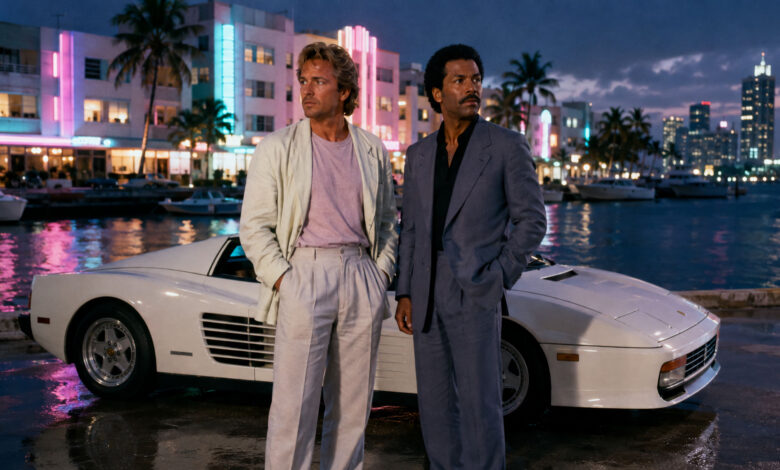
Created by Anthony Yerkovich and shaped decisively by executive producer Michael Mann, the series rejected the visual language of conventional network police drama. Miami was not merely a location but an active presence: pastel Art Deco buildings, decaying hotels, causeways, marinas, nightclubs, tropical sunlight and streets transformed by drug money. Contemporary songs were allowed to occupy entire sequences without dialogue, while Jan Hammer’s electronic score gave private grief, professional failure and late-night driving their own emotional architecture. The clothes, cars and colours attracted immediate attention, but the best episodes used beauty to make the violence feel colder.
Across five seasons, Crockett and Tubbs confront traffickers, arms dealers, corrupt officials, intelligence operations, organised crime and the steady futility of a drug war in which removing one supplier creates a vacancy for another. The quality becomes less consistent during the later years, and several fourth-season experiments appear to have been approved during a gas leak. At its peak, however, Miami Vice is much more than stylish nostalgia. It is a bleak, atmospheric crime drama about undercover officers gradually losing the boundary between the roles they perform and the people they have become.
Miami Vice Transmission Details
- Show: Miami Vice.
- Years Active: 1984–1989 on NBC. Several withheld episodes were shown after the televised finale, with the last receiving its first US transmission on USA Network in January 1990.
- Seasons: 5.
- Episodes: 111 produced stories, commonly catalogued as 114 instalments when feature-length episodes are divided for syndication.
- Typical Runtime: Approximately 46–49 minutes, with several feature-length episodes.
- Original Broadcaster: NBC.
- Where to Watch:
- US: All five seasons are currently available free with adverts on Tubi. Digital purchase options include Amazon Video, Apple TV Store and Fandango at Home.
- UK: The complete series is currently available to purchase through Amazon Video. No subscription or free streaming service presently carries the full series in the UK.
- Creator: Anthony Yerkovich.
- Key Executive Producers: Michael Mann, Anthony Yerkovich, George Geiger and Dick Wolf.
- Key Producer: John Nicolella.
- Main Cast: Don Johnson, Philip Michael Thomas, Edward James Olmos, Saundra Santiago, Olivia Brown, Michael Talbott and John Diehl.
- Original Supervising Officer: Gregory Sierra plays Lieutenant Lou Rodriguez during the opening episodes before Edward James Olmos joins as Lieutenant Martin Castillo.
- Notable Guest Performers: Bruce Willis, Liam Neeson, Julia Roberts, Helena Bonham Carter, Ben Stiller, Viggo Mortensen, Wesley Snipes, Pam Grier, John Turturro, Giancarlo Esposito, Leonard Cohen, Eartha Kitt, Frank Zappa, Miles Davis, Willie Nelson, Phil Collins, Glenn Frey and James Brown.
- Theme Music: Jan Hammer composed the “Miami Vice Theme” and the recurring “Crockett’s Theme”. Hammer scored seasons one to four, with Tim Truman becoming the principal composer for season five.
- Production Companies: Michael Mann Productions and Universal Television.
- Primary Filming Location: Miami and Miami Beach, Florida, with extensive location filming around South Beach, Biscayne Bay, Downtown Miami, Coconut Grove and the surrounding waterfront.
- Signature Vehicles: Crockett initially drives a black replica Ferrari Daytona Spyder before receiving a white Ferrari Testarossa. Tubbs is regularly associated with a pale 1964 Cadillac Coupe de Ville convertible.
- Sub-Genre Tags: Crime drama, police procedural, undercover drama, neo-noir, action drama, detective television, drug-trafficking drama, urban thriller, buddy cop television and 1980s television.
Miami Vice Signal Strength (aka: Is It Worth Your Binge?)
Yes, although its reputation as an extended collection of pastel jackets only describes the surface.
The pilot, “Brother’s Keeper”, establishes the programme with remarkable confidence. Crockett loses his partner during an investigation into drug lord Esteban Calderone. Tubbs arrives from New York using his dead brother’s identity and pursuing the same man. Their suspicion becomes cooperation, and the famous night drive accompanied by Phil Collins’s “In the Air Tonight” announces that this will not be a police series in which music politely waits behind dialogue.
The first two seasons contain the richest concentration of essential episodes. The plots are recognisably procedural, but direction, editing and sound push them towards something closer to urban cinema. Episodes such as “Evan”, “Smuggler’s Blues”, “Definitely Miami” and “Out Where the Buses Don’t Run” use the weekly crime story to explore guilt, obsession and moral exhaustion.
Season three darkens the colours and the mood. The Daytona disappears, the white Testarossa arrives and Crockett’s undercover life becomes increasingly corrosive. Larry Zito’s death gives the series one of its most painful consequences, while Castillo’s past and Tubbs’s family connection to the Calderones continue to expand the world beyond individual investigations.
Season four is where the binge becomes more adventurous. There are still strong episodes, particularly those involving Crockett’s marriage to singer Caitlin Davies and the consequences of his life as Burnett. There are also stories involving cryogenic revival, extraterrestrial visitation and livestock insemination. The Vice Squad apparently solved South Florida’s drug problem for several weeks and had to find other activities.
The fifth season restores much of the darkness. Crockett’s amnesia and complete assumption of the Burnett identity force the series to confront a question it had been circling from the beginning: if an undercover officer lives convincingly as a criminal for long enough, how much of the criminal is performance? The answer is not particularly comforting.
Don Johnson and Philip Michael Thomas sustain the series through its uneven periods. Crockett is the more visibly damaged man, but Tubbs is never merely the calm partner who explains the plot. He has his own grief, romantic history and capacity for obsession. Their loyalty carries the programme because both understand the psychological cost of the other’s work.
Edward James Olmos supplies a different kind of authority. Castillo enters without the easy camaraderie of his predecessor and initially seems almost inhumanly controlled. Gradually, episodes reveal his history in Southeast Asia, his lost marriage and the depth of his loyalty. He rarely raises his voice because the silence has already cleared the room.
Modern viewers should expect some dated attitudes, occasional stereotypes and an uneven relationship with female characters. Gina and Trudy are capable detectives, but the scripts do not always give them material equal to their importance. The programme is also more violent and despairing than its fashion-based afterlife suggests.
The complete run is worth exploring, but viewers seeking the strongest experience need not treat every episode as compulsory. Start with the pilot, continue through the first two seasons and approach the stranger fourth-season excursions as evidence that even iconic television occasionally misplaces the map.
Vibe Check
- Tone: Stylish, melancholy and increasingly cynical, with glamour functioning as camouflage for institutional failure.
- Visuals: Pastel hotels, tropical glare, neon clubs, wet streets, luxury boats, industrial docks and white linen moving rapidly away from an explosion.
- Bingeability: High during the first three seasons and more selective afterwards.
- Crime Level: Extremely high. Miami appears to have imported cocaine in quantities normally associated with aggregate construction materials.
- Action Level: High, including gunfights, speedboat chases, car pursuits, explosions and undercover operations that develop complications before the first chorus.
- Music Level: Exceptional. Songs are used as narrative sequences rather than decorative background.
- Fashion Level: Historic. Crockett’s wardrobe convinced a generation that socks represented excessive commitment.
- Emotional Damage: Substantial and rarely covered by departmental health insurance.
- Supervisory Warmth: Castillo cares deeply about his officers and would prefer not to discuss it in words.
- Alligator Practicality: Lower than Crockett believes.
Spoiler Mode: Plot Brief for Pub Chat
Crockett begins the series investigating Colombian drug trafficker Esteban Calderone. His partner, Eddie Rivera, is killed by a car bomb, and Crockett reluctantly joins forces with a New York officer calling himself Rafael Tubbs. Crockett discovers that the man is actually Ricardo Tubbs, Rafael’s younger brother, who has assumed his identity while seeking revenge for Rafael’s murder. Calderone escapes, but Tubbs remains in Miami and joins the Vice Squad.
The team initially answers to Lieutenant Lou Rodriguez, who is later killed during Calderone’s campaign against the detectives. Lieutenant Martin Castillo takes command. His remote manner creates immediate tension, but Crockett and Tubbs gradually recognise a leader whose loyalty is matched by considerable operational experience. Castillo’s former work in Southeast Asia and his separation from his wife May Ying become central to the two-part “Golden Triangle” story.
Tubbs eventually kills Calderone, but the consequences continue through Calderone’s children. Tubbs becomes involved with Calderone’s daughter Angelina and learns that she has given birth to his son. Angelina and the child are killed during an attack connected to her half-brother Orlando, leaving Tubbs with another personal loss created by the family he originally pursued.
The Vice Squad also suffers from within. Detectives Stan Switek and Larry Zito operate as a comic partnership, but Zito is murdered during an investigation involving boxing and organised crime. His death is staged to resemble a cocaine overdose, forcing Switek to clear his partner’s reputation while coping with the loss. Switek later develops a gambling addiction that further erodes the team’s stability.
Crockett’s private life repeatedly collides with his undercover identity. His marriage to Caroline has already failed, although they share a son, Billy. He later protects and falls in love with singer Caitlin Davies. They marry, but Caitlin is murdered by Frank Hackman, a killer whose release Crockett had helped secure. Crockett tracks Hackman down and kills him, crossing a line between police work and personal execution.
After a boat explosion, Crockett develops amnesia and believes that he truly is Sonny Burnett. Free of the moral restraint attached to his real identity, he becomes an effective criminal operator and turns against his former colleagues. His memory eventually returns, but knowledge of what Burnett was capable of remains with him.
In the feature-length finale “Freefall”, Crockett and Tubbs are ordered to protect General Borbon, the corrupt former dictator of the fictional Costa Morada. They discover that American government agencies are manipulating the operation for political convenience and treating the detectives as expendable assets. Crockett and Tubbs survive, confront their superiors and resign from the force.
The series ends without a triumphant arrest or institutional reform. Crockett plans to head south, Tubbs considers returning to New York and the two men share a final conversation beside Crockett’s Ferrari. Their partnership has survived the job, but continuing to do the job would destroy what remains of them.
Miami Vice Character Shout-Outs
- James “Sonny” Crockett: A Vietnam veteran, undercover detective and exhausted custodian of the Sonny Burnett identity. Crockett is intuitive, compassionate and capable of sudden violence. His wardrobe suggests permanent leisure; his expression suggests he has not experienced it since 1974.
- Ricardo “Rico” Tubbs: A New York detective who arrives seeking revenge and remains as Crockett’s partner. Tubbs is observant, charismatic and often more adaptable socially, but personal losses repeatedly test the control he presents to others.
- Lieutenant Martin Castillo: The Vice Squad’s intensely private commander. Castillo’s silence, discipline and loyalty make him one of television’s most distinctive authority figures. He can end an argument by entering the room and looking mildly disappointed with oxygen.
- Gina Calabrese: A determined undercover detective whose relationship with Crockett never settles into a conventional romance. Gina understands Crockett’s vulnerabilities but refuses to organise her life around repairing him.
- Trudy Joplin: Gina’s partner and a perceptive investigator with strong instincts about witnesses and victims. Trudy often provides emotional intelligence within a unit trained to conceal emotion.
- Stan Switek: Surveillance specialist, Elvis Presley enthusiast and initially the more comic half of the Switek-Zito partnership. Zito’s death and Switek’s later gambling problems reveal a more vulnerable man beneath the shirts.
- Larry Zito: Switek’s loyal partner. His murder transforms what appeared to be a dependable comic pairing into one of the programme’s clearest demonstrations that recurring characters are not protected from the world they police.
- Lieutenant Lou Rodriguez: The squad’s original commander and a warmer presence than Castillo. His death demonstrates that Calderone’s organisation can reach directly into the department.
- Izzy Moreno: A recurring informant, opportunist and entrepreneur whose definition of useful intelligence depends heavily upon whether anybody is checking it.
- Caroline Crockett: Sonny’s former wife and the mother of his son. Caroline represents the stable domestic life Crockett wants to protect but can no longer inhabit honestly.
- Caitlin Davies: A successful singer whom Crockett initially protects and later marries. Their relationship briefly offers him a future outside undercover work before Hackman’s revenge destroys it.
- Elvis: Crockett’s pet alligator, marine-security consultant and the only resident of the St Vitus Dance who appears completely satisfied with the accommodation.
Miami Vice Memorable Moments
- Crockett and Tubbs driving through Miami at night while “In the Air Tonight” builds towards its drum break in “Brother’s Keeper”.
- Eddie Rivera’s death in the pilot, immediately establishing the cost of Crockett’s investigation.
- Tubbs revealing his real identity and the murder that brought him to Miami.
- The first full blast of Jan Hammer’s Grammy-winning opening theme.
- Castillo arriving at the Vice Squad and replacing friendly supervision with weaponised silence.
- Bruce Willis playing arms dealer Tony Amato in “No Exit”.
- Crockett and Tubbs pursuing Calderone through the Bahamas.
- Castillo confronting his past and attempting to rescue May Ying in “Golden Triangle”.
- Glenn Frey’s music accompanying the movement and moral ambiguity of “Smuggler’s Blues”.
- Crockett confronting his former friend Evan Freed in one of the programme’s most emotionally complex episodes.
- Hank Weldon’s final revelation in “Out Where the Buses Don’t Run”, accompanied by Dire Straits’ “Brothers in Arms”.
- The sun-bleached trap at the centre of “Definitely Miami”.
- Crockett and Tubbs taking the investigation to New York in “The Prodigal Son”.
- The destruction of Crockett’s Daytona replica and the later arrival of the white Testarossa.
- Willie Nelson appearing as a retired Texas Ranger in “El Viejo”.
- Zito’s death and Switek’s refusal to accept the official story.
- Tubbs discovering that Angelina Calderone has given birth to his son.
- Crockett and Caitlin marrying despite the incompatibility of celebrity, undercover policing and staying alive.
- Caitlin being murdered by Hackman while Crockett is unable to reach her.
- Crockett tracking down Hackman and choosing vengeance over arrest.
- The boat explosion that erases Crockett’s memory and leaves Sonny Burnett in control.
- Burnett turning his criminal expertise against the officers who know his true identity.
- Crockett recovering his memory but being unable to dismiss what he did without it.
- Crockett and Tubbs discovering that their final protection assignment is a political deception.
- Both detectives walking away from the department in “Freefall”.
- The last roadside conversation beside the Testarossa, with partnership surviving after official duty has run out of road.
Performance Highlights
Don Johnson became a television star because he understood that Crockett could not be played as a man enjoying his own image. The cars, clothes and waterfront home are tools of the Burnett identity. Johnson gives Crockett a persistent weariness that prevents the surface glamour from becoming self-congratulation. He looks most convincing when the music is loud and the character has nothing left to say.
Johnson’s performance develops considerably across the run. Early Crockett is impulsive but still believes the job has boundaries. Later seasons reveal a man whose cover identity has occupied too much psychological space. The Burnett arc works because Johnson changes posture, rhythm and focus without turning the criminal version into an unrelated personality.
Philip Michael Thomas brings warmth and agility to Tubbs. He can move from streetwise humour to controlled rage without losing the character’s intelligence. Tubbs also carries the series’ first personal mission, and the Calderone stories repeatedly return him to the grief that brought him south.
Thomas is particularly strong when Tubbs’s composure fails. His relationship with Angelina exposes hope, suspicion and vulnerability, while the deaths of Angelina and their child add another loss that the series cannot solve with an arrest. Tubbs survives through adaptability, but the performance never suggests adaptation is painless.
Edward James Olmos makes restraint dramatic. Castillo speaks softly, moves deliberately and withholds the easy approval expected from a television commander. When his past is revealed, Olmos does not discard the control. He shows the emotion pressing against it. Castillo’s rare displays of physical action consequently carry enormous force.
Saundra Santiago and Olivia Brown create a credible working partnership even when the scripts underuse Gina and Trudy. Santiago gives Gina independence and emotional directness, particularly in scenes with Crockett. Brown allows Trudy’s empathy to operate as investigative intelligence rather than softness.
Michael Talbott and John Diehl begin as comic support but gradually make Switek and Zito one of the programme’s most convincing friendships. Diehl’s departure gives Talbott difficult later material, with Switek losing both his partner and the uncomplicated personality he once brought to surveillance duty.
The guest performances became part of the attraction. Some visitors were established actors, others were musicians, and several were future stars appearing before their careers accelerated. Bruce Willis, Pam Grier, Liam Neeson, Julia Roberts, Wesley Snipes and Viggo Mortensen move through the same world as Phil Collins, Miles Davis, Willie Nelson, Leonard Cohen and Frank Zappa. Casting meetings must occasionally have resembled somebody dropping the decade down a staircase.
Skull Face’s Take
Some police detectives receive an unmarked saloon, a sensible coat and a supervisor who discourages alligators.
Sonny Crockett receives a Ferrari, a yacht, twelve pale jackets and an undercover identity with better credit than most departments. Rico Tubbs receives Miami humidity despite dressing for Manhattan. Castillo receives a windowless office in which to practise staring through the souls of junior officers.
The strange thing is that Miami Vice could have been ridiculous. Sometimes it is ridiculous. There are episodes involving frozen reggae singers and unexplained encounters with alleged aliens. Yet when the programme is good, the style becomes inseparable from the tragedy. Beautiful images do not conceal the despair. They sharpen it.
Crockett and Tubbs repeatedly seize drugs, money and criminals without changing the system that produces them. Another supplier arrives, another official is compromised and another witness discovers that government protection has opening hours. The sports cars move quickly because standing still might encourage reflection.
Skull Face verdict: 9 neon sunsets out of 10. One point deducted because Elvis the alligator is clearly the most reliable officer in the unit and remains unfairly excluded from departmental meetings.
Why Miami Vice Has Drama/Action Icon Potential
Few television programmes have changed the appearance of their medium so quickly. Miami Vice arrived when American network drama was still visually associated with functional lighting, familiar backlots and scores composed specifically to stay behind the action. The series treated each episode as a small film, using colour, location, editing and popular music as storytelling elements.
Crockett and Tubbs became immediately recognisable silhouettes. Rolled sleeves, unstructured jackets, loose shirts, loafers and minimal ties created a style copied far beyond the programme. The clothes worked because they expressed the environment and the undercover assignment. These detectives needed to enter the nightclubs, boats and luxury homes where traffickers displayed wealth.
The cars became equally important. The black Daytona replica established Crockett’s dangerous elegance, while the white Testarossa became one of the defining screen vehicles of the decade. Tubbs’s Cadillac provided a different expression of style, connecting New York confidence with Miami leisure.
The music gave the series an emotional identity no wardrobe could create. Jan Hammer’s synthesisers could deliver propulsion, solitude or dread, while contemporary recordings allowed sequences to unfold according to the structure of a song. “In the Air Tonight” is remembered not because the pilot used a famous track but because image, character and music were edited into a single dramatic event.
The programme also made failure central to its heroism. Crockett and Tubbs are capable detectives, but their victories are temporary. Criminals escape, witnesses die and political interests override justice. The heroes remain iconic not because they control Miami but because they continue operating after understanding that they do not.
Its influence reaches beyond police television. Music videos, advertising, fashion photography, crime films and video games absorbed elements of its imagery. Later programmes could imitate the colours and cars, but the combination of visual pleasure and moral defeat remained harder to reproduce.
Deep Dive Highlights
Anthony Yerkovich developed the concept from his interest in asset-forfeiture laws and the strange financial realities of undercover policing. The original project was known as Gold Coast before becoming Miami Vice. The premise allowed detectives to use confiscated criminal property as part of their cover, explaining how public employees gained access to cars, clothes and boats normally associated with the people they were investigating.
Michael Mann did not create the series, but his executive production shaped its visual and thematic identity. Mann had already explored urban crime through Thief and the television series Crime Story would follow. His preference for architecture, modern design, electronic music and professionals defined by their work became fundamental to Miami Vice.
The production filmed extensively in Miami rather than disguising Los Angeles. During the early 1980s, parts of South Beach contained deteriorating Art Deco hotels and relatively little traffic. Crews sometimes repainted building exteriors to fit the episode’s palette, helping popularise an architectural landscape that later became central to Miami’s international image.
Colour was controlled carefully. Earth tones were frequently avoided in favour of white, turquoise, pink, blue, green and other shades associated with the tropical environment. Night scenes used neon, reflections and pools of directional light rather than simply flooding streets with conventional television illumination.
Contemporary music required unusually high licensing expenditure. Songs by Phil Collins, Peter Gabriel, Dire Straits, Glenn Frey, U2, Tina Turner, Depeche Mode, The Police and many others were not merely placed beneath montages. They determined pacing and sometimes carried emotional information that the characters could not state.
Jan Hammer worked with synchronised video so his electronic score could respond precisely to movement and editing. The “Miami Vice Theme” became a commercial hit and won Grammys for Best Instrumental Composition and Best Pop Instrumental Performance. “Crockett’s Theme” achieved separate chart success, particularly in Europe.
The famous black Ferrari Daytona Spyder was not a genuine Daytona. It was a replica constructed on a Chevrolet Corvette chassis. Legal objections from Ferrari contributed to its removal, after which Ferrari supplied Testarossas to the production. The cars arrived black but were repainted white so they would remain visible during night filming.
Crockett’s Testarossa was supported by a modified stunt vehicle based on a De Tomaso Pantera. The result allowed action filming without repeatedly exposing an expensive road car to the Vice Squad’s relaxed attitude towards municipal speed limits.
The casting combined established performers, musicians and actors near the beginning of major careers. This was partly fashionable stunt casting, but it also helped the city feel populated by people from music, sport, politics and entertainment rather than a conventional pool of weekly television suspects.
Dick Wolf joined the production during the third season, years before creating Law & Order. His involvement coincided with a darker procedural direction. The later history of American crime television therefore passes unexpectedly through a department in which detectives conduct surveillance while dressed for cocktails.
Real Miami crime informed many stories. Drug trafficking, arms smuggling, police corruption, the aftermath of the Mariel boatlift and American involvement in Latin America gave the series material more complicated than its glamorous image suggested. The programme exaggerated operational methods, but its sense of a city transformed by illegal money was grounded in contemporary reality.
The fourth season’s tonal instability reflects a series searching for novelty after its visual methods had been widely copied. Some experiments are interesting; others involve plots that no amount of Jan Hammer could have negotiated safely. The final season’s return to noir fatalism feels like an acknowledgement that the programme worked best when beauty and despair occupied the same frame.
Legacy & Impact
Miami Vice permanently expanded the visual possibilities of network television. It demonstrated that weekly drama could use location, production design, licensed music and cinematic editing without sacrificing commercial appeal. Later series inherited that freedom even when they rejected every recognisable feature of its style.
Its fashion influence was immediate. Pastel jackets, T-shirts beneath tailoring, loafers without visible socks and deliberately casual luxury entered mainstream menswear. Imitators often reproduced the clothing without understanding that Crockett’s wardrobe was part of an undercover construction rather than a suggestion for office Fridays.
The programme helped reshape perceptions of Miami. Its version of the city combined Art Deco heritage, Latin American culture, tropical beauty, violent crime and sudden wealth. Tourism and redevelopment later transformed many of the locations, meaning the series now documents the city it was simultaneously helping to reinvent.
The soundtrack changed the relationship between television and popular music. Record companies recognised that placement in a dramatic sequence could generate attention beyond conventional advertising. The practice is now routine, but Miami Vice made it central to a programme’s weekly identity.
The series also influenced crime cinema and later television noir. Its emphasis on compromised institutions, temporary victories and psychologically eroded professionals anticipated darker prestige dramas. The difference is that many successors moved the despair indoors and painted it grey.
Don Johnson became one of the defining television stars of the decade, while Crockett and Tubbs became a standard reference point for the buddy-cop partnership. Their racial difference is present but not used as the complete explanation for their relationship. They work because both men recognise displacement, grief and the danger of becoming the role required by the job.
Michael Mann returned to the material for the 2006 feature film starring Colin Farrell and Jamie Foxx. The film abandoned much of the series’ playful glamour for digital darkness and procedural detail, but retained the interest in undercover identity and emotional isolation.
The influence on video games is particularly visible in Grand Theft Auto: Vice City, which borrowed the tropical criminal economy, period soundtrack, architecture and colour palette while transforming them into an interactive satire. Countless advertisements, music videos and fashion shoots have made similar withdrawals from the visual account.
Not every episode has aged equally, but the landmark sequences still feel deliberate rather than quaint. The night drive in “Brother’s Keeper”, the wall in “Out Where the Buses Don’t Run”, the fatal heat of “Definitely Miami” and the final resignation in “Freefall” remain examples of television trusting image and music to carry complicated emotion.
Miami Vice is remembered for teaching television how to look cool. Its deeper achievement was understanding that coolness is most dramatically useful when the person wearing it is falling apart.
Want to Go Deeper?
- Watch all five seasons of Miami Vice free on Tubi (Currently available with adverts in the United States.)
- Check current UK streaming and purchase availability (The latest provider information for all five seasons.)
- Browse the complete Miami Vice episode guide on IMDb (Episode titles, original dates, cast details and viewer ratings.)
- Explore Jan Hammer’s Grammy history (Includes both Grammy wins for the “Miami Vice Theme”.)
- Read about Dick Wolf’s work on Miami Vice (NBC’s overview of the producer’s career before Law & Order.)
- Read how the series helped reshape Miami’s visual identity (The relationship between the programme, Art Deco preservation, architecture and the city’s pastel reinvention.)
Miami Vice leaves Crockett and Tubbs without badges but with their partnership intact, finally escaping a system that had spent five seasons dressing institutional failure beautifully.
Recommended TV Products
Watch Lioness Season 3 on Prime Video
Inspired by a U.S. Military program, three agents embark on a dangerous undercover mission following the 9/11 terrorist attack.
Watch Now
Watch Law & Order: Special Victims Unit on Prime Video
From the creator of "Law & Order", comes a powerful series chronicling the life and crimes of the Special Victims Unit of the NYPD.
Watch Now
The Terminal List Season 2: Coming Soon
Season Two finds James Reece searching for a new purpose after finishing his list. But when the CIA corners him, Reece must clear his name by stopping a resurgent terrorist group that has turned an ally to their cause. In this globe-trotting espionage thriller, Reece will uncover a conspiracy that reaches from Moscow to Langley, even to his own family's history.
Watch the TrailerAs an Amazon Associate I earn from qualifying purchases.