Byte-Sized Overview
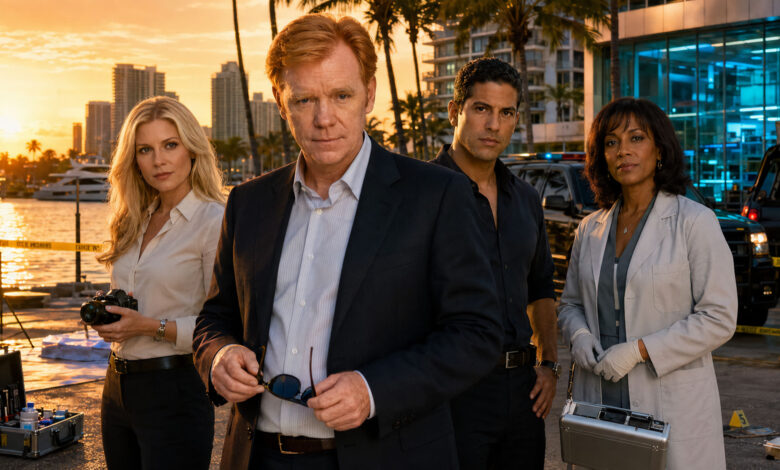
A red-haired forensic lieutenant arrives at a sun-drenched crime scene, studies the evidence, turns sideways, delivers a pun and applies his sunglasses with the solemnity of a knight lowering his visor. Somewhere nearby, Roger Daltrey is preparing to scream.
CSI: Miami follows Lieutenant Horatio Caine and the Miami-Dade Crime Lab as they investigate murders, explosions, kidnappings, organised crime and an improbable number of incidents involving glamorous people standing near swimming pools. The team combines forensic science with detective work, examining blood, ballistics, fingerprints, trace evidence and digital records until the guilty person realises that leaving one microscopic fibre behind was an expensive decision.
The first direct spin-off from CSI: Crime Scene Investigation takes the parent show’s laboratory techniques and rebuilds them in saturated orange, electric blue and permanent sunlight. David Caruso turns Horatio into one of the most distinctive police characters of the century, while Emily Procter, Adam Rodriguez and a changing ensemble supply the science, warmth and human damage around him. It is stylish, melodramatic, scientifically optimistic and so committed to its own atmosphere that even the corpses appear colour-graded.
CSI: Miami Transmission Details
- Show: CSI: Miami
- Years Active: 2002–2012
- Episodes: 232 across ten seasons
- Where to Watch:
- US: Hulu, Paramount+ and digital purchase through services including Apple TV and Amazon Video
- UK: All ten seasons are currently available to purchase through the Apple TV Store; no subscription streaming option is consistently listed
- Creators: Anthony E. Zuiker, Carol Mendelsohn and Ann Donahue
- Showrunner: Ann Donahue
- Introduced In: “Cross Jurisdictions”, a second-season episode of CSI: Crime Scene Investigation broadcast in May 2002
- Main Cast: David Caruso, Emily Procter, Adam Rodriguez, Khandi Alexander, Rory Cochrane, Kim Delaney and Sofia Milos
- Later Main Cast: Jonathan Togo, Rex Linn, Eva LaRue, Megalyn Echikunwoke, Eddie Cibrian and Omar Benson Miller
- Theme Music: “Won’t Get Fooled Again” by The Who
- Related Series: CSI: Crime Scene Investigation, CSI: NY, CSI: Cyber, CSI: Vegas and the unscripted series The Real CSI: Miami
- Sub-Genre Tags: Forensic Procedural, Crime Drama, Police Drama, Action, Mystery and Sunshine Noir
CSI: Miami Signal Strength (aka: Is It Worth Your Binge?)
Yes, especially if you like your forensic science conducted inside a glass building apparently illuminated by a permanent tropical sunset.
CSI: Miami understands the pleasure of a reliable formula. A visually striking crime opens the episode. Horatio assesses the emotional and evidential damage. The team separates facts from lies, enhanced graphics take the audience into bullets and blood vessels, and a suspect who considered themselves extremely clever is confronted with something found on a cufflink.
The cases are designed for clarity and momentum rather than documentary realism. Evidence rarely spends six months waiting in a laboratory queue. Databases return answers with the speed of a quiz-show contestant. The investigators move comfortably between crime-scene collection, scientific analysis, suspect interrogation and armed arrest, creating a very efficient workplace and a somewhat worrying distribution of authority.
What lifts the series above its formula is its style. The photography embraces heat, water, glass and colour. Miami is presented less as a city than a heightened state of mind in which every luxury house has an ocean view and every expensive party contains one guest with a motive. Slow motion, split screens and microscopic visualisations turn evidence into spectacle without making the basic investigations difficult to follow.
The ensemble also gives the weekly machinery a human centre. Calleigh Duquesne’s ballistics expertise and calm optimism balance Horatio’s gathering severity. Eric Delko brings energy, vulnerability and a personal connection to Miami’s Cuban community. Alexx Woods treats victims with maternal tenderness, while Tim Speedle’s dry intelligence and Ryan Wolfe’s anxious precision offer very different kinds of investigator.
The show becomes more serialised as it continues. Horatio’s supposedly dead brother, his relationship with Yelina, the Mala Noche gang, his brief marriage to Marisol, Eric’s brain injury and the discovery of Horatio’s son all extend beyond individual cases. These arcs add emotional stakes, although they occasionally make Horatio’s family history resemble an especially hostile witness statement.
Its weaknesses are visible. The science can be simplified or exaggerated. Suspects often confess after forensic evidence has already done the hard work. Horatio’s mannerisms intensify until pausing, turning and removing sunglasses become distinct stages of police procedure. Later seasons sometimes pursue escalation simply because last week’s exploding yacht is difficult to follow with an ordinary burglary.
Yet that excess is central to the appeal. CSI: Miami is not merely watched; it is entered. For forty-five minutes, the light is golden, the evidence is conclusive and Horatio Caine knows exactly where to stand before the opening credits.
Vibe Check
- Tone: Sincere, sun-baked and permanently poised between forensic precision and operatic revenge
- Visuals: Orange skies, blue laboratories, glass offices, waterfront mansions and enough reflective surfaces to occupy an entire evidence team
- Bingeability: Very high; the procedural structure makes one more case feel administratively reasonable
- Action Level: Higher than the parent series, with explosions, pursuits, organised crime and regular opportunities for Horatio to draw his weapon
- Forensic Confidence: Absolute; every fibre has a story and every database is apparently feeling unusually cooperative
- Conspiracy Scale: Begins with individual murders and expands into gangs, corrupt officials, federal operations and the Caine family archive
- Humour Level: Mostly unintentional but frequently magnificent, particularly before the theme tune
- Family Work-Life Balance: Poor; colleagues become family because actual relatives are often undercover, endangered or dead
- Sunglasses Readiness: Operational at all times, including lighting conditions where normal people would reconsider
Spoiler Mode: Plot Brief for Pub Chat
CSI: Miami is launched through “Cross Jurisdictions”, an episode of the original CSI in which Catherine Willows and Warrick Brown travel from Las Vegas to Miami while investigating a kidnapping and murder. They meet Horatio Caine, Calleigh Duquesne, Eric Delko, Tim Speedle and medical examiner Alexx Woods, establishing a warmer, brighter and more action-driven variation on the franchise.
When the series begins properly, Horatio shares authority with Megan Donner, the former head of the crime lab returning after bereavement leave. Megan’s evidence-led caution clashes with Horatio’s instinctive, protective style. She resigns during the first season, leaving Horatio as the undisputed centre of the unit and allowing David Caruso’s very particular command posture to assume full operational control.
Horatio is a former bomb-squad technician and homicide detective who treats victims, especially children, with unusual gentleness. With suspects, corrupt officers and anyone threatening his team, the temperature changes considerably. He becomes investigator, protector and occasionally avenging force, willing to operate at the edge of procedure when formal justice appears unlikely to arrive on time.
The early team is held together by contrasting personalities. Calleigh is a Louisiana-born ballistics specialist whose brightness encourages people to underestimate her. Delko handles fingerprints, narcotics and underwater recovery, while Speedle specialises in trace and impression evidence. Alexx talks to the dead as she examines them, treating each body as a person temporarily entrusted to her care rather than an interesting container of clues.
Horatio’s private life centres on his brother Raymond, a police officer believed to have been killed in the line of duty. Raymond’s widow, Detective Yelina Salas, develops feelings for Horatio without knowing that Raymond is alive and working undercover for the federal government. Horatio carries the truth while watching Yelina attempt to rebuild her life, an arrangement that combines protection, secrecy and enough suppressed emotion to power the laboratory.
The first permanent team tragedy arrives in the third-season premiere, “Lost Son”. Tim Speedle and Horatio investigate a jewellery shop connected to a kidnapping. Speedle’s poorly maintained weapon jams during a shoot-out, and he is fatally wounded. His death affects the entire unit, particularly Delko and Alexx, and becomes one of the rare procedural losses the series never completely resets.
Patrol officer Ryan Wolfe is recruited as Speedle’s replacement. Ryan is intelligent, ambitious and attentive to detail, partly because obsessive-compulsive tendencies make disorder difficult for him to ignore. His desire to prove himself can become defensiveness, and later gambling problems and professional mistakes place him at odds with the team. He is fired, works outside the lab and eventually earns his way back, although trust requires rather more processing than a fingerprint.
Season four introduces Natalia Boa Vista as a DNA specialist assigned through a federal grant. She is eventually exposed as an FBI informant required to report on problems inside the lab. The apparent betrayal damages her relationships, but the team learns that her position was more complicated than it seemed. Natalia later becomes a full CSI and survives continuing trauma connected to her abusive former husband, kidnappings and the occupational hazard of being near a season finale.
The Mala Noche gang drives one of the show’s largest continuing arcs. Delko’s sister Marisol is receiving treatment for cancer when she becomes close to Horatio. They marry, but the relationship is brutally short. Marisol is shot by gang members and dies, sending Horatio and Delko into a pursuit extending from Miami to Rio de Janeiro.
In Brazil, Horatio confronts Antonio Riaz, the man responsible for Marisol’s murder. Raymond is also drawn into the operation and is killed after his undercover life catches up with him. Horatio protects Yelina and his nephew before returning to Miami, carrying two more deaths behind the sunglasses and becoming noticeably harder in later seasons.
Eric suffers a major turning point when he is shot in the head during the fifth-season two-parter “No Man’s Land” and “Man Down”. He survives surgery but experiences memory problems, hallucinations and difficulty with his professional assessments. The team supports his recovery, though his vulnerability also exposes how completely the work has become his identity.
His relationship with Calleigh develops slowly from friendship and professional trust into romance. The series repeatedly interrupts them with injuries, other partners, secrets and employment changes, but their connection remains one of its strongest long-term emotional threads. By the final seasons they function less like a will-they-won’t-they device and more like two people trying to build something stable inside a workplace where stability is regularly bagged as evidence.
Horatio discovers that he has a teenage son, Kyle Harmon, from a past relationship with Julia Winston. Kyle has already entered the criminal-justice system and becomes a target through Horatio’s enemies. Horatio tries to protect and guide him while dealing with Julia’s instability and criminal associations. Their story reinforces the central contradiction of Horatio Caine: he is exceptionally good at protecting vulnerable strangers and considerably less successful at preventing his own family from entering organised-crime plots.
Alexx leaves the medical examiner’s office after her son becomes endangered and she recognises how much death the job has brought into her family. She returns in guest appearances as an emergency physician, meaning her decision to spend more time among the living still allows the occasional reunion when those living have been shot.
Season six ends with Horatio apparently assassinated. Ryan receives a message suggesting the operation has been completed, but the next season reveals that Horatio staged the shooting as part of a plan to expose dangerous enemies and protect those around him. The deception is effective, although the willingness of colleagues to accept Horatio’s death confirms that the team’s workplace expectations have become troublingly flexible.
Season eight flashes back to 1997 and introduces Jesse Cardoza, an investigator who worked with Horatio before the familiar team formed. Jesse returns from Los Angeles to pursue the man who murdered his wife and joins the lab alongside art-theft specialist Walter Simmons. At the beginning of season nine, a deliberate halon-gas attack strikes the crime lab. Jesse falls, suffers a fatal head injury and dies despite the team’s efforts, giving the newer ensemble its own painful loss.
The ninth-season finale places Horatio and Natalia in mortal danger. Escaped convict Randy North shoots Horatio, while Natalia is trapped in the boot of a car pushed into the water. Horatio survives long enough to free her, and both return for season ten carrying physical and psychological consequences. In Horatio’s near-death vision, Marisol appears and sends him back, which is touching but also confirms that even the afterlife expects him to finish the case.
The final episode, “Habeas Corpse”, was produced as a season finale rather than a planned series conclusion. Assistant state attorney Josh Avery is murdered, and evidence places Ryan at the scene. Horatio must investigate one of his own while ruthless lawyer Darren Vogel exploits every weakness in the team.
The evidence ultimately points to CSI Samantha Owens, who had a relationship with Avery and killed him during a confrontation. Ryan discovers the truth, the case is resolved and Calleigh completes the adoption of siblings Austin and Patty North. The episode closes without destroying the lab, killing Horatio or separating the team. CBS cancelled the programme the following month, so its last case functions as an accidental ending: work continues, family expands and Horatio remains available should Miami require one more carefully angled warning.
CSI: Miami Character Shout-Outs
- Horatio Caine: Crime-lab lieutenant, former bomb technician and protector of victims who can turn standing sideways into a command decision
- Calleigh Duquesne: Ballistics specialist whose warmth, Southern accent and optimism conceal one of the sharpest scientific minds in the building
- Eric Delko: Fingerprint, drug and underwater-recovery expert whose injuries, losses and relationship with Calleigh form much of the show’s emotional continuity
- Alexx Woods: Medical examiner, maternal centre of the early team and the only person able to make talking to a corpse feel compassionate rather than alarming
- Tim “Speed” Speedle: Dry, intelligent trace specialist whose casual approach to weapon maintenance produces the series’ most consequential lesson
- Ryan Wolfe: Precise, ambitious replacement for Speed who discovers that earning a place on the team is easier than keeping everybody’s trust
- Natalia Boa Vista: DNA specialist, reluctant federal informant and survivor who develops into a determined field investigator
- Frank Tripp: Homicide detective, practical ally and supplier of the expression worn by a normal policeman when Horatio announces the plan
- Yelina Salas: Detective, private investigator and emotional centre of the complicated relationship between Horatio and his supposedly dead brother
- Megan Donner: Original crime-lab head whose evidence-first approach gives the opening season a source of productive tension
- Jesse Cardoza: Former colleague who returns from Los Angeles carrying a personal murder investigation and finds a second home in the lab
- Walter Simmons: Art-theft specialist whose intelligence, humour and easy rapport bring welcome energy to the later team
- Marisol Delko-Caine: Eric’s sister and Horatio’s wife, whose murder transforms the Mala Noche conflict into an intensely personal campaign
- Tom Loman: Socially awkward but capable medical examiner who inherits a room still defined by Alexx’s presence
CSI: Miami Memorable Moments
- The backdoor pilot “Cross Jurisdictions”, where the Las Vegas team meets Horatio and the Miami laboratory receives its first blast of orange sunlight
- The first pre-credits sunglasses turn, establishing that crime-scene analysis can have its own ceremonial choreography
- “Dispo Day”, where an ambush raises questions about compromised police information and Speedle’s neglected firearm
- “Lost Son”, as Speed’s weapon jams during a shoot-out and the original team suffers its defining loss
- “Crime Wave”, which combines a tsunami warning, planned bank robbery and the programme’s belief that ordinary weather lacks ambition
- The CSI: NY crossover beginning with “Felony Flight” and continuing through “Manhattan Manhunt”
- Horatio and Marisol’s wedding, followed almost immediately by the Mala Noche attack that kills her
- “Rio”, where Horatio and Delko pursue Antonio Riaz while Raymond’s undercover story reaches its fatal end
- Delko being shot in “No Man’s Land” and fighting to survive in “Man Down”
- Calleigh’s abduction in “All In”, where she leaves forensic clues for her colleagues while held captive
- Horatio removing his sunglasses at Marisol’s grave, a small gesture carrying considerably more emotion than most speeches
- The season-six finale appearing to kill Horatio before revealing an elaborate staged operation
- “Out of Time”, which returns to 1997 and reconstructs the early crime-lab team
- The halon attack that kills Jesse Cardoza at the beginning of season nine
- Horatio rescuing Natalia from a submerged car after he has been shot
- “Habeas Corpse”, where Ryan becomes the suspect and Calleigh finally adopts Austin and Patty
Performance Highlights
- David Caruso: Creates an instantly recognisable character from pauses, stillness, controlled compassion and the most analysed pair of sunglasses in television history
- Emily Procter: Gives Calleigh intelligence, humour and warmth while making her forensic confidence feel earned rather than supplied by the script
- Adam Rodriguez: Handles action, grief, neurological damage and romantic uncertainty without losing Delko’s restless energy
- Khandi Alexander: Makes Alexx the emotional anchor of the early seasons and gives every victim dignity before the science begins
- Rory Cochrane: Brings dry understatement and scruffy intelligence to Speed, making his abrupt death land harder than his limited run might suggest
- Jonathan Togo: Allows Ryan’s precision, insecurity and ambition to create genuine friction instead of presenting him as a simple replacement
- Eva LaRue: Develops Natalia from suspicious outsider to credible investigator while giving weight to her history of abuse and survival
- Rex Linn: Supplies Frank Tripp with sturdy authority, blunt humour and the invaluable ability to react like a real detective surrounded by stylised people
- Sofia Milos: Gives Yelina independence and emotional complexity despite spending much of her story inside the Caine brothers’ secrets
- Kim Delaney: Creates an effective early counterweight to Horatio through Megan’s insistence that intuition must answer to evidence
- Omar Benson Miller: Brings Walter intelligence, relaxed humour and a social ease that refreshes the later-season ensemble
- Eddie Cibrian: Makes Jesse immediately likeable, ensuring his death affects the team despite the character’s comparatively brief return
- Robert LaSardo: Turns Memmo Fierro into the enduring human face of the Mala Noche threat through menace, patience and repeated refusal to remain safely imprisoned
Skull Face’s Take
CSI: Miami is the forensic procedural as tropical opera.
The original CSI often feels nocturnal and cerebral. Its Las Vegas team studies evidence beneath artificial light while Gil Grissom considers insects and human nature. Miami moves the same machinery into daylight, turns the colour saturation up until the sky requires protective eyewear and gives its leader a firearm, a tragic family and the authority to make declarative statements beside moving water.
It should be ridiculous. Frequently, it is ridiculous. Horatio’s pauses become long enough to process a secondary crime scene. Suspects wait patiently while he changes viewing angle. The cold-open puns grew into an internet language of their own, helped by a scream from The Who that can make even weak wordplay sound like the conclusion of a constitutional crisis.
But mockery only explains part of the show’s durability. Caruso commits completely. Horatio never acknowledges the theatricality because, to Horatio, protecting a frightened child and facing a cartel killer are matters of absolute moral importance. The performance may be mannered, but the conviction is genuine.
The rest of the team prevents the programme becoming one man’s extended sunglasses demonstration. Calleigh is a terrific procedural character: technically skilled, emotionally intelligent and able to deliver dense ballistics information without draining a scene of life. Delko’s wounds and losses accumulate visibly. Alexx gives the dead humanity. Tripp brings the room back to earth whenever everybody else begins glowing orange.
The science should not be used as professional training. Laboratory processes are compressed, certainty is exaggerated and the same investigators collect evidence, analyse it, conduct interviews and join armed arrests. Skull Face recommends against citing season four in court unless the judge specifically requests more split-screen montages.
As television, however, it works. The episodes are cleanly constructed, visually distinctive and unusually confident about delivering satisfaction. Evidence produces truth. Truth gives Horatio leverage. The culprit discovers that wealth, influence and excellent waterfront property cannot defeat trace analysis.
There are better crime dramas, subtler crime dramas and crime dramas in which removing sunglasses requires fewer camera angles. Very few are more immediately themselves. Ten seconds of orange sky, a blood spatter and David Caruso looking over the top of his lenses are enough to identify the entire programme.
Why CSI: Miami Has Drama/Action Icon Potential
CSI: Miami achieved icon status before it finished its run. The question is not whether people remember it, but whether they remember anything before Horatio reaches for the sunglasses.
That cold-open ritual is one of television’s most successful pieces of character branding. A crime is discovered, Horatio interprets its moral shape, a line lands, the glasses move and “Won’t Get Fooled Again” detonates the credits. Repetition turns the sequence into anticipation. Viewers know what is coming and enjoy the precision of its arrival.
The show’s visual design is equally important. Orange and teal existed before CSI: Miami, but few programmes used them with such missionary enthusiasm. High contrast, white clothing, blue glass and golden light make the series recognisable even without its cast. The city becomes a forensic fantasy assembled from Florida landmarks, Californian streets and a laboratory apparently designed by someone who considered normal office lighting an admission of defeat.
Horatio is also built from an iconic contradiction. He is restrained in movement but enormous in presence. He speaks quietly while the programme around him grows louder. His compassion towards victims, especially children, gives moral purpose to the style, while his willingness to confront gangs and corrupt officials moves the series towards action drama.
The ensemble creates enough continuity for 232 episodes. Calleigh and Delko grow from colleagues into partners. Speed’s death continues to echo. Ryan spends years negotiating his place. Natalia moves from informant to trusted investigator. Alexx, Frank and Walter give the lab different kinds of family energy. Cases reset, but relationships leave residue.
Its international success completed the transformation. A 2006 ratings study using data from twenty countries named CSI: Miami the world’s most popular television programme because it appeared in more national top-ten rankings than any other series. Horatio’s stance travelled extremely well.
The programme also survives through parody. The sunglasses meme, Roger Daltrey’s scream and the structure of the opening pun have been copied across television, comedy and online culture. Parody can diminish a show, but it can also preserve it. People who have never watched a complete case still understand that a dramatic pun requires eyewear.
Deep Dive Highlights
- CSI: Miami was the first direct spin-off from CSI: Crime Scene Investigation
- The team debuted in the original CSI episode “Cross Jurisdictions” on 9 May 2002
- The series itself premiered on CBS on 23 September 2002
- Ann Donahue, Carol Mendelsohn and Anthony E. Zuiker created the programme, with Donahue serving as showrunner
- Jerry Bruckheimer was an executive producer across the franchise
- David Caruso is the only actor credited in all 232 episodes
- Emily Procter was the first principal performer cast for the spin-off
- The programme won the 2003 People’s Choice Award for favourite new television drama
- “A Simple Man” won the 2003 Primetime Emmy for outstanding cinematography for a single-camera series
- “Rush” won the 2007 Primetime Emmy for stunt coordination
- “Won’t Get Fooled Again” continued the CSI franchise tradition of using songs by The Who as opening themes
- Most episodes end their cold open with Horatio delivering a line and putting on or removing his sunglasses before Roger Daltrey’s scream
- That repeated sequence became one of the defining television memes of the 2000s
- A 2006 study using ratings from twenty countries named CSI: Miami the world’s most popular programme based on its number of top-ten appearances
- Interior scenes were filmed primarily at Raleigh Manhattan Studios in Manhattan Beach, California
- Long Beach frequently doubled for Miami because its coastline, canals, palms and newer high-rise buildings could imitate South Florida
- The building used for the crime-lab exterior was a credit-union headquarters in Hawthorne, California
- Production also filmed genuine Florida exteriors in Miami Beach, Coconut Grove and Coral Gables
- “Crime Wave” used the threat of a tsunami as cover for an elaborate bank robbery
- “Lost Son” was written around Rory Cochrane’s decision to leave the programme
- The series introduced CSI: NY through the 2004 episode “MIA/NYC NonStop”
- The 2005 episodes “Felony Flight” and “Manhattan Manhunt” formed another crossover with CSI: NY
- The shorter nineteenth-episode final season concluded on 8 April 2012
- CBS cancelled CSI: Miami in May 2012, after its finale had already been produced and broadcast
- The Real CSI: Miami, an unscripted true-crime programme using the franchise name, premiered in 2024
Legacy & Impact
CSI: Miami helped turn a successful procedural into a global television system. The original CSI proved that forensic science could anchor a primetime drama. Miami proved the template could be transplanted, recoloured and given a different emotional temperature without losing its appeal.
Its success cleared the route for CSI: NY, later followed by CSI: Cyber and CSI: Vegas. The franchise became less dependent on one cast or city, while the Miami series demonstrated how strongly location, colour and performance style could distinguish programmes built around almost identical case structures.
The show also contributed to the so-called CSI effect: the belief that jurors and the public came to expect sophisticated forensic evidence in criminal cases. That phenomenon is debated and cannot be attributed to one programme, but CSI: Miami certainly participated in presenting laboratory science as fast, decisive and visually spectacular. Real forensic specialists rarely receive a slow-motion journey through the inside of a bullet before lunch.
Its aesthetic escaped the procedural genre. The orange-and-teal palette became shorthand for heat, danger and polished early-2000s spectacle. Its split screens, rapid evidence montages and extreme close-ups helped define the visual grammar of network crime television during the period.
Horatio Caine produced the most durable individual legacy. David Caruso’s delivery was widely imitated, but imitation confirms precision. The sideways stance, quiet warning and sunglasses routine form a silhouette as clear as Columbo’s raincoat or Sherlock Holmes’s deerstalker. Horatio became both a sincere television hero and a meme without either identity completely defeating the other.
The international figures remain extraordinary. Being identified as the world’s most popular programme in the 2006 study shows how effectively the format crossed languages and cultures. The cases were self-contained, the images communicated instantly and Horatio’s moral certainty required very little translation.
Cancellation denied the programme a deliberate farewell, but “Habeas Corpse” accidentally provides a suitable final note. Ryan is cleared, a corrupt colleague is exposed, Calleigh creates a family and the team remains at work. Horatio does not retire or deliver a concluding speech. Somewhere beyond the final frame, another crime scene is waiting and the sunglasses remain within authorised reach.
Want to Go Deeper?
- Watch CSI: Miami on Paramount+ in the US (Two hundred and thirty-two opportunities to determine whether the sunglasses are evidence or essential equipment)
- Check current UK availability on JustWatch (At present the evidence points towards digital purchase rather than subscription streaming)
- Explore CSI: Miami on IMDb (Cast, crew and episode details for anyone constructing a database without dramatic blue lighting)
- Read the CSI: Miami series overview (Production history, cast changes, filming locations and confirmation that much of Miami was actually Long Beach)
- Investigate the real-world CSI effect in The New Yorker (Useful evidence that juries, laboratories and television writers do not always process science at the same speed)
Recommended TV Products
The Terminal List Season 2: Coming Soon
Season Two finds James Reece searching for a new purpose after finishing his list. But when the CIA corners him, Reece must clear his name by stopping a resurgent terrorist group that has turned an ally to their cause. In this globe-trotting espionage thriller, Reece will uncover a conspiracy that reaches from Moscow to Langley, even to his own family's history.
Watch the Trailer
Watch Reacher Season 4 on Prime Video
A chance encounter with a distraught stranger on the Philadelphia subway draws Jack Reacher into a deadly mystery.
Watch Now
Watch Lioness Season 3 on Prime Video
Inspired by a U.S. Military program, three agents embark on a dangerous undercover mission following the 9/11 terrorist attack.
Watch NowAs an Amazon Associate I earn from qualifying purchases.