Byte-Sized Overview
The Duttons have survived the journey of 1883, founded a ranch and reached the twentieth century. Their reward is drought, debt, prohibition, organised violence, a brutal winter and the discovery that wealthy men can steal land just as effectively with a tax receipt as earlier men did with a rifle.
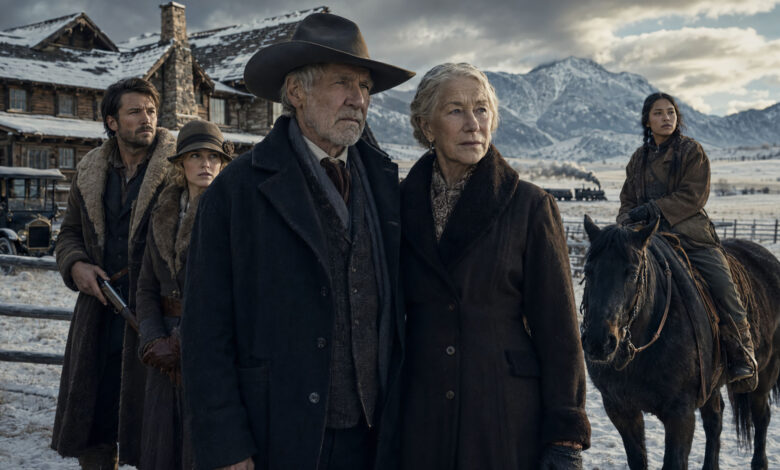
1923 finds Jacob and Cara Dutton running the Yellowstone Ranch after the deaths of James and Margaret. Jacob is James’s brother, Cara is the formidable aunt who helped raise the orphaned Dutton boys, and both have spent decades turning a grave in Paradise Valley into a working empire. Harrison Ford and Helen Mirren play them as a marriage built from affection, endurance and the useful ability to discuss an approaching gun battle without wasting everybody’s afternoon.
The story extends far beyond Montana. Spencer Dutton, the youngest surviving son of James and Margaret, has returned from the First World War but not from its psychological damage. He hunts dangerous animals in Africa until Alexandra, an aristocratic Englishwoman with a low tolerance for the life selected on her behalf, chooses him and joins a journey that makes the original wagon train look unusually direct.
A third strand follows Teonna Rainwater, a young Native American woman enduring abuse inside a Catholic boarding school. Her escape exposes the violence used to erase Indigenous identity and gives the series its most historically important material. It is also the storyline least able to offer relief through wealth, family influence or a conveniently placed livestock commission.
Taylor Sheridan combines Western, family saga, survival romance and historical drama across two seasons. The result is enormous, handsome and frequently devastating. 1883 asked whether the Duttons could reach Montana. 1923 asks whether anybody can keep it once bankers, miners, weather and several branches of government notice where they have settled.
1923 Transmission Details
- Show: 1923, also marketed as 1923: A Yellowstone Origin Story.
- Years Active: 2022-2025.
- Seasons: 2.
- Episodes: 15, comprising eight episodes in season one and seven in season two.
- Original Broadcaster: Paramount+, beginning on 18 December 2022 and concluding on 6 April 2025.
- Where to Watch:
- US: Paramount+.
- UK: Paramount+.
- Creator: Taylor Sheridan.
- Writer: Taylor Sheridan wrote all fifteen episodes.
- Primary Director: Ben Richardson directed the complete series.
- Key Executive Producers: Taylor Sheridan, David C. Glasser, John Linson, Art Linson, Ron Burkle, David Hutkin, Bob Yari, Ben Richardson, Michael Friedman and Keith Cox across the two-season production.
- Main Cast: Harrison Ford, Helen Mirren, Brandon Sklenar, Julia Schlaepfer, Darren Mann, Michelle Randolph, Aminah Nieves, Brian Geraghty, Jerome Flynn and Timothy Dalton.
- Dutton and Montana Ensemble: James Badge Dale, Marley Shelton, Robert Patrick, Sebastian Roché, Caleb Martin, Brian Konowal, Kerry O’Malley and Jessalyn Gilsig.
- Teonna Story Ensemble: Michael Spears, Leenah Robinson, Cole Brings Plenty, Jeremy Gauna, Jamie McShane and Jennifer Carpenter.
- International and Travelling Ensemble: Robert Petkoff, Bruce Davison, Jo Ellen Pellman, Augustus Prew, Janet Montgomery and Gilles Marini.
- Narrator: Isabel May reprises Elsa Dutton as the voice connecting 1923 to 1883 and the wider family story.
- Composers: Brian Tyler and Breton Vivian.
- Production Companies: MTV Entertainment Studios, 101 Studios and Bosque Ranch Productions.
- Related Productions: 1883 introduces James, Margaret, Elsa and young John Dutton and establishes the ranch. Yellowstone follows John Dutton III and reveals the eventual fate of the land. 1923 supplies the generational bridge between them and definitively identifies Spencer and Alexandra’s son as John Dutton II.
- Sub-Genre Tags: Historical Western, family saga, survival drama, frontier drama, period romance, crime drama, Montana, Prohibition, land disputes, Native American history, Indian boarding schools, post-war trauma and television prequels.
1923 Signal Strength (aka: Is It Worth Your Binge?)
Yes, particularly if 1883 left you wondering how a bereaved family with one cabin became powerful enough to make the whole of modern Montana check its boundary maps.
The first attraction is obvious. Harrison Ford and Helen Mirren could make a discussion about fencing supplies feel like the constitutional convention. Ford gives Jacob Dutton a tired, flinty authority. He is not the young pioneer James was or the politically insulated patriarch John III becomes. He is a man in his seventies defending a large ranch with limited cash, a small group of loyal riders and a legal system whose usefulness depends upon which rich man spoke to the judge most recently.
Mirren is even more essential. Cara writes the letters that connect the scattered story, organises the ranch when Jacob is wounded and turns maternal affection into a form of strategic command. Her Irish accent occasionally wanders across the Atlantic more freely than Alexandra, but her presence is absolute. Cara can offer comfort, prepare a meal and announce revenge with the same controlled warmth.
Brandon Sklenar and Julia Schlaepfer become the emotional centre. Spencer is a decorated veteran using danger to quiet memories of war. Alexandra is introduced as an aristocratic young woman facing a respectable marriage and recognises almost immediately that respectability without choice is merely a well-furnished prison. Their romance is deliberately huge: leopards, elephants, shipwrecks, duels, ocean crossings, trains and snowstorms stand between the first meeting and Montana. The programme sometimes mistakes additional suffering for forward movement, but the performers keep the relationship alive beneath the machinery.
Aminah Nieves gives the series its fiercest performance as Teonna. Her story is not a decorative historical subplot. It dramatises the abuse, forced assimilation and destruction of identity associated with the American Indian boarding-school system. Teonna’s resistance begins inside an institution that labels cruelty as salvation and continues after escape because church and state treat her survival as a crime. Nieves carries rage, fear, grief and an increasingly guarded hope without making Teonna an abstract symbol.
That material needs a warning. The series contains physical and sexual abuse, racist violence, suicide, torture, animal attacks and cruelty presented at considerable length. Donald Whitfield’s treatment of women becomes especially graphic and repetitive. The intention is to demonstrate his appetite for domination, but the point is established long before the scenes stop. Viewers may reasonably feel the production lingers where implication would have been more powerful.
Structurally, 1923 is more ambitious and less tidy than 1883. The action moves between Montana, Africa, Europe, the Atlantic, New York, Texas and Oklahoma. Season one gives the strands room to breathe, though Spencer remains far from the central conflict after eight episodes. Season two accelerates the journeys while introducing enough robberies, assaults, corrupt officials and hostile travellers to suggest the entire transport network was personally offended by the Dutton marriage.
The ranch story is strongest when it connects old violence to modern capital. Banner Creighton begins as a desperate sheep farmer whose animals need grazing land. Jacob’s brutal frontier justice turns him into an enemy. Mining magnate Donald Whitfield then converts that anger into an acquisition strategy, paying the Dutton tax debt and planning tourism, skiing and an airport. The threat is not merely that Whitfield has more gunmen. He understands that development can make dispossession appear like progress.
The physical production is extraordinary. Montana landscapes, African camps, ocean passages, Grand Central Station, dusty Texas towns and the snowbound ranch give the series a scale rare on television. Costumes express class and survival without looking freshly hired. The second season creates winter with enough conviction that wrapping a blanket around the television seems reasonable.
Historical drama remains drama. The series compresses geography, law, travel and social history. Teonna’s story draws upon real systems rather than documenting one recorded individual, while Marshal Mamie Fossett is inspired by a real but sparsely documented woman in law enforcement. The show is most truthful in atmosphere and institutional cruelty, not in promising that every journey and jurisdiction would operate exactly as shown.
Fifteen substantial episodes make the series bingeable, although the feature-length finale requires planning and possibly tea. Watch 1883 first if possible. 1923 explains enough to stand alone, but Cara’s letters, Spencer’s parentage and Elsa’s narration gain much more weight when the audience already knows the graves beneath the ranch.
Vibe Check
- Tone: Sweeping, severe and romantic, with tenderness constantly pursued by armed men or weather.
- Visuals: Montana mountains, African plains, ocean liners, steam trains, winter ranches and interiors designed for people whose money has begun behaving badly.
- Bingeability: High, although the separated storylines repeatedly delay reunions by inventing another continent-sized inconvenience.
- Western Level: Very high, expanded by Prohibition crime, European aristocracy and enough rail travel to exhaust a timetable.
- Historical Detail: Rich in texture and social context, with dramatic compression applied whenever the journey needs another threat.
- Action Level: High. Ambushes, animal attacks, gunfights, shipwrecks, duels and blizzards operate alongside legal and financial warfare.
- Romance Level: Epic, sincere and punished with suspicious efficiency.
- Family Harmony: Stronger than in Yellowstone, largely because Jacob and Cara speak to one another before arranging retaliatory violence.
- Villainy Level: Timothy Dalton appears in a silk dressing gown and makes property tax feel like a supernatural threat.
- Travel Advice: If Spencer and Alexandra select the route, take another route.
Spoiler Mode: Plot Brief for Pub Chat
Major spoilers for both seasons begin here. The following includes the complete ending, the final Dutton family connection and several journeys no reputable travel agent would defend.
Elsa Dutton narrates the decades between 1883 and 1923. James and Margaret establish the Yellowstone Ranch around Elsa’s grave, but neither enjoys a long retirement. James dies after being shot by horse thieves in 1893. Margaret survives him only briefly, and her final letter brings James’s brother Jacob and his wife Cara to Montana.
Jacob and Cara have no children of their own. They raise James and Margaret’s sons, John and Spencer, while building the ranch into a major cattle operation. By 1923, John is a middle-aged rancher working beside Jacob. His son Jack represents the next generation and is preparing to marry Elizabeth Strafford.
The family faces drought, locusts and an economic depression in Montana. Cattle can still move towards higher grazing, but sheep belonging to Banner Creighton and other Scottish immigrants are starving. Banner cuts Jacob’s fences and moves his flock onto Dutton land. Jack discovers the trespass and is attacked.
Jacob leads the Yellowstone riders into the mountains, saves Jack and captures Banner’s men. As head of the Montana Livestock Association, he uses authority with very little interest in a courtroom. He hangs the sheep farmers from a tree and drives their animals down to the reservation, where the flock can feed Native families. Banner survives when the rope fails to kill him and crawls away carrying a grievance large enough to fund the rest of the series.
In Africa, Spencer Dutton hunts animals that have begun hunting people. He survived the First World War and received the Medal of Honor, although he regards military recognition as another object unable to explain what happened to him. Nightmares and a willingness to face lions at close range reveal how little value he places upon his own survival.
During a leopard hunt, Spencer meets Alexandra. She is travelling with an aristocratic party and engaged to Arthur, a man suitable in every way except the important ones. Alex sees the damage in Spencer and the freedom surrounding him. She abandons her engagement, runs after his departing car and chooses uncertainty with a stranger over a predetermined life among people who regard that choice as madness.
Their relationship develops through danger. They hunt a rogue elephant, become stranded and survive an attack before deciding to leave Africa. A tugboat intended to carry them towards the Suez Canal collides with a ghost ship. Spencer and Alex spend hours trapped on the overturned hull before rescue. The captain of the vessel that finds them marries them at sea, giving the couple a legal bond and the audience several minutes in which maritime travel appears briefly positive.
Back in Montana, Banner recruits men and ambushes the Dutton party returning from town. John Dutton is killed. Jacob is shot repeatedly and left near death. Jack and Elizabeth are wounded, although both survive. Cara retrieves a shotgun and kills one of the attackers in the confrontation glimpsed at the beginning of the series.
Emma, John’s widow, cannot imagine a future after his death. She dies by suicide at his grave, leaving Jack without either parent. Jacob slowly recovers while Cara assumes public leadership. She calls a livestock association meeting, exposes the attack and pushes the ranchers towards organising law enforcement capable of resisting private armies.
Cara also writes to Spencer. Months of slow international post mean he learns of the attack long after it occurs. Her letters tell him John is dead, Jacob is badly wounded and the family needs him home. Spencer immediately abandons hunting and begins the journey towards Montana with Alex.
Banner finds a much more powerful ally in Donald Whitfield. Whitfield is a mining magnate who sees land as an asset awaiting a more profitable owner. He pays Banner’s legal costs, supplies money and recruits men. Banner wants revenge upon Jacob. Whitfield wants the Yellowstone Ranch, its resources and the opportunity to turn the mountains into a destination for the wealthy.
Whitfield’s methods expose the transition between frontier force and corporate force. He can hire gunmen, influence judges and exploit existing prejudice. He also understands taxes. When the Duttons cannot pay their property tax, Whitfield pays it on their behalf. If Jacob cannot repay him by the deadline, the ranch deed will pass to Whitfield. The family can win every gunfight and still lose to accounting.
Jack and Elizabeth marry after the ambush, trying to create a future while death remains visible around them. Elizabeth becomes pregnant but later miscarries. Their grief deepens the pressure upon a family convinced that survival requires another generation, as though producing an heir were one more piece of ranch work to complete before winter.
Ranch foreman Zane Davis has a hidden family. His wife Alice is Chinese American, and Montana’s anti-miscegenation law makes their marriage illegal. Whitfield’s influence helps expose them. Police beat Zane, arrest Alice and threaten their children. The attack demonstrates that the Duttons are not the only family whose home can be taken through law dressed as morality.
Teonna Rainwater begins inside a Catholic boarding school where Native children are punished for speaking their languages and retaining their identities. Sister Mary subjects Teonna to humiliation, physical abuse and sexual assault. Father Renaud treats resistance as evidence that greater punishment is required. The institution calls the process education while attempting to destroy the person being educated.
Teonna fights back and kills Sister Mary. Sister Alice discovers her and also dies during the struggle. Teonna escapes, while her grandmother Issaxche tries to bring her home through official channels. Authorities assault Issaxche, and she later dies from her injuries.
Hank Plenty Clouds shelters Teonna and helps disguise her as a boy named Joe. Priests sent by Father Renaud track them. Hank is killed protecting her, but Teonna kills the attacker. Her father Runs His Horse and Hank’s son Pete find her. The three travel south, hoping distance and another jurisdiction can provide safety.
Father Renaud joins Marshal Kent in pursuit. Kent represents the state power that allows the boarding school to define an abused girl as a murderer while ignoring the crimes committed against her. Their search expands across Native communities and ranches, leaving more bodies behind than the person they claim to bring to justice.
Spencer and Alex reach Sicily and arrange passage on the SS Majestic. Unfortunately, Arthur and his family are aboard. Arthur challenges Spencer to a duel. Spencer wins without killing him, but Arthur attacks afterwards and goes over the rail during the struggle. The ship’s inquiry accepts self-defence, yet Arthur’s father uses his influence to have Spencer removed at the next port.
Alex is prevented from leaving with her husband. Her family assumes authority over her, and the ship sails before she can escape. She calls to Spencer that she will meet him in Bozeman. Their single journey becomes two, because the series has located a fresh way to place several thousand miles between people already married.
Season two begins as a severe Montana winter isolates the Yellowstone. The family has sold most of its cattle and lives from limited stores and whatever the men can hunt. Wolves and a mountain lion approach the house. Elizabeth is bitten by a wolf and undergoes a course of painful rabies treatment because waiting to learn whether the animal was infected is not a medical strategy Cara is prepared to entertain.
Jacob and Sheriff McDowell confront the judge handling Zane and Alice’s case. They expose his own illegal alcohol supply and secure the family’s release, but Zane has suffered a serious head injury. A doctor eventually relieves pressure on his brain through emergency surgery at the ranch. He survives, though the episode makes a modern clinic appear an extravagant fantasy.
Whitfield watches Norwegian workers ski near his mine and recognises a commercial future. He pitches a mountain resort, tourism and air travel to investors. His vision anticipates the development battles of Yellowstone: wealthy visitors will arrive for the landscape, then reshape it until the people already living there cannot afford to remain.
Banner begins to understand that Whitfield does not regard him as a partner. The sheep farmer wanted justice for his men and security for his family. Whitfield regards both the sheepherders and Duttons as temporary obstacles. Even Banner’s dead flock becomes evidence that struggle is pointless unless one owns the capital controlling the result.
Spencer works in the boiler room of a ship travelling to Galveston. He befriends Luca, a young Sicilian crewman, and intervenes when another man attacks him. Reaching Texas does not simplify the journey. Prohibition has made transport dependent upon criminals and corrupt police, and Spencer becomes involved with bootleggers connected to Sal Maceo.
Luca is killed, and Spencer is forced into a police operation involving an alcohol shipment to Fort Worth. He escapes the gunfight, helps a woman being publicly abused by temperance campaigners and jumps aboard a freight train. Hostile travellers attempt to rob him inside the carriage. Spencer survives again, though every mile north seems determined to require a separate body count.
Alex crosses the Atlantic alone and pregnant, although she initially keeps the knowledge private. New York introduces her to theft, assault and the practical difficulty of reaching Montana without enough money. She catches a westbound train, works in the dining car for food and defends herself when a passenger sexually assaults her. Witnesses Paul and Hillary support her account when railway staff and police initially treat her as the offender.
The couple befriend Alex and help her continue. Her education, confidence and title offer less protection than she expected in a country whose systems repeatedly favour the man with money, authority or the first opportunity to give a statement. Schlaepfer allows Alex’s wit to survive without pretending resilience prevents fear or exhaustion.
At the ranch, Elizabeth learns she is pregnant again. Jack sees the child as proof that their future can outlast the violence. Cara offers support while recognising that the young couple have attached an enormous burden to a life not yet born. The pregnancy also appears, for a time, to resolve the uncertain line between 1923 and modern Yellowstone.
Marshal Mamie Fossett joins the search for Teonna. She is a more observant and principled law officer than Kent, prepared to investigate rather than accept the boarding school’s version. Her presence does not erase the injustice of the pursuit, but it introduces the possibility that law might recognise evidence rather than merely enforce power.
Fossett encounters Spencer in Texas and confirms his identity through Sheriff McDowell. She learns he is a decorated war hero, information Spencer receives with impressive indifference. Fossett gives him a ticket north. Spencer finally boards a train capable of taking him towards Montana rather than another improvised criminal enterprise.
Alex’s train is delayed by extreme snow. Paul and Hillary continue west with her, but conditions worsen and their carriage becomes stranded away from the main train. Hillary dies from exposure. Paul leaves to seek help and does not return. Alex uses their remaining belongings to make a small fire inside the carriage, fighting frostbite, dehydration and premature labour while convinced she may die within reach of her destination.
Whitfield identifies a remote area without a resident population, local court or conventional jury. His men use it to dispose of bodies. The place is the earlier form of the “train station” later used by the Duttons in Yellowstone. The series makes the connection deliberately uncomfortable: the family eventually adopts a disposal method introduced by the man trying to steal its land.
Whitfield’s violence becomes increasingly sadistic. Women brought to his home are tortured and controlled for his pleasure. Banner witnesses enough to understand that serving Whitfield will not protect his family or preserve any remaining moral boundary. The sequences establish Whitfield as monstrous, although their duration risks using the suffering of women as atmosphere after the character’s nature is already unmistakable.
Teonna, Runs His Horse and Pete become lost in the dry country. Pete rides ahead to find water and encounters Renaud and Kent. A shoot-out kills Pete. Kent’s own cruelty finally repulses Renaud, who shoots the marshal, but the priest continues pursuing Teonna as though killing his companion has purified the mission.
Renaud reaches Teonna and her father while they sleep. He kills Runs His Horse. Teonna attacks the priest, burns him and kills him after a final struggle. She has defeated the principal architect of her abuse, but freedom arrives after the deaths of her grandmother, Hank, Pete and her father. Survival has cost her nearly every person capable of sharing it.
In Montana, Sheriff McDowell confirms that Spencer is close. Jacob prepares to meet his train at Livingston while Whitfield’s men plan attacks at both the station and ranch. Jack is ordered to remain home and protect Cara and Elizabeth. Unable to tolerate waiting while others fight, he rides towards the station and is murdered by men posing as deputies.
Banner decides to abandon Whitfield. He tells his wife to take their son and hidden money to Portland, then approaches Jacob. Jacob refuses to let him escape the war he began but promises to protect Banner’s family if Banner helps finish it.
At the same time, Whitfield’s gunmen attack the Yellowstone Ranch. Cara takes a rifle position, Zane and the remaining cowboys defend the buildings, and Elizabeth arms herself inside. The attackers use automatic weapons and firebombs. The ranch house becomes a battlefield rather than the secure monument later generations imagine it to be.
Spencer’s train passes the frozen carriage containing Alex. She creates enough flame to attract attention. Spencer sees her, jumps from the moving train and finally reaches his wife. The reunion is immediate, loving and painfully brief. A doctor aboard the train discovers severe frostbite and necrosis. Alex is also in premature labour.
The train reaches Livingston, where Jacob, McDowell, Banner and Whitfield’s men wait. A gunfight erupts. Spencer protects Banner’s wife and child, saves Jacob and finally stands beside his family. Banner kills Clyde, Whitfield’s agent inside the livestock commission, but McDowell does not understand the change of allegiance and shoots Banner. Dying, Banner receives Jacob’s renewed promise that his family will reach Portland.
Spencer must choose between remaining with Alex on the train to Bozeman or helping defend the ranch. Alex tells him to go. He joins Jacob’s men, reaches Yellowstone during the assault and shoots the gunman controlling the battle with an automatic weapon. Cara sees her nephew through the rifle scope before running to embrace the man summoned through two seasons of letters.
Alex reaches hospital. Doctors explain that her frostbitten legs and one hand must be amputated immediately. Her pregnancy is only around six months advanced, and they believe the baby will not survive. Alex refuses surgery until she can deliver him. The child cries and breathes. She names him John after Spencer’s brother.
Jacob sits with Alex and tries gently to persuade her to accept treatment, but she chooses to remain with the baby during what doctors expect will be his only hour. Spencer arrives and lies beside his wife and son. When morning comes, Alex has died. John remains alive.
The child is John Dutton II, future father of John Dutton III from Yellowstone. The revelation finally settles the family line. Modern John descends from Spencer and Alexandra, not from Jack and Elizabeth as many viewers had assumed during season one.
Spencer and Jacob confront Whitfield. Spencer shoots him and forces him to say Alexandra’s name before killing him. The mansion burns, ending the financier’s claim and ensuring no tidy legal process survives to reclaim the property. The Duttons save the ranch in the manner future generations will repeatedly mistake for tradition.
Marshal Fossett finds the aftermath of Teonna’s pursuit. With Kent, Renaud and the witnesses dead, the murder case cannot be sustained. Fossett supports Teonna in court, and the charges are dismissed. A Crow man gives her a horse and rifle and advises her to travel towards California. She rides west alone, acknowledging that resisting was right but cost everything.
The Duttons bury Alexandra and Jack. Elizabeth, pregnant and widowed, leaves Montana with Cara’s blessing. The series does not reveal the future of her child. Spencer remains at Yellowstone to raise John, and Elsa’s narration explains that he never remarries. He later has a second son with a widow, but Alex remains the love defining his life.
Jacob retires from active ranch work and sits with Cara as they care for baby John. Spencer takes responsibility for the cattle and land. The inheritance has passed, not through the line everybody expected, but through the veteran who spent years trying to escape his memories.
Decades later, an elderly Spencer visits Alex’s grave. Elsa explains that he dies forty-five years after his wife. In the final scene, Spencer and Alex meet again at a formal dance beyond life. She tells him he took long enough. After two seasons in which every road kept them apart, they finally dance without another train, ship, gunman or weather system interrupting.
1923 Character Shout-Outs
- Jacob Dutton: James Dutton’s older brother and the patriarch who transformed a fragile homestead into a powerful ranch. Jacob is hard, pragmatic and capable of terrible violence, but Ford makes the cost visible. He does not enjoy every necessary act. He simply has a very expansive definition of necessary.
- Cara Dutton: The emotional and strategic centre of Yellowstone in this generation. Cara raises her nephews, commands the ranch, writes to Spencer and defends the house. Her marriage to Jacob supplies the franchise with the unusual sight of two Dutton adults communicating successfully.
- Spencer Dutton: A First World War veteran, hunter and reluctant heir. Spencer believes danger is the only environment quiet enough for him until Alex gives survival a purpose. His journey brings the family line home through the son neither he nor the audience expected to survive.
- Alexandra Dutton: Aristocratic, witty and ferociously determined. Alex chooses Spencer, crosses continents alone and retains humour through circumstances designed to remove it. Her death establishes the modern Dutton line while denying her the future she travelled so far to reach.
- Teonna Rainwater: A survivor of institutional abuse who refuses erasure. Teonna’s resistance is not presented as painless liberation. Every escape produces another pursuit, and her final freedom is inseparable from grief.
- Jack Dutton: John’s son and Jacob’s great-nephew. Jack is brave, impulsive and desperate to prove he can protect the ranch. His decision to disobey Jacob leads directly to his death, another Dutton confusing participation in violence with readiness to inherit its consequences.
- Elizabeth Strafford: Jack’s wife, twice pregnant and repeatedly injured by the life she is expected to continue. Elizabeth’s eventual departure is not cowardice. It is one of the few moments when a character recognises that surviving the ranch may require leaving it.
- Banner Creighton: A sheep farmer whose legitimate desperation becomes revenge. Banner commits terrible acts and serves a worse man, but his final choice protects Jacob and gives his family a chance to escape.
- Donald Whitfield: A mining magnate who treats people, land and law as resources. Dalton’s smooth delivery makes him more threatening than a shouting gunman. Whitfield can describe a ski resort while arranging murder and consider both ordinary entries in a business plan.
- Zane Davis: Yellowstone’s loyal foreman and a man whose private family is criminalised by racist law. His ordeal reveals that service to a powerful ranch cannot protect everybody from the state.
- Sheriff William McDowell: Jacob’s lawman ally, operating where formal procedure and frontier loyalty overlap. Robert Patrick gives him enough dry intelligence to recognise when legality has become a weapon.
- Runs His Horse: Teonna’s father, who searches for his daughter and refuses to let the boarding school define her. His death leaves her free of the institution but devastatingly alone.
- Pete Plenty Clouds: Hank’s son and Teonna’s protector. Pete offers companionship and the possibility of a future before the pursuit claims him.
- Marshal Mamie Fossett: A determined federal marshal who investigates rather than simply hunts. Her willingness to understand evidence gives Teonna the first meaningful encounter with legal authority that does not begin by denying her humanity.
- John Dutton II: The premature son of Spencer and Alexandra. His survival provides the direct bridge to modern Yellowstone, proving that the family dynasty depends upon a child doctors believed would live for less than an hour.
1923 Memorable Moments
- Jacob discovering Banner’s sheep on Yellowstone land and imposing justice from a tree.
- Banner surviving the hanging and beginning the revenge that reshapes both seasons.
- Spencer facing a leopard in Africa while Alexandra decides respectable life has lost the argument.
- Alex running after Spencer’s departing vehicle and leaving her engagement behind.
- The tugboat collision and the couple waiting for rescue on its overturned hull.
- Cara receiving Jacob after the ambush and taking command while he fights to live.
- John Dutton’s sudden death and Emma’s funeral grief.
- Teonna finally striking back against Sister Mary.
- Cara’s livestock association speech and open promise of war.
- Spencer reading the delayed letters telling him his brother is dead.
- Whitfield paying the Yellowstone property tax and explaining how a receipt can steal a ranch.
- Arthur challenging Spencer aboard the Majestic and losing twice.
- Alex promising to meet Spencer in Bozeman as the ship carries her away.
- Cara killing the mountain lion outside the ranch house.
- Jacob and McDowell using a judge’s illegal whisky to free Zane’s family.
- The doctor performing emergency surgery on Zane at the snowbound ranch.
- Whitfield watching skiers and seeing the commercial future of Montana.
- Alex defending herself in the dining car and witnesses finally telling police the truth.
- Spencer learning almost casually that he received the Medal of Honor.
- The first historical appearance of the place later called the train station.
- Teonna defeating Father Renaud after losing Runs His Horse.
- Jack riding away from the safety he was ordered to protect.
- Banner turning against Whitfield and saving Jacob at Livingston.
- Alex’s fire beside the tracks attracting Spencer’s passing train.
- Spencer and Alex reuniting in the snow after two seasons apart.
- Cara seeing Spencer through her rifle scope during the attack on Yellowstone.
- Alex naming her premature son John and choosing to hold him.
- Spencer forcing Whitfield to speak Alexandra’s name.
- Teonna riding towards California after the charges are dismissed.
- Jacob describing Alex as a talking shooting star.
- The elderly Spencer lying beside Alex’s grave.
- Spencer and Alex sharing the final dance no earthly journey allowed them.
Performance Highlights
Harrison Ford avoids turning Jacob into a larger version of John Dutton. His authority is quieter and more physical. Ford’s slight weariness belongs to a man whose body remembers every winter and gunshot, while the voice can still stop a room. Small reactions are especially effective: Jacob watching Cara, absorbing the news of another death or trying to comfort Alex without pretending the situation can be repaired.
Helen Mirren gives the show its most complete performance. Cara is tender without softness being mistaken for weakness. Mirren can make a letter feel like action and a domestic scene feel politically important. When Cara picks up a weapon, it is not a transformation into somebody tougher. It reveals that the warmth and the steel have always belonged to the same woman.
Brandon Sklenar carries a difficult combination of stillness and spectacle. Spencer must be credible fighting predators, surviving war memories and anchoring a grand romance. Sklenar keeps him restrained enough that Alex’s effect becomes visible. The character does not suddenly become cheerful. He begins imagining a future, which is a much greater change.
Julia Schlaepfer turns what could have been an adventurous society runaway into one of the franchise’s most memorable characters. Alex’s wit is not ornamental. It is a survival mechanism and a refusal to let suffering dictate the language of every room. Schlaepfer is excellent through the long solo journey and devastating in the hospital, where humour, terror and maternal choice remain present together.
Aminah Nieves refuses simplification. Teonna is furious because fury is rational, frightened because danger is real and capable of tenderness without being required to forgive. The performance gives historical horror a specific human centre. Teonna never exists merely to educate the Duttons or improve another character’s moral understanding.
Timothy Dalton clearly understands the value of elegant menace. Whitfield rarely needs volume. He smiles, explains money and lets everybody else realise he has already purchased the institution they planned to appeal to. The performance becomes less subtle when the character’s sexual sadism dominates, but Dalton maintains a chilling belief that ownership is the natural order of life.
Jerome Flynn gives Banner more dimension than the revenge plot strictly requires. He begins with a recognisable grievance, becomes responsible for an atrocity, discovers he has sold himself to a monster and finally chooses family over victory. Flynn keeps the contradictions intact rather than requesting acquittal.
Darren Mann and Michelle Randolph make Jack and Elizabeth’s youth painful. They are asked to carry a dynasty before either has built an ordinary marriage. Brian Geraghty brings warmth and competence to Zane, while Robert Patrick provides McDowell with amused practicality. Jennifer Carpenter arrives late but establishes Fossett quickly as a woman whose authority comes from attention rather than performance.
Michael Spears, Cole Brings Plenty and Jeremy Gauna create a family around Teonna that makes each later loss register. Sebastian Roché makes Father Renaud frightening because he interprets domination as sacred duty. Isabel May’s narration completes the circle, allowing Elsa to observe descendants living upon the land selected for her grave.
Skull Face’s Take
1923 is what happens when a Western receives the budget of an international epic and the emotional instincts of somebody who regards happiness as a suspicious pause before weather.
The obvious headline is Ford and Mirren, and both justify it. Jacob and Cara are the healthiest leading couple in the Dutton universe, admittedly a competition in which several entrants have attempted murder during family discussions. They love one another, respect competence and occasionally exchange information before acting. The franchise may never recover from such radical behaviour.
Yet Spencer and Alex own the story. Their romance is enormous enough to survive a leopard, an elephant, a shipwreck, an ocean liner, a duel, forced separation, robbery, Prohibition, several trains and a Montana winter. It cannot survive Taylor Sheridan holding the final script. The ending is cruel, but it is not empty. John II lives because Alex refuses to surrender the hour she can give him.
Teonna’s story is more important and often harder to watch. It prevents the Dutton struggle from becoming the only version of dispossession on screen. Jacob fears losing land acquired by his family. Teonna faces a system designed to take language, identity, relatives and freedom. Placing those stories beside one another does not make them equivalent. It exposes the difference.
The series sometimes exhausts its own power. Spencer and Alex encounter so many obstacles that adversity begins queuing at the station. Whitfield’s abuse of women is repeated beyond narrative necessity. The final season also has to move multiple characters across a continent while settling land, family and legal questions in seven episodes. Subtlety occasionally gets thrown from the train to make room.
Even with those reservations, 1923 delivers. It looks magnificent, acts without embarrassment and ends decisively. It explains the family line without reducing the characters to genealogical plumbing. More importantly, it makes the modern ranch feel temporary. Every generation calls itself the owner; every generation is actually keeping watch for the next funeral.
Skull Face verdict: strong signal, severe weather warning. Bring fifteen hours, emotional waterproofing and absolutely no confidence in the advertised railway connection.
Why 1923 Has Drama/Action Icon Potential
1923 has the ingredients of an enduring prestige Western: major stars, cinematic scale, a complete story and characters whose individual journeys remain meaningful beyond the franchise connection.
Jacob and Cara broaden the Dutton mythology. They are not founders in the manner of James and Margaret, nor modern custodians like John III. They are builders. Their generation converts a family grave and cabin into an institution, establishes political authority through the livestock commission and learns that protecting land now requires navigating banks, taxation and development.
Spencer and Alex supply the iconic romance. Their story uses the scale of old Hollywood adventure while allowing Alex genuine choice and agency. She does not simply wait at home for the damaged hero. She chooses him, travels alone and becomes central to the family line. The final dance gives their relationship a visual ending audiences can remember independently of plot mechanics.
Teonna gives the drama historical force. Westerns have often treated Native people as obstacles, guides or symbols around settler protagonists. Her storyline centres the person targeted by assimilation and follows resistance from her perspective. The material is imperfect and separated too long from the other plots, but it refuses the comforting myth that progress reached Montana evenly.
The action is varied and well staged. Animal attacks feel different from ambushes; shipwreck survival differs from a railway gunfight; the ranch siege combines familiar Western defence with weapons announcing a more industrial century. The series understands that 1923 sits between eras. Horses, telephones, cars, aircraft, automatic weapons and steam trains occupy the same contested landscape.
Its villains also reflect that transition. Banner belongs to the older West, where grazing and honour create blood feuds. Whitfield belongs to the emerging corporate order, where a resort proposal can achieve what gunmen cannot. The Duttons defeat him violently, but Yellowstone proves the development idea survives. Killing the man does not kill the market.
The programme’s icon potential ultimately lies in images: Cara on the porch with a rifle, Jacob beneath his heavy coat, Spencer walking from smoke with the elephant gun, Alex running after a vehicle in Africa, Teonna cutting away the imposed identity of the school and the couple meeting at the final dance. The family tree may attract viewers. Those images are what remain after the branches have been labelled.
Deep Dive Highlights
The title describes more than a date. 1923 places the ranch at a historical junction. Prohibition enriches criminal networks and corrupts law enforcement. Economic depression reaches rural Montana before the national crash commonly associated with 1929. Mechanisation and transport compress distance while creating new forms of power. The West has not ended; it is being incorporated.
Whitfield’s ski resort is the clearest bridge to Yellowstone. He looks at snow that is killing cattle and sees leisure for wealthy visitors. The same landscape has different economic meanings depending upon who can afford insulation. Later developers pursue airports, resorts and housing around the Dutton ranch. Whitfield dies, but his idea becomes the future surrounding the property.
The property-tax plot changes the meaning of conquest. James found the valley through grief. Jacob defends it with rifles. Whitfield nearly acquires it through a payment recorded by the county. The law does not replace violence; it determines whose violence will receive paperwork.
The early train station reference performs a similar reversal. Modern Duttons treat the Wyoming ravine as part of ranch folklore, a place where enemies disappear beyond ordinary jurisdiction. 1923 links the idea to Whitfield’s operation. The family’s later tradition is partly inherited from its enemy, demonstrating how easily survival absorbs the methods it once opposed.
Cara’s letters are the structural counterpart to Elsa’s narration. Elsa speaks across generations, giving the land memory. Cara writes across distance, trying to bring one necessary person home. Both women hold the saga together through language while men repeatedly assume the principal work involves firing a weapon.
Spencer’s war trauma connects national history to family inheritance. He survived industrial warfare and then chooses dangerous animals because their intentions are clear. A lion does not call domination progress or hide an ambush within a tax statute. Alex cannot remove the trauma, but she gives Spencer a reason to live alongside it.
Alex represents a different escape from inheritance. Her title and engagement offer privilege without self-determination. She rejects a family plan and joins a man whose own family is desperate to pull him back into obligation. Their romance therefore moves in opposite directions: Alex leaves a prescribed dynasty while Spencer returns to one.
Teonna’s forced schooling reveals the darkest form of institutional inheritance. The school aims to sever children from language, family and culture so nothing can pass between generations. Teonna’s survival is therefore not only physical. Every word, memory and refusal preserves continuity against a system designed to break it.
The series does not formally identify Teonna as an ancestor of Thomas Rainwater, and viewers should resist turning every shared surname into a completed family chart. Her story has thematic connection to modern Broken Rock and the land prophecy, but her individual future remains open when she rides towards California.
The John Dutton II revelation resolves the franchise’s largest genealogical uncertainty. John Dutton Sr., killed in season one, is Jack’s father and Spencer’s older brother. Jack is not the grandfather of modern John III. Spencer and Alex’s premature baby John becomes John II, later father of the Yellowstone patriarch. Elsa is therefore John II’s aunt, and Spencer is John III’s grandfather.
The finale also refuses to close every branch. Elizabeth leaves pregnant after Jack’s death. Elsa states that Spencer later fathers another son with a widow. Neither child’s later story is supplied. The direct modern line is settled, but the Dutton family still contains space for descendants not yet followed on screen.
Jacob and Cara’s childlessness is central rather than incidental. They preserve another couple’s line and become parents through action. The ranch survives because family is treated as a responsibility rather than a strictly biological fact. Modern Yellowstone, obsessed with blood inheritance, forgets how dependent its dynasty was upon an aunt and uncle who arrived because Margaret wrote for help.
The final dance completes a pattern established by 1883. Elsa imagines an afterlife with Sam; Spencer reunites with Alex. Sheridan’s origin stories allow love to escape mortality even when the living world refuses a happy ending. Whether that is spiritual consolation or emotional blackmail will depend upon how recently the viewer finished the hospital sequence.
Legacy & Impact
1923 proved that the Yellowstone universe could support a second historical register without repeating the wagon trail. It expanded the family story into global adventure while keeping land ownership, grief and inheritance at the centre.
The casting gave the franchise immediate prestige. Harrison Ford and Helen Mirren did not appear as decorative elder stars. Their marriage became one of the saga’s strongest relationships, providing a model of Dutton loyalty that did not depend upon emotional starvation. Jacob and Cara are violent when required, but they are not mysterious to one another.
Spencer and Alex became the series’ defining pair. The conclusion established them as the grandparents of John Dutton III and transformed Alexandra from a romantic addition into a foundational figure. The modern ranch survives through the child she protects during her final hours.
The confirmation also alters Yellowstone. John III’s severity descends not only from James, Jacob and generations of ranch warfare, but from Spencer’s trauma and Alexandra’s choice. The dynasty celebrated as masculine stewardship depends upon women whose names the modern family rarely speaks: Elsa, Margaret, Cara and Alex.
Teonna’s storyline brought the Indian boarding-school system into a franchise watched by a large mainstream audience. It does not replace documentary history or Native testimony, and its violence should not become prestige decoration. At its best, the story makes forced assimilation impossible to treat as distant background to a heroic settlement narrative.
The second season’s audience demonstrated continued interest in the origin stories, while the completed ending gives 1923 a useful advantage over an endlessly expanding drama. Fifteen episodes tell one conflict, resolve the principal romance and identify the next generation. Future productions may add context, but the series does not need another season to explain what its final image means.
Its influence upon the wider saga is visible in recurring ideas. Whitfield’s resort predicts Market Equities. The zero-population killing ground predicts the train station. The livestock commission becomes the power later used by John and Kayce. Each modern institution carries an older compromise inside it.
The series also complicates the heroic mythology of keeping the ranch. The Duttons save Yellowstone from Whitfield, but viewers know that another generation eventually returns the land to Broken Rock. Jacob’s victory is real and temporary. The same is true of every ownership claim made during the seven generations.
As a companion to 1883, the show deepens the original tragedy. James and Margaret reached Paradise Valley but died before seeing what the ranch became. Their sons were raised by Jacob and Cara. John was murdered; Spencer lost Alex; Jack was killed; Elizabeth fled. The property survives by consuming futures faster than the family can produce them.
Yet the ending is not only bleak. Teonna rides free. Banner’s wife and son are promised safe passage. Zane returns to his family. Baby John lives. Cara and Jacob reach a porch where, for one afternoon, nobody is asking them to defend the valley. Spencer works the land and carries Alex’s memory for another forty-five years.
1923 leaves the ranch secure, the family line clarified and the emotional bill unpaid. That is about as close to victory as a Dutton prequel is prepared to travel.
Want to Go Deeper?
- Watch both seasons of 1923 on Paramount+ (All fifteen episodes, including the feature-length final reckoning.)
- Browse the official 1923 episode guide (Titles and streaming details for both seasons.)
- See where 1923 fits in the Dutton viewing order (The chronological route from 1883 to the modern ranch.)
- Explore the official Dutton family timeline (Includes the confirmed identity of John Dutton II.)
- Continue through the Yellowstone origin stories (A direct guide to the two historical series.)
- Read Paramount’s production information and releases (Cast, executive producers, release dates and official announcements.)
Recommended TV Products
Watch Reacher Season 4 on Prime Video
A chance encounter with a distraught stranger on the Philadelphia subway draws Jack Reacher into a deadly mystery.
Watch Now
Watch Lioness Season 3 on Prime Video
Inspired by a U.S. Military program, three agents embark on a dangerous undercover mission following the 9/11 terrorist attack.
Watch Now
Watch Law & Order: Special Victims Unit on Prime Video
From the creator of "Law & Order", comes a powerful series chronicling the life and crimes of the Special Victims Unit of the NYPD.
Watch NowAs an Amazon Associate I earn from qualifying purchases.